
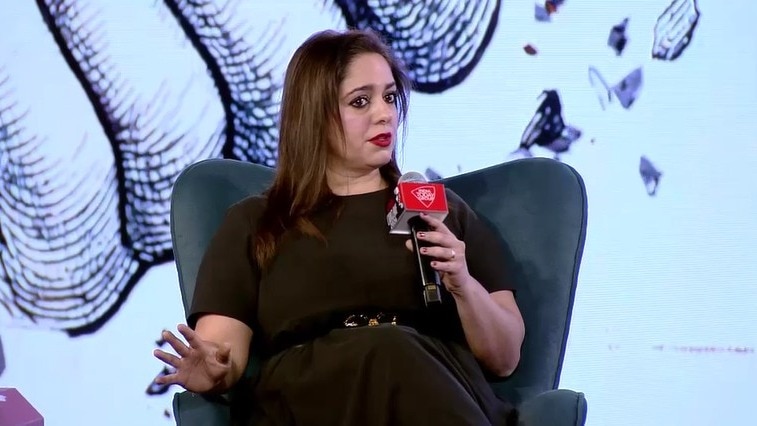
As the US-Iran war enters its third week, geopolitical shifts triggered by the conflict could reshape alliances and strengthen partnerships such as that between the United States and India, geopolitical consultant Adelle Nazarian said at the India Today Conclave 2026 on Saturday.
Nazarian said that while no one benefits from the war at a human level, the conflict is intensifying geopolitical competition over the future global order. “Frankly, there is no one that benefits from war on a human level,” she said. “But geopolitically, this is a tremendous challenge and competition for the new global order.”
Nazarian added that the crisis is likely to push Gulf nations closer to Western powers while strengthening strategic ties with countries like India. “I feel it’s going to bring about a stronger US-India relationship, and it’s also going to result in a strategic realignment of GCC nations towards the West. Ultimately, the West and middle nations like India are going to benefit,” she said.
‘IRANIANS WANT A DIFFERENT FUTURE’
Nazarian said conversations with people inside Iran reveal a complex and divided public mood, but many Iranians appear increasingly frustrated with economic hardship and political restrictions.
“I’ve been speaking with people inside Iran very frequently, and what I’ve seen is a huge mix depending on who you’re speaking to,” she said.
However, she noted that many Iranians – including those in the diaspora across the United States, Europe and the Gulf – favour a more democratic and less religiously driven political system.
“The majority of people are tired of struggling to support themselves and their families,” she said, noting that even members of Iran’s former economic elite have faced financial hardship in recent years.
Nazarian said meaningful political change in Iran must ultimately come from within the country rather than being imposed externally.
ROLE OF IRGC COULD BE DECISIVE
Nazarian suggested that internal power centres within Iran, particularly within the Islamic Revolutionary Guard Corps (IRGC), could play a key role in shaping the country’s future direction.
She said Iran may be approaching a moment where elements within the ruling establishment must decide whether to maintain the existing system or align with public demands for change.
“Are they going to be on the side of continuity – what has been happening for the past 47 years – or will they be on the side of the people and change?” she asked.
At the same time, Nazarian said she does not foresee a scenario where an external figure or exiled leader becomes Iran’s next head of state.
RELIGIOUS STATES FACE LONG-TERM LIMITS
Nazarian also argued that countries built around explicit religious political identities face long-term challenges in sustaining stability. “Nations that present their identity with a religious identity rarely survive over time,” she said.
She cited examples such as the Islamic Republic of Iran and Pakistan, suggesting that modern states increasingly gravitate toward secular political frameworks and democratic values.
According to her, many Iranians today identify culturally with their Persian heritage but are less driven by religious ideology.
NEW WEST ASIAN ALIGNMENTS EMERGING
Nazarian said the war could accelerate strategic shifts across the Gulf region, pushing several Gulf Cooperation Council (GCC) states closer to the West and partners such as India.
She noted that countries like Bahrain, Kuwait and the United Arab Emirates have already faced security pressures linked to Iran and are reassessing their strategic partnerships. “This is an indication that you cannot attack your neighbours and expect to remain immune from consequences,” she said.
As a result, Nazarian said Iran risks becoming increasingly isolated if its current political structure remains unchanged.
ENERGY AND RARE EARTHS TO SHAPE NEW ORDER
Nazarian said energy security remains a major factor shaping geopolitical realignments, particularly as tensions in the Strait of Hormuz continue to raise concerns over global oil supplies.
However, she argued that the future geopolitical competition may increasingly revolve around technology and rare earth resources rather than traditional energy dominance.
“There has been a strategic shift toward diversification of assets and a move away from heavy reliance on oil,” she said.
Nazarian said emerging competition in areas such as artificial intelligence, advanced technology and critical minerals will define the next phase of global strategic rivalry.
A ‘COLD WAR 2.0’ DRIVEN BY TECHNOLOGY
Nazarian described the evolving geopolitical landscape as a new kind of strategic rivalry – different from the Cold War but similarly ideological. “This is a Cold War 2.0, if you want to call it that,” she said.
Unlike earlier conflicts driven primarily by military confrontation, she said the emerging rivalry will be defined by technological innovation, artificial intelligence and economic competition.
Nazarian said the United States would likely remain a leading military and technological power and predicted that its partnership with India would play a central role in shaping the next global order.


