
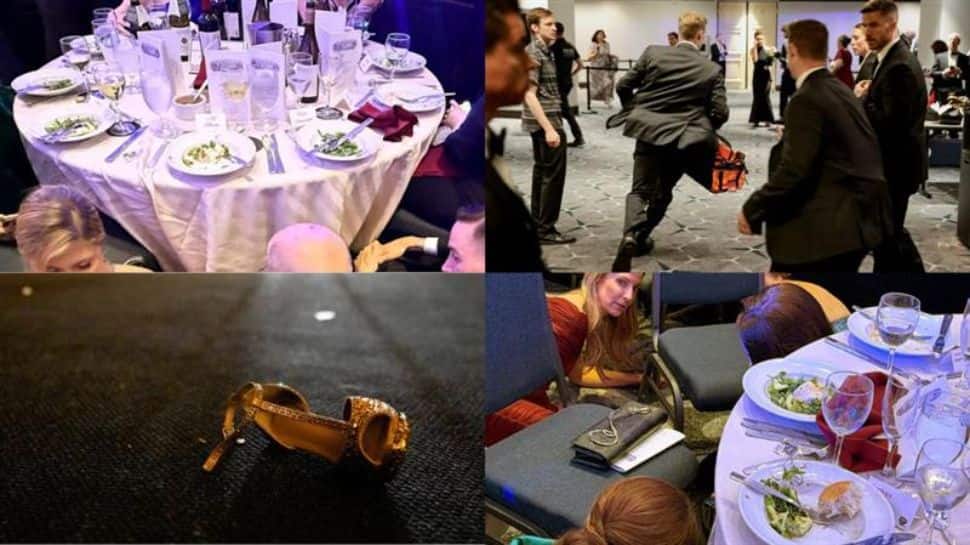
Washington: The White House Correspondents’ Dinner, one of the most high-profile events of the United States, turned into a scene of panic on April 25 evening when gunfire broke out outside the venue, sending guests inside the ballroom scrambling for cover.
Reporters, politicians and guests described chaos inside the hall as security teams moved to respond. CNN’s Wolf Blitzer said a police officer pushed him to the ground almost immediately after spotting the attacker in the vicinity of the hall.
“And then they grabbed me, the police officers, and they take me back into the men’s room, where it was safe, and there were about 15 other men who are stuck in there, and they won’t let them out,” he said.
Inside the ballroom, CNN’s Jake Tapper said he saw Secret Service agents running through the aisle. He said he did not hear the initial gunshots, but the reaction inside the room made it clear something was wrong.
“People were jumping under tables, and people were very upset and worried,” he said.
Several attendees told reporters that chairs were pushed back, people dropped to the floor and conversations stopped as soon as the security response began.
Glass breaking and people taking cover
One attendee speaking to CNN’s Brianna Keilar described the moment he was leaving the ballroom when the situation escalated. He said glass started breaking overhead and fell into the area as multiple shots were heard nearby. It added to the confusion as people moved toward exits and stairways.
US Attorney for the District of Columbia Jeanine Pirro, who was also present, said the atmosphere inside the room changed instantly.
“When I lifted my head and when I looked up, every law enforcement officer was out there, as we all had our heads down, thousands of them,” she said.
Usually filled with speeches, laughter and political exchanges, the ballroom fell into silence as security teams moved in and guests followed instructions to stay low or move away from open areas.
In his column for POLITICO, John F. Harris, founding editor and global editor-in-chief who was also attending the event, wrote that the evening began like any other correspondents’ dinner, with “the massive ballroom at the Washington Hilton was filled with an indistinct buzz from thousands of mostly inconsequential conversations all blended together across a sea of hundreds of tightly packed tables, just like always happens before the formal programme gets underway”.
He then described how quickly that normal setting changed. “The next moment was utterly bizarre: Women in gowns, men in tuxes, nearly everyone in the place crouching down on the floor as the ballroom turned quiet. When people tentatively lifted their gazes to survey the room, we saw men with machine guns standing at the head table where President Donald Trump had been and cabinet secretaries being escorted by agents one-by-one out of the giant hall,” he wrote.
Harris said that the reaction inside the room was not immediate panic in the way people might expect. Instead, he described a slower sense of confusion, “The sensation instead was something akin to the blurred in-between zone of consciousness when a phone call awakens you in the middle of the night. Huh, what’s happening, I’m confused, is this for real?”
He also described how the sound outside did not land the same way for everyone. “In my case, and I sense for others around me, that is not quite how it felt as the incident took place. The noise was on the periphery of awareness, not enough to cause a jolt alarm or even to interrupt my conversation,” he wrote.
As security agents took control, guests gradually realised the seriousness of the situation. Harris wrote, “The subconscious instinct to assume normal order was overcome by cognitive recognition that something definitely abnormal was underway. People were ducking on the floor. C’mon, I wondered, is that really necessary? The sight of agents with guns brandished made it clear that joining colleagues on the ground was in fact a good idea.”
He also described how professional instincts took over even in that moment, “Once there, my thoughts were dominated first by a question: What the hell is actually happening? Then came a journalist’s instinctual reaction: Whatever the answer is, the president just got rushed out of the event, this is a big damn story.”
For a period after the initial response, communication inside the ballroom was limited. Harris said that the building’s structure made phone connectivity unreliable, leaving many unsure of what was happening outside.
“The physical characteristics of the Hilton ballroom, set deep within the bowels of the cavernous hotel, mean cell phone service is often not very good,” he wrote, adding that people “milled about and asked each other what they had heard”.
Rumours spread quickly inside the room, including the belief that the attacker had been killed just outside the ballroom doors, though that later turned out to be incorrect.
The evening, already disrupted by the evacuation of US President Donald Trump and other officials, did not return to normal programming. White House Correspondents’ Association President Weijia Jiang of CBS News eventually confirmed that the dinner would not resume that night.
Harris also placed the incident in a broader context, adding that the Hilton ballroom and its layout have long raised questions about event security, especially given past incidents involving politicians at or near the venue. He also pointed to Trump’s own history, including past assassination attempts as part of the backdrop to the evening.
Sudden reaction on stage
A video from the event showed US President Donald Trump and First Lady Melania Trump speaking with mentalist Oz Pearlman shortly before the incident took place. In the clip, the conversation is interrupted by a loud noise. A visible shock spread across faces at the table before security personnel rush the president off the stage area.
Trump later described the incident as a “traumatic experience” for his wife during a press briefing after the evacuation.
Security personnel, including members of the United States Secret Service, moved to secure the venue and guide attendees out of the ballroom. Guests were directed to safe zones inside the building, while others were escorted out through controlled exits.


