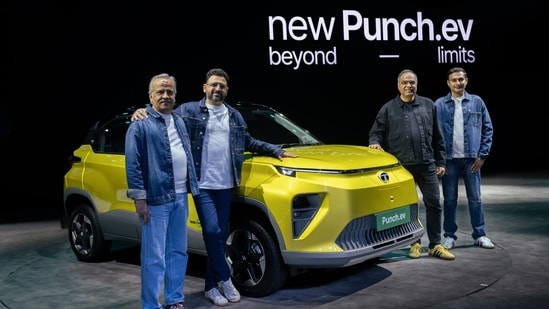
Tata Motors Passenger Vehicles Ltd. is betting that a refreshed, budget-friendly version of its Punch EV will be the catalyst that it needs to recapture a majority of India’s fast-growing but fiercely contested electric vehicle market—a share it has watched erode as new rivals drove in.
But Vivek Srivatsa, chief commercial officer at Tata Motors Electric Mobility Ltd., says the company’s ambitions extend well beyond defending existing turf. The new Punch EV, he argues, is designed to unlock a segment that’s skips the EV segment—the first-time car buyer.
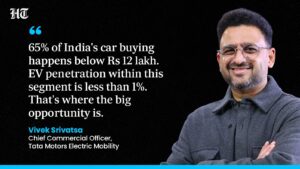
“Punch EV always used to attract a good amount of first-time car buyers—not just first-time EV buyers. But with the new Punch EV, the enhancements that we have done, we want to attract even more,” Srivatsa had told HT Business in an exclusive interview ahead of the model’s commercial launch. “We want the Punch EV to become the ideal choice for the first-time car buyer.”
He declined to offer forward guidance on sales target for the Punch EV in the ongoing calendar year or upcoming fiscal, citing company policy.
Still, the strategic pivot is significant. Tata Motors PV once commanded well over 70% of India’s electric-car market. That share has slipped below 50% as the likes of Mahindra & Mahindra Ltd. and JSW MG Motor Pvt. Ltd. muscled in, even as largest carmaker Maruti Suzuki India Ltd. waits in the wings.
Yet, Srivatsa frames the retreat as a structural feature of market evolution—and insists Tata Motors is playing a longer game.

India’s total electric-car market is running at roughly 200,000 units annually—a fraction of total industry volume at nearly 4.5 million. Srivatsa’s argument is that mainstream EV adoption will only happen when an entry-level buyer choosing between a ₹10-12 lakh petrol or CNG car sees an EV as genuinely credible. Until now, they haven’t.
The new Punch EV targets that inflection point precisely. Tata Motors PV is positioning it against the Punch AMT CNG—arguing that customers drawn to alternative fuels and automatic transmissions are natural EV converts. On that basis, Srivatsa claims near price parity has been achieved at entry trim level—a feat that had eluded the company at lower price points until now.

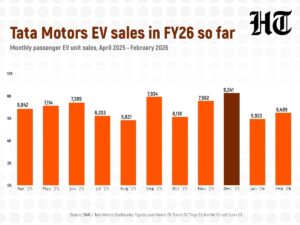
The chart tells a nuanced story. After a firm start to FY26, Tata’s monthly EV sales softened through August-October window—a dip Srivatsa attributed to the government’s GST restructuring for ICE vehicles, which widened the effective price gap between petrol and electric at a critical juncture.
“It was a temporary setback for sure,” he said. “Suddenly we moved backwards in terms of price parity because ICE got a big GST benefit. EVs did not get any additional benefit, and the gap between ICE and EVs increased.”
The CAFE-III wildcard
Whatever temporary relief the GST revision gave ICE vehicles, India’s incoming Corporate Average Fuel Efficiency Phase III norms—or CAFE-III norms—threaten to reverse. Set to take effect from April 2027, the norms mandate a fleet-average CO2 emission ceiling of approximately 91.7 g/km, a steep tightening from the current CAFE-II threshold of 113 g/km.
For manufacturers overwhelmingly reliant on internal combustion engines, the arithmetic is punishing. To bring down fleet averages, automakers must either dramatically improve ICE efficiency—expensive and technically bounded—or rapidly scale EV portfolios to dilute the emissions average. EVs, which produce zero tailpipe emissions, are the most effective compliance lever available.
Industry analysts estimate that without meaningful EV volumes, several mid-sized Indian automakers could face an existential crisis. That financial overhang is already reshaping investment decisions across the sector, accelerating both EV launches and localisation that might otherwise have taken years longer.
For Tata Motors, which enters the CAFE-III era with the broadest EV portfolio of any domestic manufacturer—spanning the Tiago EV, Punch EV, Nexon EV, Curvv EV and the new Harrier EV—the incoming norms represent a competitive moat. The accumulated EV production experience built since the Nexon EV’s 2020 launch gives Tata a structural headstart rivals will struggle to replicate quickly.
Localisation is central to that advantage. Srivatsa confirmed the new Punch EV carries localisation content in excess of 50%, underpinning both its eligibility for government incentives and its resilience to currency-driven cost pressures on imported battery components. Manufacturing is anchored at Tata’s Pune facility rather than the emerging EV ecosystem in Sanand, Gujarat—a deliberate diversification to avoid concentration risk in any single supply geography.
Charging ahead
Tata Motors PV is simultaneously moving to dismantle range anxiety—the persistent psychological barrier keeping entry-level buyers wary of EVs. The company currently operates more than 200,000 home chargers installed with customer vehicles, and has built a growing network of co-branded “Tata Mega Chargers”—high-speed DC fast chargers at high-footfall locations.
Srivatsa said the company plans to more than double its public mega charging points from 450 to over 800 within the next year.
A ‘verified charger’ audit programme—under which Tata Motors PV teams inspect and rate third-party chargers on uptime and interface quality—aims to tackle chronic unreliability at public charging stations. Over 5,000 community chargers have been deployed in apartment complexes and residential societies where dedicated parking is absent, removing a structural barrier to EV ownership in India’s dense urban centres.
On the product front, Srivatsa confirmed the Sierra EV remains on track for a Q2 or Q3 launch in 2026, with all-wheel drive (AWD) as standard. The Avinya—Tata Motors PV’s purpose-built next-generation EV platform—remains scheduled for a debut in 2027.
Whether the Tata Punch EV can single-handedly reverse Tata’s market share slide remains an open question. Mahindra’s electric SUVs have generated strong early demand, and the broader industry expects several new entrants in the sub- ₹15 lakh EV segment over the next 18 months.
Tata Motors PV banks on Punch, Sierra to outsell the wider SUV market in 2026
But with CAFE-III approaching and the entry-level segment largely unclaimed, Tata’s timing to launch the refreshed Punch EV may be shrewder than it looks. The first brand to make a sub- ₹12 lakh EV feel genuinely mainstream—reliable, fast-charging, and emotionally reassuring for a first-time buyer—will not merely gain market share. It can potentially reshape the wider EV ecosystem.