

China Launches Emergency Rescue Mission for Stranded Astronauts
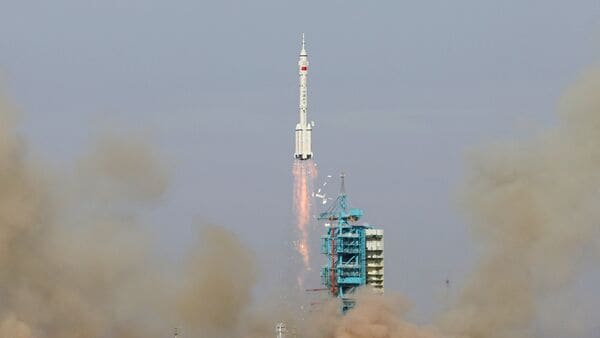
In a dramatic space rescue operation, China has launched an emergency mission to bring home three stranded astronauts aboard the Tiangong space station. The Shenzhou-22 spacecraft blasted off on Tuesday as a “rescue ship” after the crew’s original return vehicle was damaged by space debris.
Key Developments
- Three Chinese taikonauts stranded aboard Tiangong space station
- Emergency Shenzhou-22 launch conducted as rescue mission
- Space debris collision damaged original return spacecraft
- Crew remains in good condition awaiting rescue
China’s First-Ever Emergency Space Launch
The China Manned Space Agency confirmed the Shenzhou-22 mission marks the country’s “first-ever emergency launch” in its space program history. The uncrewed spacecraft lifted off from Jiuquan Satellite Launch Centre at 12:11 Beijing time aboard a Long March-2F rocket.
Originally scheduled for a 2026 manned mission, the spacecraft was urgently repurposed as a replacement crew ship for the stranded Shenzhou-21 crew. The vehicle was sent to space “with full cargo load” to support the rescue operation.
How the Astronauts Got Stranded
Taikonauts Zhang Lu, Zhang Hongzhang and Wu Fei currently have no way to depart the Tiangong station, either during emergencies or for their scheduled return. This unprecedented situation arose because their original Shenzhou-21 spacecraft had to be used to return the previous Shenzhou-20 crew.
The Shenzhou-20 return vehicle suffered damage from space debris, forcing mission controllers to repurpose the Shenzhou-21 spacecraft for the earlier crew’s return. Yang Yuguang, Chair of the Space Transportation Committee at the International Astronautical Federation, confirmed the space debris collision detection.
“The Shenzhou 21 astronaut crew is working normally and in good condition in orbit,” the China Manned Space Agency stated.
Swift Response Compared to International Incidents
Yang Yuguang highlighted how China’s rapid response compares favorably with similar international space emergencies. He recalled Russia’s Soyuz-MS22 incident in 2022, where a coolant leak from space debris collision delayed crew return by nearly six months.
The official also referenced Boeing’s Starliner mission, where NASA astronauts Sunita Williams and Barry Wilmore experienced nine-month delays due to propulsion system malfunctions.
“This time, we, China, only delayed for nine days for the Shenzhou 20 crew for their return,” Yuguang emphasized, praising the mission’s swift coordination.
The Shenzhou-20 crew had already completed over 200 days in space before their emergency return using the Shenzhou-21 spacecraft. Now the Shenzhou-21 crew awaits their homecoming aboard the newly launched Shenzhou-22 rescue vessel.


