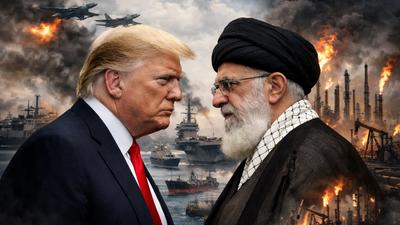
The United States and Iran appear closer to a potential military confrontation than at any point in recent years, with diplomacy narrowing and military preparations intensifying.
A visible US military surge in the Middle East, renewed nuclear brinkmanship, faltering nuclear diplomacy and fresh satellite imagery showing fortified Iranian nuclear sites have sharpened fears that Washington and Tehran may be approaching a critical juncture, edging toward a major escalation.
Fanning the fears further, Trump on Thursday while speaking at the inaugural Board of Peace meeting warned that if there is no “meaningful deal” over the period of next 10 days, America might escalate, taking a step further threatening “bad things.”
Sources cited by Axios say the Trump administration is weighing options for a possible large-scale campaign that could resemble a sustained military operation rather than limited strikes.
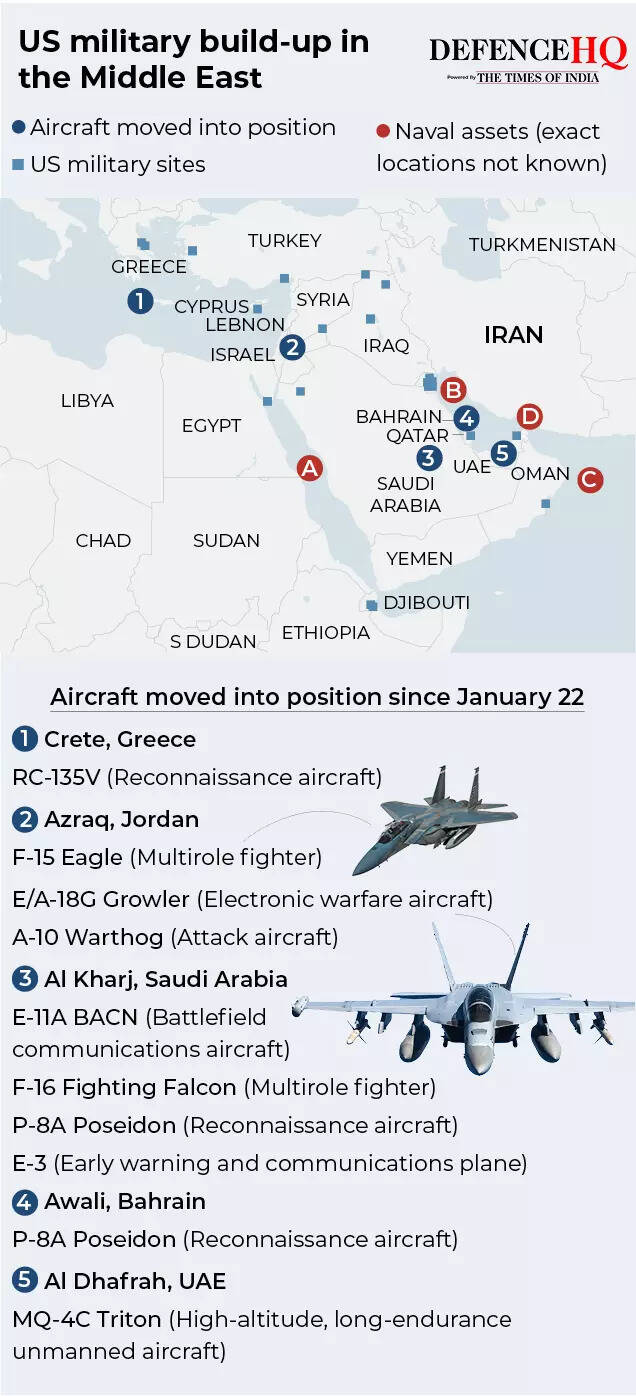
In recent weeks, the Trump administration has moved additional aircraft carriers, fighter jets and air defence systems into the region, according to reports by Axios. At the same time, new satellite images reviewed by Reuters show Iran reinforcing nuclear and missile-linked facilities with concrete shielding and buried tunnel entrances.
Behind closed doors, negotiations have continued. US officials have met Iranian representatives in Geneva, but public messaging from Washington indicates limited optimism about a breakthrough. The White House has maintained that President Donald Trump prefers a diplomatic solution – even as officials acknowledge that military options are being weighed.
The combination of stalled talks, visible force posture and hardening nuclear infrastructure has raised questions in Washington, Tel Aviv and beyond about whether the current standoff could escalate into a broader confrontation.
Here are five reasons tensions are nearing a tipping point:
1. Nuclear deal deadlock
At the core is the long-running dispute over Iran’s nuclear programme. The 2015 nuclear deal brokered under former US President Barack Obama was abandoned by President Donald Trump during his first term. Efforts under former President
Joe Biden to revive the agreement did not succeed.
Trump, who returned to office last year, has sought a new deal but has also warned of consequences if talks fail.
His advisers recently met Iran’s foreign minister Abbas Araghchi in Geneva. While both sides described the talks as making progress, US officials are reportedly not optimistic about closing key gaps.
Vice president JD Vance told Fox News the discussions “went well” in some ways, but added that “in other ways it was very clear that the president has set some red lines that the Iranians are not yet willing to actually acknowledge and work through.”
White House press secretary Karoline Leavitt said “there are many arguments one can make in favor of a strike against Iran”, while adding that the president prefers diplomacy and that “Iran would be wise to make a deal”.
2. Massive US military buildup
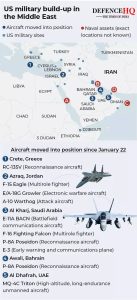
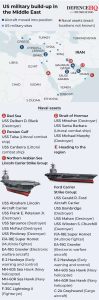
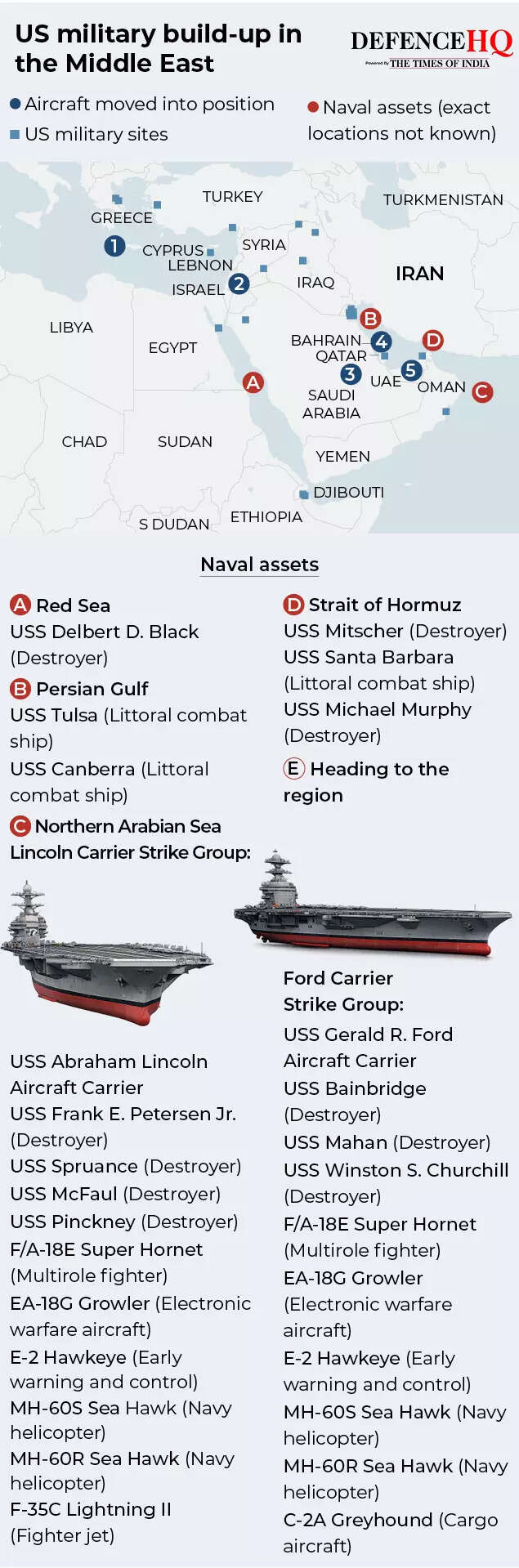
The US has deployed what Reuters describes as its largest military presence in the Middle East since the 2003 invasion of Iraq. Two aircraft carriers, multiple warships, fighter jets and air defence systems have been positioned in the region.
Over 150 military cargo flights have reportedly transported weapons and ammunition.
CNN reported that US forces could be prepared to act as soon as this weekend, though no final decision has been taken.
According to Axios, Trump’s earlier threats over Iran’s crackdown on protesters and the subsequent military buildup have heightened expectations that force may be used if diplomacy collapses.
3. Iran hardening nuclear sites
Satellite images analysed by Reuters show Iran reinforcing key facilities.
At the Parchin military complex, southeast of Tehran, images indicate reconstruction of a previously damaged structure and what the Washington-based Institute for Science and International Security described as a “concrete sarcophagus” over a facility identified as Taleghan 2.
ISIS said imagery pointed to the presence of a long cylindrical chamber that could be a high-explosives containment vessel, noting that such vessels are “critical to the development of nuclear weapons,” though they may have conventional uses.
Iran denies seeking nuclear weapons.
At Isfahan, satellite imagery shows tunnel entrances to an underground complex have been backfilled with soil. Near Natanz, activity around a mountain tunnel complex suggests further efforts to reinforce entrances.
Analysts cited by Reuters said burying and shielding facilities would provide greater protection against aerial strikes.
4. Israeli pressure and coordination
Israel is preparing for a scenario of war within days and is advocating for a broader operation targeting not only nuclear infrastructure but also missile capabilities and potentially regime stability, according to several reports.
US and Israeli officials expect any future campaign to be more extensive than last year’s 12-day conflict, during which the US joined Israeli strikes on underground nuclear facilities.
Israeli prime minister Benjamin Netanyahu and Trump have remained in close coordination, including on economic pressure measures against Tehran.
5. Oil market and regional calculations
Energy dynamics are also a factor. The current oil market conditions, relatively stable supply and moderate prices, may offer a strategic window for military action.
The Strait of Hormuz remains a critical chokepoint for global oil trade. Iran has previously threatened to disrupt it. This week Tehran has partially closed the critical waterway, a route accounting for almost 1/5th of global oil supply.
At the same time, officials cited by Axios suggest that Iran’s regional proxy network has been weakened in recent years, potentially influencing US and Israeli assessments of retaliation risks.
However, analysts warn that any strike could trigger wider escalation.
What’s next?
US officials have given Iran a two-week window to present a detailed proposal following the latest Geneva talks.
Reuters reported that President Trump is consulting advisers and foreign leaders as he weighs diplomacy against military action.
While there is no confirmation that strikes are imminent, the convergence of stalled negotiations, visible military deployments and satellite evidence of Iranian fortification has sharpened concerns that a conflict could unfold with little warning.
For now, diplomacy remains officially on the table, but officials and analysts believe window may be narrowing.