Editor’s note: On March 1st, Iranian state television confirmed that Iran’s supreme leader, Ali Khamenei, had been killed in an airstrike
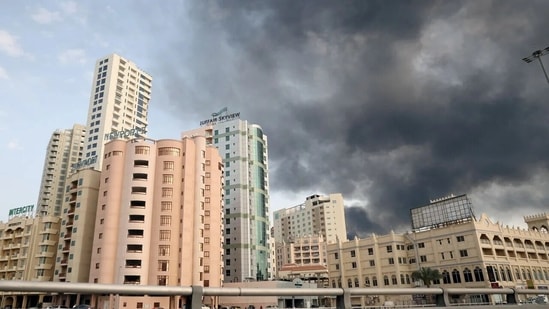
SMOKE BILLOWING over the skyline after a drone attack. Civilians running in panic as air-defence interceptors boom overhead. A migrant worker killed by falling debris after a missile was shot down. For months, as America geared up to strike Iran, Gulf monarchs lived in fear of such scenes. They scrambled to dissuade Donald Trump from attacking and to push the Islamic Republic to make a deal. Their efforts failed—and now the war they dreaded has come to the Middle East.
One Subscription.
Get 360° coverage—from daily headlines
to 100 year archives.

E-Paper

Full
Archives

Full Access to
HT App & Website

Games
Already subscribed? Login

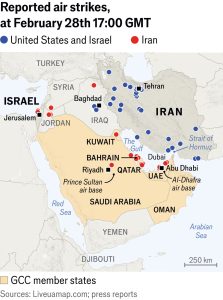
The conflict began with a wave of strikes by American and Israeli warplanes on the morning of February 28th. Bombing continued throughout the day, aimed at both Iran’s leaders and its military bases. By the evening it was still hard to assess the damage. The regime insisted that its most senior officials were alive and well; it made similar claims at the start of the 12-day war with Israel in June, though, only to be compelled later to reverse some of them.
Iran wasted little time retaliating—not only against Israel, but against its Arab neighbours across the Persian Gulf. In Bahrain it hit an American naval base with both a missile and a kamikaze drone. Kuwait, Qatar, Saudi Arabia and the United Arab Emirates (UAE) shot down numerous volleys of Iranian missiles, though one person was killed by shrapnel in Abu Dhabi, the capital of the UAE. The Gulf states are not parties to the war. Still, for Iran, the logic in striking them is twofold.
First, most of them host American bases or soldiers. Bahrain is home to America’s Fifth Fleet; Qatar, to the regional headquarters of its central command. Dozens of American warplanes arrived in recent weeks at al-Dhafra air base in Abu Dhabi and Prince Sultan air base south-east of Riyadh. In the run-up to the war, Saudi Arabia and the UAE forbade America from using bases on their soil to attack Iran. But for Iran this is a distinction without a difference. Second, all six members of the Gulf Co-operation Council (GCC) are close American allies. Hit them hard enough, the regime reckons, and they may push Mr Trump to sue for peace.
The fear of such retaliation was one reason why Gulf leaders had urged America not to attack. Another was the belief that Mr Trump would try to topple the regime, tipping a country of 92m people into the sort of chaos that swept Iraq after the American-led invasion in 2003.
Oman led efforts to negotiate a nuclear deal that would stave off war. Envoys from America and Iran held three rounds of talks, most recently in Geneva on February 26th; a follow-up meeting was scheduled in Vienna for next week. On February 27th Badr Albusaidi, the Omani foreign minister, told CBS News that a deal was “within our reach” and could “be agreed tomorrow”. The bombs started falling hours later.
That diplomatic track is almost certainly dead. This is the second time that Iran has been attacked while engaged in talks with America (the first was in June). Though Iran seemed willing to make some concessions around its nuclear programme, there was still a wide gap between the parties. Mr Albusaidi said Iran was willing to sign a deal that would forbid it from stockpiling significant amounts of enriched uranium. The Iranians themselves did not confirm this, however—and even if his comments were accurate, the offer fell far short of Mr Trump’s demand that Iran not be allowed to enrich uranium at all.
More importantly, Mr Trump no longer seems willing to settle for a nuclear deal. In a video message posted after the bombing began he urged Iranians to “take over your government”. Hours later in a call with the Washington Post he said his goal was “freedom for the people” of Iran. The president is prone to changing his mind, but for now the goal is regime change, not arms control.
Mr Albusaidi took to social media to vent his frustrations. “I urge the United States not to get sucked in further. This is not your war,” he wrote on X. His post—his first comment on the war—irked some readers in the Gulf: he condemned America but said nothing about his neighbours in the GCC being bombed.
That reaction points to the dilemma for Gulf rulers. Their region enjoys a reputation as an oasis of stability in a tough region; missiles zooming overhead are bad for business. Qatar and the UAE have both temporarily closed their airspace, forcing two of the world’s biggest airlines to cancel hundreds of flights. Ship-tracking data suggests that oil tankers are starting to avoid the Strait of Hormuz, the conduit for one-third of the world’s seaborne crude. Iran appears to be moving to close it. Still, the Gulf could probably weather a brief, limited campaign without lasting consequences.
But there are signs that Iran is expanding its targets. On Saturday evening a Shahed drone hit the commercial airport in Kuwait, injuring several workers and damaging the terminal. Explosions were heard in Dubai, the commercial hub of the UAE, where a luxury hotel on the Palm Jumeirah, a ritzy man-made island thick with $10m villas, was set ablaze. The Saudis said Iran tried to hit their eastern province, home to the kingdom’s oil industry. It is one thing to absorb attacks on American bases. Strikes on your own infrastructure are something else entirely.
Gulf states have long viewed the Islamic Republic as a menace: it runs a rogue nuclear programme, stockpiles missiles and arms Arab militias. But they have nonetheless spent the past few years engaged in rapprochement with their foe, hoping to avoid exactly this scenario. Saudi Arabia restored diplomatic ties in 2023 after a seven-year freeze. The UAE did so even earlier. They publicly urged Mr Trump not to start a war. Yet for all of that, they now find themselves under attack from Iran.
Even regional rivals are closing ranks. Saudi Arabia and the UAE have spent the past two months in a bitter feud over their divergent foreign-policy goals. Senior officials from the two countries have not spoken since late December. On Saturday, though, the Saudi crown prince called the Emirati president to discuss the war.
There is no consensus yet on what to do next. Some Gulf officials still hope to revive diplomacy. Others think the die is cast. One Saudi close to the royal court suggests that Gulf states might lift their restrictions on America launching strikes from their territory: if Iran has already targeted them, they might as well take sides. The GCC has spent months trying to avoid a regional war, only to be dragged into one against its will.