

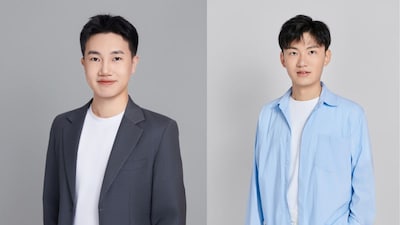
Young AI Innovators Reject Elon Musk’s Millions to Pursue Breakthrough Technology
Two 22-year-old childhood friends from Michigan have made headlines worldwide after turning down a multimillion-dollar acquisition offer from Elon Musk’s xAI to continue developing what experts call a potentially transformative artificial intelligence system.
Key Takeaways
- William Chen and Guan Wang rejected Elon Musk’s multimillion-dollar offer
- Their Hierarchical Reasoning Model (HRM) outperformed major AI systems with just 27 million parameters
- The technology shows promise in reducing AI hallucinations and improving reasoning capabilities
- Company preparing to expand with US office opening
The Visionary Partnership
William Chen and Guan Wang, co-founders of Sapient Intelligence, began their journey in high school where they bonded over “metagoals” – wildly ambitious visions for the future. Wang aimed to create an algorithm capable of solving any problem, while Chen focused on designing systems that could optimize everything from engineering tasks to real-world processes.
“One day, we’re going to have an AI that’s smarter than humans,” Chen told Fortune. “If we don’t build it, someone else will. So we hope to be the first.”
Academic Foundation and Early Success
After high school, Chen followed Wang to Tsinghua University in Beijing, where they quickly gained professor support for their ambitious AI research. They challenged the dominance of current large-language models (LLMs), with Chen stating, “Large-language models have structural limitations. We want a new architecture that overcomes them.”
Their breakthrough came with OpenChat, a compact LLM trained on high-quality conversations using reinforcement learning. The model’s academic popularity eventually caught Elon Musk’s attention, leading to the multimillion-dollar offer they ultimately declined.
The Hierarchical Reasoning Model Breakthrough
Sapient Intelligence’s new system, the Hierarchical Reasoning Model (HRM), represents a fundamental shift in AI architecture. In June testing, a prototype with just 27 million parameters outperformed far larger systems from OpenAI, Anthropic and DeepSeek on structured reasoning tasks including advanced Sudoku, mazes, and the notoriously difficult ARC-AGI benchmark.
“It was crazy,” Chen said. “Just changing the architecture gave the model what we call reasoning depth.”
How HRM Differs from Traditional AI
Unlike traditional transformer models that rely on statistical word prediction, HRM uses a two-part recurrent design that imitates human thought processes – combining deliberate reasoning with fast, instinctive responses.
“It’s not guessing,” Chen emphasized. “It’s thinking.”
According to company data, their models hallucinate significantly less than current LLMs and match state-of-the-art performance in diverse applications including weather forecasting, quantitative trading, and medical monitoring.
Future Expansion
Sapient Intelligence is now preparing to open a US office, with the young founders positioning their work as a major step toward the next era of artificial general intelligence.