
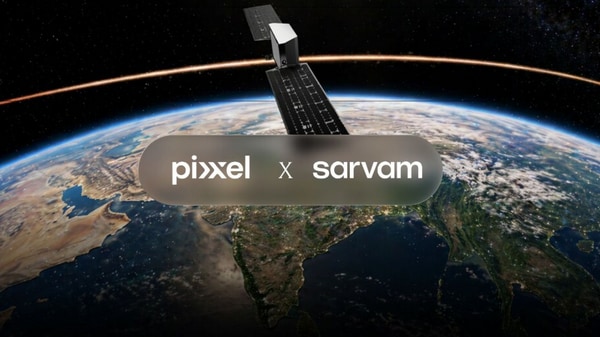
As space-based computing gains momentum globally, India is taking early steps to build computing infrastructure beyond Earth, a shift driven by rising data demand, energy constraints and strategic interest in developing domestic AI capabilities.
Pixxel, a US-Indian private space technology company, on Monday said in a statement on X that it has entered a partnership with Sarvam, an Indian artificial intelligence company headquartered in Bengaluru, Karnataka, to develop India’s first orbital data centre satellite, called Pathfinder.
The development is significant as countries, including the United States, those in Europe, and China, explore similar technologies. In India, parallel efforts are also emerging, with Agnikul Cosmos and NeevCloud partnering to build the country’s first AI-powered data centre in space.
The Pathfinder, a 200-kg satellite expected to reach orbit by the end of 2026, will host GPUs (graphics processing units) to train and infer Sarvam’s AI model.
Unlike conventional satellite computing, which relies on low-power edge processors optimised for survival rather than performance, the Pathfinder satellite will use hardware comparable to that found in terrestrial data centres powering frontier AI models, according to the Bengaluru-based startup.
The announcement comes as a growing number of tech giants, including Google and Elon Musk-owned SpaceX, along with several startups, look to space to bypass Earth’s power constraints.
Global data centre capacity is estimated to reach 200 GW by 2030, according to American real estate services company JLL (Jones Lang LaSalle). Meanwhile, a report cited by The Indian Express notes that India’s data centre capacity is expected to grow sixfold, from 1.8 GW to about 10.5 GW by 2031, according to Morgan Stanley estimates.
However, the concept of orbital data centres has been dismissed by many experts as commercially unviable at present, The Indian Express reported, noting that launch costs would need to fall sharply from current levels in the low thousands of dollars per kilogram to the low hundreds for such systems to become economically viable.
Industry analyses and expert commentary suggest that launch costs remain the single biggest barrier to space-based computing and would need to decline significantly to approach cost parity with terrestrial data centres, according to reports by Ars Technica.
Experts have also raised concerns about the practical challenges of operating data centres in space, including the difficulty of repairing or replacing failed hardware such as GPUs in orbit, an issue highlighted in coverage by Tom’s Hardware, which noted that hardware failures could significantly increase costs and operational risks.
The Indian Space Research Organisation (ISRO) is also exploring next-generation satellites with on-board data processing and storage capabilities, according to the Centre’s response in Parliament on 11 December.
Pixxel-Sarvam partnership
As part of the partnership, Pixxel said it will design, build, launch, and operate the Pathfinder satellite. The satellite will be developed at Gigapixxel, the company’s upcoming facility designed to scale satellite production to up to 100 units. Pixxel did not disclose additional technical details about Pathfinder.
Sarvam, on the other hand, will handle the training and inference of its language models directly in orbit. The models and inference platform will process data without dependence on foreign cloud or ground infrastructure, according to a statement released on X.
The mission will further validate real-time AI inference and data processing in the harsh space environment. It is expected to test performance, power management, thermal constraints, and real-time data workflows under operational conditions while establishing the technical and commercial groundwork for future orbital data centre systems.
“Orbital data centres open up a new frontier, where compute can be powered by abundant solar energy, operate closer to space-based data, and move beyond some of the limits faced on Earth. For Pixxel to build the next generation of space infrastructure, we have to help shape this shift, not watch it happen from the sidelines,” Pixxel CEO Awais Ahmed said in a statement.
“Sarvam has been building India’s full-stack AI platform from the ground up, and partnering with Pixxel allows us to extend that sovereign stack into space. Having India-built models running in orbit aboard an India-built satellite is exactly the kind of foundational capability that the country needs to control its own intelligence infrastructure,” Sarvam CEO Pratyush Kumar said.
Besides housing chips to train AI models, Pathfinder will also carry a hyperspectral imaging camera capable of capturing high-fidelity hyperspectral data. This data will be analysed directly in orbit using foundation models trained in space.
“Instead of sending large volumes of raw imagery back to Earth for processing, the system can identify patterns, detect changes, and generate insights in real time. This significantly reduces the delay between data capture and decision-making, enabling faster responses across environmental monitoring, resource management, and critical infrastructure tracking,” Pixxel said.
From data collection to processing in orbit
The partnership also reflects a broader shift in the space industry from satellites that primarily collect data to systems that can process it in orbit. Such architectures are designed to reduce latency and transmission requirements by analysing data closer to its source, a model increasingly discussed in industry literature on edge computing.
India’s parallel efforts, including the Agnikul Cosmos–NeevCloud collaboration reported by The Economic Times, indicate growing domestic interest in this segment, although most projects remain at an early stage.
Albeit, the push toward orbital data centres is closely tied to energy demand. Data centres are estimated to account for around 1–2% of global electricity consumption, with that share expected to rise alongside AI workloads, according to Morgan Stanley and JLL reports.
Space, with access to near-continuous solar energy and natural cooling, is being explored by companies as a potential alternative, although its feasibility at scale remains uncertain.
Running AI models on domestic infrastructure, even in orbit, could also reduce reliance on foreign cloud providers, aligning with the “sovereign AI” approach highlighted in Sarvam’s statements.
Early-stage, high-risk frontier
For now, missions like Pathfinder remain proof-of-concept. High costs, technical risks and operational challenges, particularly around launch economics and hardware maintenance in orbit. Meanwhile, the bottom line is India’s early bets on orbital data centres signal a shift from a space programme focused on launching satellites to one exploring computing infrastructure in orbit, placing it among a small group of countries and companies testing this approach.


