
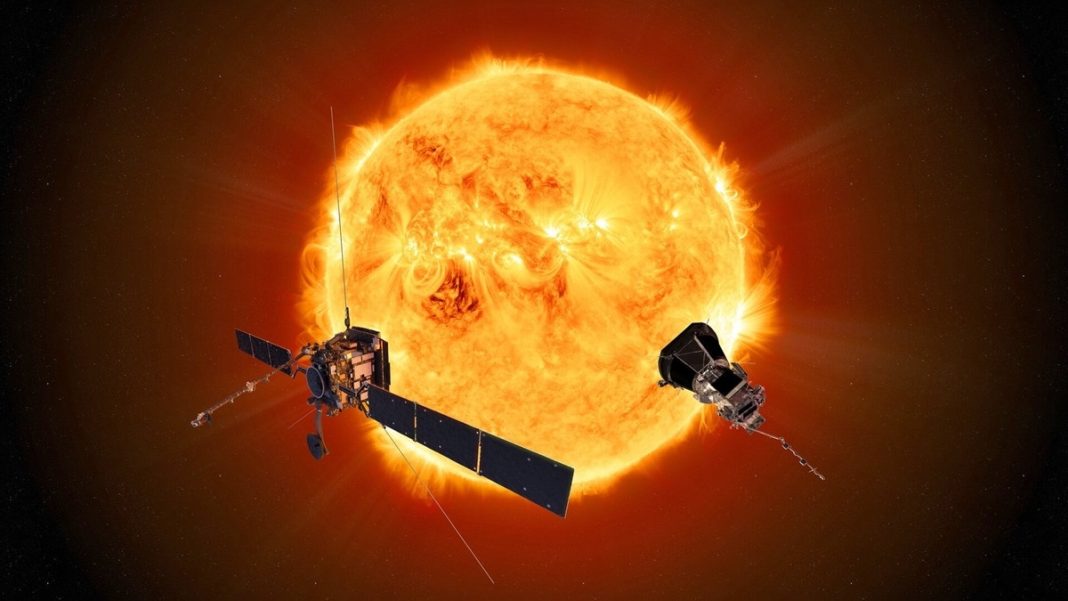
The Sun has unleashed a series of powerful solar storms toward Earth, triggering spectacular auroras across continents and putting satellites and power grids on high alert. Scientists explain this heightened activity is due to our star reaching the peak of its 11-year cycle.
Key Takeaways
- Solar Cycle 25 has reached its maximum, making the Sun highly volatile
- Indian scientists accurately predicted this strong solar cycle
- Multiple X-class solar flares and CMEs have impacted Earth this month
- These space weather events can disrupt satellites, GPS, and power grids
A Stormy Star at Peak Activity
“Our star, the Sun, is a stormy star,” explains the Center of Excellence in Space Sciences India (CESSI) at IISER Kolkata. The Sun follows an 11-year magnetic activity cycle called the sunspot or Schwabe cycle. During the solar maximum phase, sunspots multiply dramatically, making the Sun significantly more volatile.
A decade ago, Indian scientists led by Prof. Dibyendu Nandi correctly forecast that the current solar cycle would be stronger than the previous one, peaking in 2024. Even as the cycle begins its gradual decline, the Sun continues generating intense storms.
The Science Behind Solar Mood Swings
Solar physicist Dr Richa Jain clarifies we are in Solar Cycle 25, which started in December 2019 and is now at maximum intensity. During this phase, the Sun’s magnetic field transforms from an orderly configuration to a tangled, unstable state. This magnetic chaos fuels sunspots, solar flares, and coronal mass ejections (CMEs).
The process called magnetic reconnection—when twisted magnetic field lines snap and realign—releases tremendous energy. This powers solar flares and propels giant plasma clouds toward Earth at incredible speeds.
Sunspot Cluster Triggering Repeated Eruptions
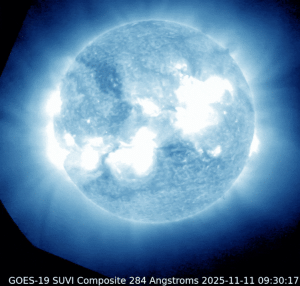
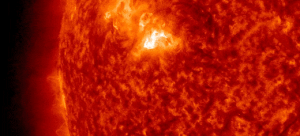
Over the past week, CESSI researchers monitored a hyperactive sunspot cluster designated Active Region 14274. Their analysis revealed the region’s magnetic configuration was highly energized, creating perfect conditions for major solar storms.
On November 6, the team issued an alert warning the region was primed for intense flares. Their prediction proved accurate when, between November 9-11, Active Region 14274 produced three powerful X-class solar flares—the strongest category available.
Each flare was accompanied by a coronal mass ejection (CME)—massive clouds of hot plasma particles hurled into space at millions of kilometers per hour. These CMEs reached Earth on November 11-12 as forecasted, with NASA’s Lagrange Point L1 satellites confirming both timing and impact speed.
Why Solar Eruptions Matter
CMEs represent the most disruptive form of solar activity. When they collide with Earth’s magnetic field, they can:
- Disrupt satellite operations
- Interfere with telecommunications and GPS signals
- Damage spacecraft electronics
- Increase atmospheric drag, causing satellites to lose altitude
- Generate widespread auroras
A strong 2022 storm caused 38 SpaceX Starlink satellites to fall from orbit. Last year, an intense event created rare low-latitude auroras that lit up Ladakh’s skies red.
With Earth still recovering from recent impacts, a third CME is approaching. “If it arrives while Earth’s space environment is still disturbed, it may lead to hazardous space conditions,” warns Prof. Nandi. This could push auroras to unusually low latitudes again and potentially cause outages in space-dependent services.
As global dependence on satellites grows for communication, navigation, climate monitoring, and defense, accurate space weather forecasting has become crucial. Indian solar physicists are establishing themselves as global leaders in this critical field, with all eyes remaining on our stormy star as it continues generating solar tempests.