

Key Takeaways
- Earth’s magnetic field has a growing weak spot called the South Atlantic Anomaly (SAA)
- The anomaly has expanded by nearly half the size of Europe since 2014
- Satellites passing through face increased radiation risks and potential damage
- ESA’s Swarm satellites provide crucial monitoring data until at least 2030
Earth’s invisible protective shield has developed a significant vulnerability that’s expanding rapidly. The South Atlantic Anomaly, a weak spot in our planet’s magnetic field, has grown by an area nearly half the size of continental Europe over the past decade, posing serious risks to satellites and space technology.
What is the South Atlantic Anomaly?
The SAA was first detected southeast of South America in the 19th century and has been expanding eastward toward Africa. Recent data reveals the expansion includes a rapidly weakening section over the Atlantic Ocean near Africa, where magnetic field lines unexpectedly re-enter Earth’s core – a phenomenon scientists call “reverse flux patches.”
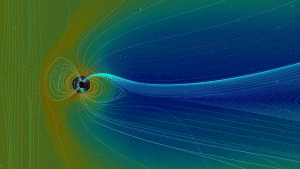
Scientists have discovered that the weak region in Earth’s magnetic field has increased. (Photo: ESA)
How Earth’s Magnetic Field Works
Earth’s magnetic field originates approximately 3,000 kilometers beneath the surface in the planet’s molten iron outer core. The churning flow of liquid iron generates electric currents that create our dynamic electromagnetic shield, which is essential for protecting life by deflecting harmful cosmic radiation.
ESA’s Swarm Mission Findings
The European Space Agency’s Swarm satellite constellation, launched in 2013, has been tracking magnetic changes with unprecedented precision for over 11 years. The three satellites measure magnetic signals from Earth’s core, mantle, crust, and atmosphere, allowing scientists to understand why the field weakens in some areas while strengthening in others.
Global Magnetic Shifts
While the SAA expands, other magnetic regions are also changing significantly. Over Siberia, magnetic strength has increased, while the Canadian region has weakened. These shifts are connected to the north magnetic pole’s gradual movement toward Siberia.
Importance for Space Operations
The expanding anomaly exposes satellites passing over the South Atlantic to heightened cosmic radiation and charged solar particles, increasing risks of hardware damage and communication blackouts. Continuous monitoring of the SAA is vital for safeguarding satellites and other space assets vulnerable to intensified radiation in this growing weak spot.
The Swarm mission will continue delivering critical data well beyond 2030, providing essential insights for navigation, space weather prediction, and understanding Earth’s deep interior processes that shape our protective magnetic shield.