
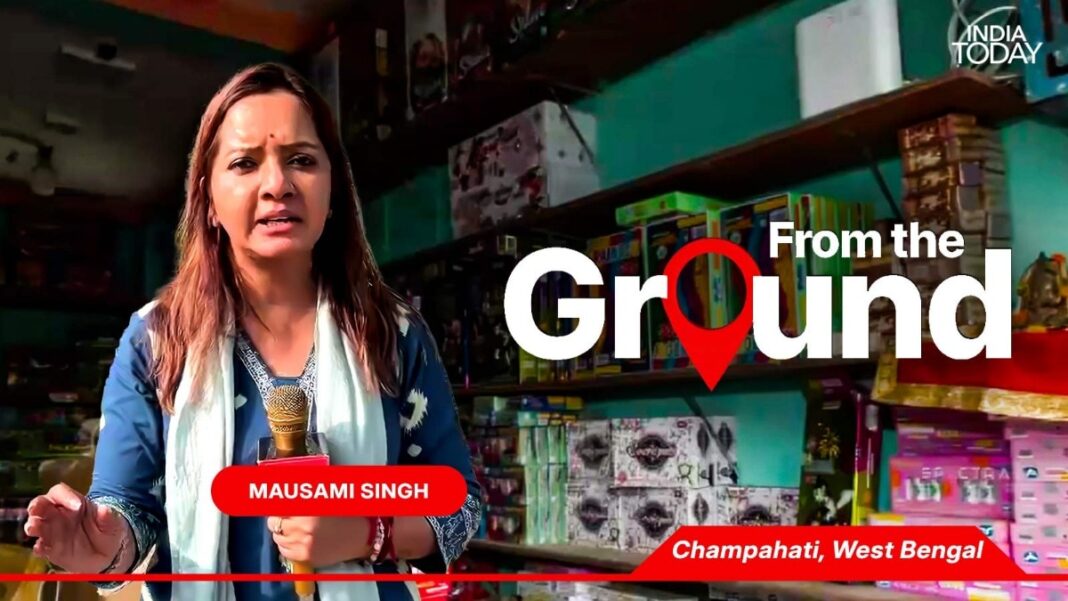
In election season, politicians circle voters and revere them like gods. But in Haral village of West Bengal’s South 24 Parganas, that reverence feels fleeting, confined to campaign days rather than lived realities.
An uneasy silence hangs over this village, once known for lighting up festivities with its firecrackers. Shops are shuttered. Work has halted. Even voices seem subdued. As West Bengal votes in the second phase across 142 Assembly segments, including South 24 Parganas, the India Today team travelled to Haral to understand what lies beneath this quiet.
A VILLAGE BUILT ON FIRE, NOW ENGULFED IN SILENCE
Haral’s identity has long been tied to firecrackers. Generations have depended on this trade. But walking through its narrow lanes today, one notices not activity, but absence. Rows of closed shops line the streets, and tools lie unused inside homes.
For months, work has come to a standstill—hit by accidents, regulatory crackdowns, and now the election season.
Vishwanath Mandal, a lifelong worker in the trade, says little has moved for months. Work stopped with warnings that it would only resume after elections, or risk raids, he says—his voice carrying more fatigue than anger.
NAMES MISSING, IDENTITIES ERASED
The crisis is not just economic — it is electoral.
Across the village, residents gather around officials, trying to understand why their names have disappeared from voter lists.
A local booth-level officer (BLO) says many residents claim to have submitted documents, but officials maintain that proper paperwork was missing.
For villagers, the confusion has turned into quiet despair. Anima, a resident, says she submitted her Aadhaar card and her father’s documents multiple times, yet her name was deleted despite living there all her life.
Another resident, Shakti, shares a similar experience, saying he submitted documents several times but still found his name missing. After generations of living in the village, he says, the loss feels like losing a sense of security.
For Mamta, the loss is deeply personal. “I gave papers four to five times but my name is gone. It hurts that I cannot vote.”
LIVELIHOODS ON PAUSE, FEAR IN THE AIR
In Haral, firecrackers are not just a seasonal occupation—they are the backbone of survival. Today, that backbone is fractured.
Prehlad Haskar, a firecracker contractor, says tens of thousands depend on the trade, but a lack of regulatory clarity has made it nearly impossible to continue. Despite having licences and following environmental norms, including limits on sound and emissions, workers face constant pressure, he says.
With uncertainty mounting, many have temporarily abandoned their trade. In place of firecracker units, small vegetable stalls and cyber cafs have emerged—stopgap measures to sustain daily life.
Dilip Mandal, a shopkeeper, says repeated disruptions—from accidents to elections—have made livelihoods unpredictable. He has set up a small computer service to support his family, but says assurances from leaders about reopening shops after elections are not enough. What they need, he adds, is a permanent solution.
A FAMILY’S QUIET STRUGGLE
Inside a modest home, Vishwanath Mandal sits with his wife. Their son is critically ill and admitted to hospital.
The contrast is stark: The hands that once powered an industry now lie idle.
“If someone gives me a job, I will do it,” he says. “Right now, we survive on basic food in a few days, there is voting. Then we will see. Otherwise, we will die hungry.”
There is no drama in his voice, but only a quiet acceptance of reality.
There is talk of a government-backed firecracker hub nearby, equipped with safety infrastructure such as fire services. Residents say it could provide relief—if completed in time.
Debashish Mandal, a manufacturer, says work has been stalled for months, affecting thousands of families. If the hub is completed soon, it could revive livelihoods. For now, though, that hope remains distant.
POLITICS AMID SILENCE
As campaigning intensifies, political parties offer competing narratives.
Tumpa Sarder, the BJP candidate from Baruipur East, claims that the TMC wants to shut down the business. “TMC is trying to ruin the firecracker business in this village. This is a profession passed down through generations. When the BJP comes to power, we will remove all hurdles and ensure proper safety norms are implemented so that there are no incidents of fire.”
However, TMC candidate Bivash Sardar says that the TMC government has done everything possible to protect this industry. “A cluster and hub is being developed here, and work on a fire brigade facility is also underway. More than 400 licenses have been issued, and workers have been trained to manufacture green crackers,” he said. The current shutdown, he argues, is only temporary.
But in Haral, these exchanges feel removed from everyday struggles.
Election seasons are usually loud—filled with promises, rallies, and demands. But Haral stands out for its silence.
A village that once lit up celebrations across Bengal now sits in darkness, caught between regulations, lost livelihoods, and an uncertain future. And perhaps, in that silence lies its loudest message.
With inputs from Prasenjit Saha


