What if we told you that one of the most famous theorems you learn in school — the Pythagorean theorem — was known in India centuries before Pythagoras was born?
And what if that knowledge was wrapped not in dry formulas, but in a poetic story about a peacock and a snake?
Welcome to the world of Indian mathematics — where geometry met storytelling, and insight often preceded formal proof by centuries.
In the 12th century, the great mathematician Bhaskara II (1114–1185 CE) wrote a remarkable mathematical treatise called Siddhanta Siromai. One of its most celebrated sections, Lilavati, presents mathematics not as mechanical calculation, but as living, breathing puzzles.
A snake’s hole is at the foot of a pillar, nine cubits high. A peacock sits atop the pillar. The snake is spotted at a distance three times the pillar’s height, moving toward its hole. The peacock swoops down obliquely. At what distance from the hole do they meet, if both travel equal distances?
Pause for a moment. Imagine the scene. The tension.
The chase. Now imagine solving it — in the 1100s.
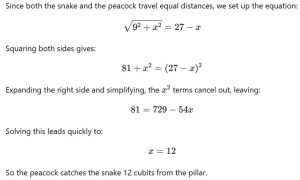
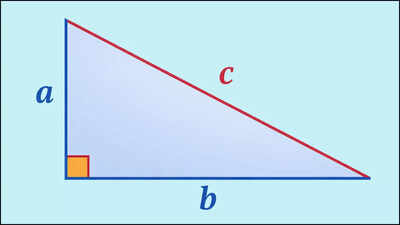
To solve the peacock’s puzzle, we begin by turning Bhāskara’s vivid scene into geometry. The pillar is 9 cubits high, and the snake starts 27 cubits away from its hole. When the peacock swoops down in a straight line, we can imagine a right triangle forming: the pillar is the vertical side (9), the distance from the pillar to the meeting point is the horizontal side (let’s call it xx), and the peacock’s flight path is the hypotenuse.
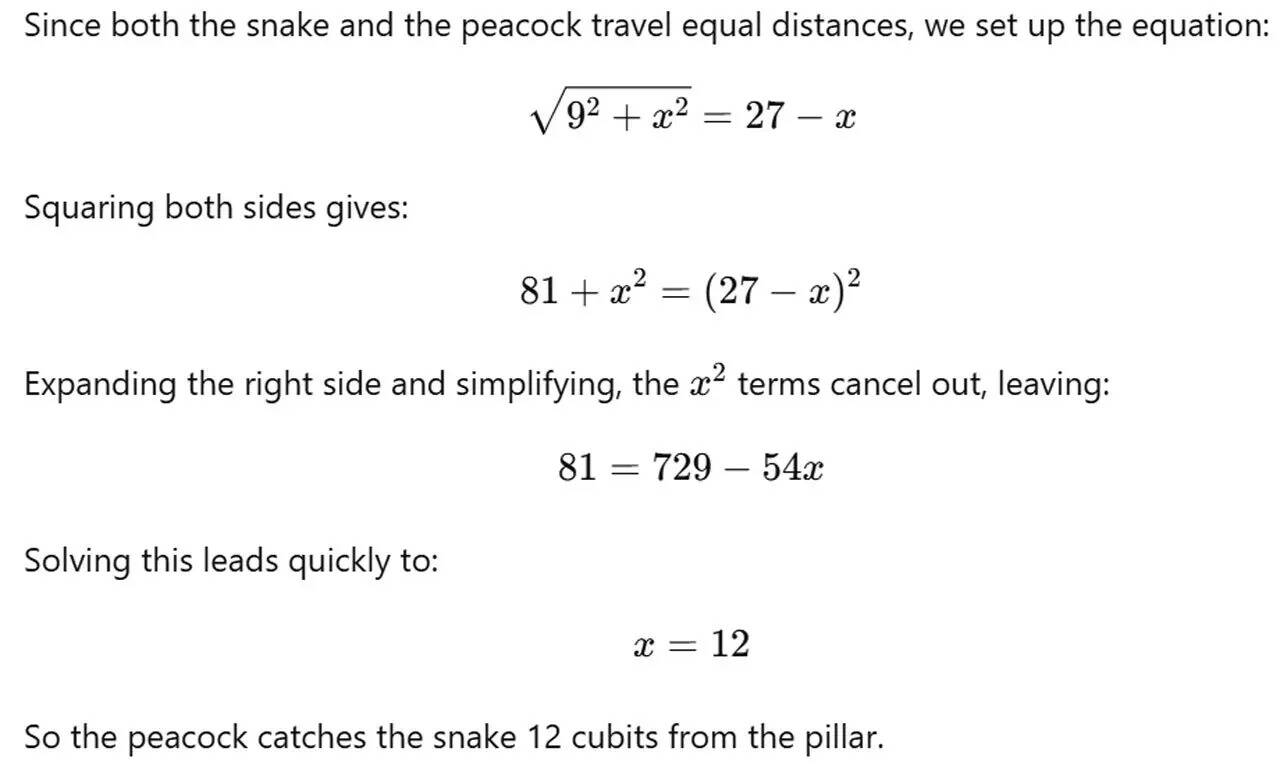
That’s the Pythagorean relationship in action. But here’s the fascinating part — this geometric principle was already known in India long before Bhaskara II.
Centuries before classical Greek mathematics flourished, Indian scholars composing ritual manuals called the Baudhayana Sulba Sutras (c. 800 BCE) described geometric constructions used to build Vedic fire altars.
One famous statement reads: “The diagonal of a rectangle produces both areas separately.”
In modern terms:
In modern terms: a
2
+b
2
=c
2
This is the Pythagorean theorem — expressed verbally nearly 300 years before Pythagoras (c. 570–495 BCE).
Importantly, the Sulba Sutras do more than state the rule. They provide:
• Numerical examples
• Pythagorean triples
• Geometric constructions
Historians of mathematics such as Kim Plofker (, 2009) and George Gheverghese Joseph (, 2011) document this early Indian knowledge in detail.
You may have heard the claim that India knew the Pythagorean theorem a thousand years before Pythagoras. It’s an exciting statement — but let’s look at the timeline more carefully. The idea appears in the Baudhayana Sulba Sutras around 800 BCE. Pythagoras lived around 570 BCE. That means the gap is closer to about 300 years, not a full thousand. Even so, this clearly shows that the principle was known in India centuries before it became linked with Greek mathematics.
There is also an important difference between knowing a rule and writing a formal proof of it. Ancient Indian scholars understood the geometric relationship and used it in practical constructions. Even earlier, Babylonian tablets from around 1800 BCE show number patterns that follow the same rule. Later, around 300 BCE, Euclid presented a clear, step-by-step logical proof in his book . That proof tradition became highly influential in Europe, which is one reason the theorem came to carry Pythagoras’s name.
Today, historians agree that this idea did not belong to just one civilisation. It appeared in Babylonian calculations, Indian geometry, Greek proofs, and even in Chinese mathematics independently. Rather than a single invention, the theorem is better understood as part of a shared global journey of mathematical discovery.
You might be wondering — why does any of this history really matter?
It matters because mathematics is not the achievement of just one civilisation. It is part of humanity’s shared story. When we realise that Indian mathematicians were working with geometric ideas centuries before classical Greece, that problems were taught through stories instead of formulas, and that real-life needs like altar construction and astronomy inspired innovation, mathematics suddenly feels more human and more exciting.
Indian mathematics was often far ahead of its time. The place-value system and the concept of zero were formalised in India. In Kerala, mathematicians developed ideas about infinite series centuries before similar concepts appeared in European calculus. Astronomers built detailed computational models to track planetary motion with impressive accuracy.
Seen in this light, the peacock-and-snake problem is not just a clever geometry puzzle. It is proof of a culture that combined poetry, logic and practical thinking in a seamless way.
Bhaskara II was known for his elegant style of explanation. In one famous demonstration of the Pythagorean relationship, he simply presented a diagram and wrote a single word meaning “Behold!” The idea was that the picture itself made the truth clear.
Instead of long chains of logical steps, he sometimes used geometric rearrangements that allowed students to see the result instantly. This was different from the Greek method, where mathematicians like Euclid carefully built arguments step by step in works such as the Elements. Neither approach is better or worse — they simply reflect different ways of thinking about mathematics.
Modern textbooks usually introduce a formula first and then give examples. In Lilavati, it was often the other way around. Students first encountered lively situations — merchants calculating pearls, bees hovering over flowers, or a peacock diving toward a snake. The mathematics was hidden inside the story.
This made learning feel natural and engaging. The numbers were not floating in empty space; they were part of a scene you could picture. Perhaps this is something today’s classrooms can rediscover — that imagination and logic can work beautifully together.
So was the Pythagorean theorem truly “invented” by Pythagoras?
History suggests a more interesting answer. The numerical patterns were known in Babylon. The geometric rule appeared in Indian texts like the Baudhayana Sulba Sutras. The formal proof tradition was developed and preserved in Greece. Over time, the Greek name became attached to the theorem — but the knowledge itself was shared across cultures.
Recognising this does not take anything away from Greek mathematics. Instead, it helps us appreciate how ideas travel, grow and connect civilisations.
For readers who wish to explore further, important sources include Bhaskara II’s Lilavati (12th century CE), the Baudhayana Sulba Sutras (c. 800 BCE), Kim Plofker’s Mathematics in India (Princeton University Press, 2009), George Gheverghese Joseph’s The Crest of the Peacock (Princeton University Press, 2011), and Euclid’s Elements (c. 300 BCE).
The next time you write: a
2
+b
2
=c
2
pause for a moment. Imagine a Vedic altar builder measuring diagonals. Imagine a Sanskrit poet-mathematician composing a verse. Imagine a Greek geometer constructing a proof. Imagine a Babylonian scholar inscribing numbers on clay.
All of them were thinking about the same triangle. Mathematics is older, wider and more connected than any single name. And perhaps that is the most beautiful lesson this theorem has to offer.
Ready to navigate global policies? Secure your overseas future. Get expert guidance now!