As temperatures soar and power demand reaches seasonal highs across India, a breakthrough from the Indian Institute of Technology, IIT Delhi, could offer major relief to households and the national power grid.
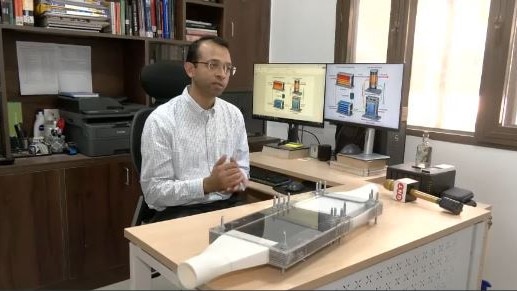
Researchers led by Professor Anurag Goyal from the Department of Mechanical Engineering have developed an innovative add-on module for conventional air conditioners that can cut electricity consumption by nearly one-third, without compromising indoor comfort.
Most air conditioners used today rely on a vapour-compression system that performs two functions at the same time: cooling indoor air and removing humidity (dehumidification). To extract moisture, the system must overcool the air below the desired room temperature so that water vapour condenses into liquid on the cooling coils.
Although this method effectively controls humidity, it is highly energy-intensive because the AC works harder than necessary simply to manage moisture levels. As a result, users often lower thermostat settings to maintain comfort, electricity bills increase, and peak power demand surges during extreme summer months.
On average, a standard room AC consumes about 1200 watts during operation.
THE IIT DELHI INNOVATION: SEPARATING COOLING AND DEHUMIDIFICATION
Prof. Anurag Goyal’s research group has developed a compact add-on module that directly tackles moisture, instead of forcing the AC to overcool the air.
HOW THE SYSTEM WORKS
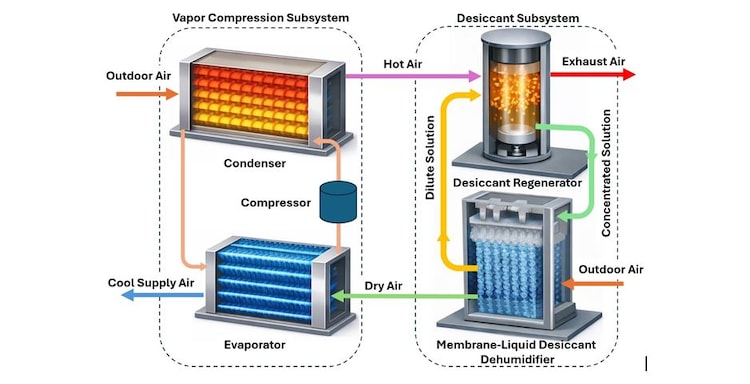
- A salt solution (liquid desiccant) absorbs water vapour directly from incoming outdoor air.
- A thin, selective polymer membrane sits between the air and the salt solution.
- The membrane prevents salt particles from entering indoor air, a common concern with traditional liquid-desiccant systems.
- By removing moisture independently, the AC no longer needs to overcool the air. This significantly reduces the energy load on the compressor.
SMART REGENERATION: NO EXTRA HEATER NEEDED
Once the salt solution absorbs moisture, it becomes diluted and must be dried (regenerated) for reuse.
Instead of adding:
- An electric heater
- A burner
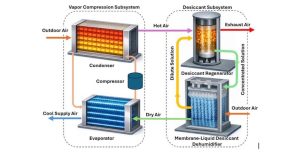
The IIT Delhi team introduced an innovative system integration method in which waste heat from the AC’s outdoor condenser unit, heat that is normally expelled into the surroundings, is captured and redirected to a regenerator module to dry the diluted salt solution.
This allows the same liquid desiccant to be continuously revived and recirculated without the need for an additional heater or burner. The design carefully matches the energy transfer rates between the vapour-compression unit and the membrane–liquid desiccant module, ensuring efficient and reliable performance across India’s varied climate conditions.
HOW MUCH ELECTRICITY CAN BE SAVED?
According to Professor Anurag Goyal, under typical operating conditions, the proposed hybrid system reduces total electricity consumption from about 1200 watts for a standard room air conditioner to nearly 800 watts, delivering roughly 33 percent lower energy use while maintaining the same indoor comfort levels.
The projected savings vary across Indian climates, with around a 28 percent reduction in very humid regions and up to 41.5 percent in dry areas, resulting in an average reduction of approximately 33 percent.
Such substantial efficiency gains could play a crucial role in easing peak electricity demand during India’s extreme summer months.
SCIENTIFIC RECOGNITION
The research has been formally documented in a study titled: “Model-based analysis of a novel hybrid membrane-liquid desiccant air conditioner for high-efficiency space cooling” Published in the Journal of Building Engineering. The paper details the system’s modelling, performance analysis, and predicted energy savings across representative Indian climates.
WHY THIS COULD BE A GAME-CHANGER FOR INDIA
If adopted widely, this technology could:
- Substantially reduce household electricity bills
- Lower national peak power demand
- Reduce carbon emissions
- Improve long-term building energy efficiency
- Support India’s climate and sustainability goals
With rising temperatures and expanding urbanisation driving increased cooling demand, innovations like this hybrid membrane-liquid desiccant AC system could mark a significant shift toward smarter, greener, and more sustainable cooling solutions for Indian buildings.
The research team anticipates broader adoption of this sustainable cooling technology, particularly in Indian residential and commercial buildings, where efficient humidity control is critical for both comfort and energy conservation.