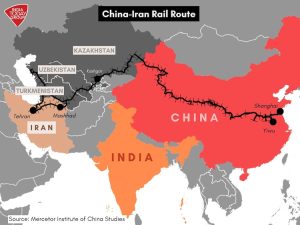
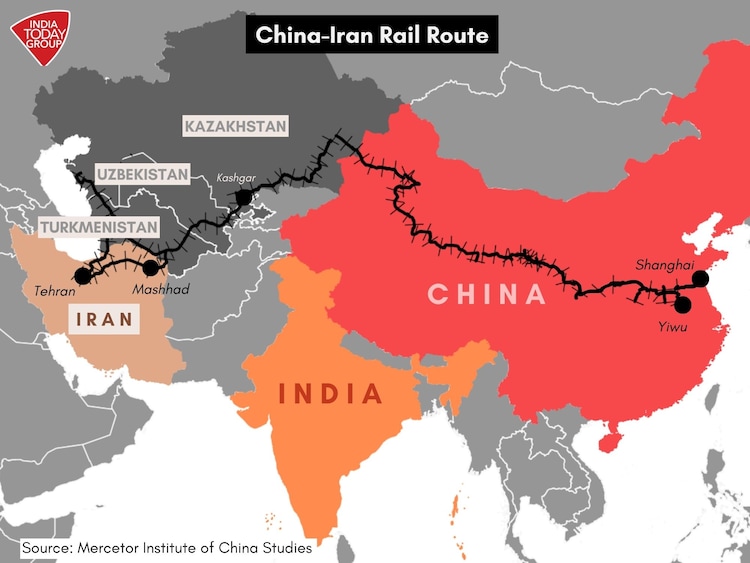
In May 2025, a freight train from Yiwu, China, rolled into an Iranian port after a 15-day journey, entering via the Incheh Borun border. For many experts, this was a landmark moment—a true game-changer. Here was a sanctions-squeezed Iran, finally linked to the world’s second-largest economy by steel and schedule; a tangible manifestation of the Belt and Road promise. In the months that followed, the symbolism did exactly what symbolism does: it expanded into a full-blown theory. China, the world believed, would be Iran’s ultimate backstop.
That narrative had been gathering steam long before the actual outbreak of hostilities. In March 2021, the two nations signed their much-publicised 25-year cooperation agreement, with projected investment worth $400 billion in Iran. In March 2023, Saudi Arabia and Iran announced the normalisation of ties brokered by China (PRC).
Then came the pre-war signals that appeared, to outside observers, as a hardening of the alignment. Just four days before the fighting commenced, Reuters reported that Iran was on the verge of a deal to procure Chinese-made CM-302 anti-ship cruise missiles. These missiles, as Reuters noted, possess a range of “about 290 kilometres” and are engineered to evade defences by flying “low and fast.”
Simultaneously, the Open-Source Intelligence (OSINT) community witnessed a new Chinese intelligence outfit, Mizarvision, pushing out what would typically be considered sensitive satellite imagery of US military movements in West Asia, days before the February 28 strikes. This only fed the perception that this time, Beijing was prepared to be more forward-leaning, and perhaps even performative, in this military build-up. And yet, once the war actually opened—and Iran’s supreme leader was eliminated on Day One—China’s response was curiously watered down.
Assuming the promised Chinese missiles had delivered on their vaunted capabilities, the US Navy’s role would have been far more difficult than what we have witnessed so far. By Day Four of the Iran war, there is hardly any evidence to suggest that the Abraham Lincoln Carrier Strike Group has taken a backseat. This group, comprising the Carrier Air Wing and destroyers USS Frank E. Petersen, Jr., USS Spruance, and USS Michael Murphy, has led the strikes from the very first day without significant hindrance.
To many, this Chinese restraint looks suspiciously like abandonment. Ahmed Aboudouh of Chatham House observes that Beijing has “refrained from coming out in strong support” even as the US amassed forces in the Gulf. He warns, however, that reading this as a betrayal is a category error: “China has always avoided backing Iran militarily.”
William Figueroa, from the University of Groningen, Netherlands, supports this in his Cambridge University Press paper published earlier this year. In Between “New Axis of Evil” and “Paper Tiger”: Expectations and Reality of the 25-Year Iran China Cooperation Agreement, he argues that the deal was routinely inflated by foreign observers. “In reality,” he writes, it “primarily outlined aspirations for future cooperation, with no specific contracts, concrete proposals, or financial targets.”
The deeper point is that the world persists in interpreting China through an American grammar of alliances. Evan Feigenbaum of the Carnegie Endowment is blunt about this conceptual mismatch. When analysts refer to Iran as a Chinese “ally,” he notes that the word is doing heavy lifting because such partnerships “carry no presumption of obligation or binding security commitment.” China is not designed to “do like America” in this theatre; the absence of a rescue is not a failure of nerve, but rather “by strategic design.”
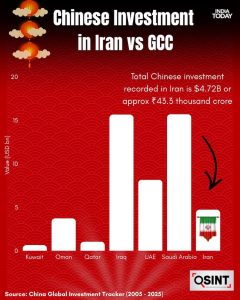
The economics make this design even more transparent. Figueroa highlights a relationship that looms large in headlines but remains small in terms of actual capital. China overtook the West as the largest trading partner with countries in the Gulf region in 2024. Chinese investment in Iran, he notes, remained a “paltry $185 million in 2023.” While trade recovered to roughly $25.3 billion, it is still only half of its 2014 peak. In stark contrast, China invested over $25 billion in Saudi Arabia alone, with trade with the GCC (Bahrain, Kuwait, Oman, Qatar, Saudi Arabia, United Arab Emirates) estimated to surge over $500 billion. These are the countries currently at the receiving end of the Iranian drones and missiles.
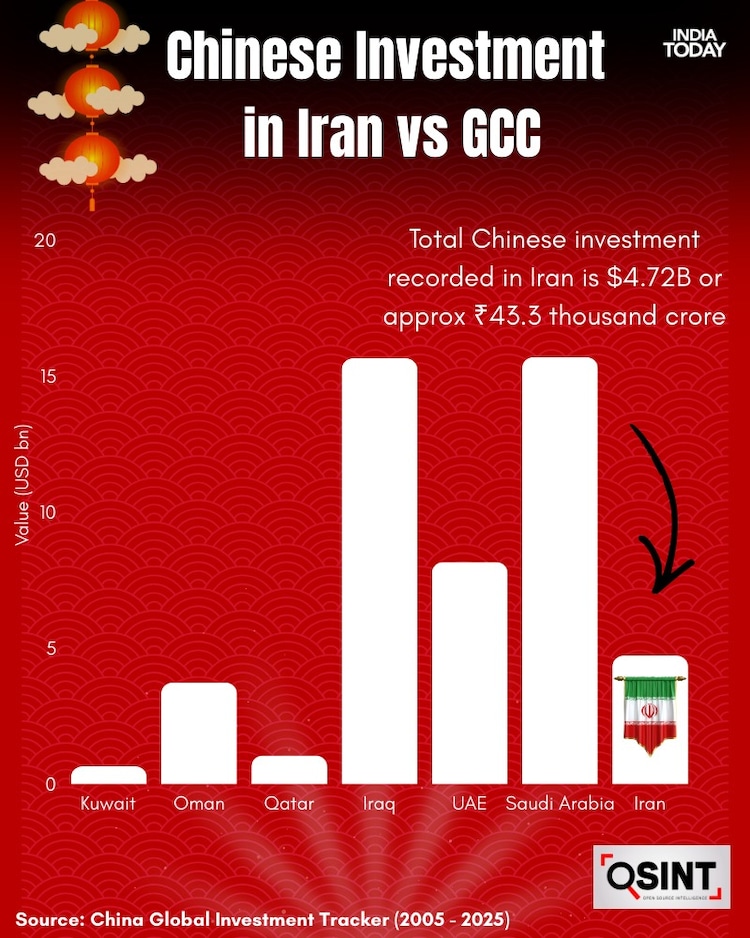
This lopsided balance sheet explains why Beijing can talk like a partner while acting like a hedger. Aboudouh describes China as “a lifeline for the Iranian economy,” pointing out that in 2025, China purchased “more than 80 per cent” of Iran’s shipped oil at a discount. However, he also highlights the constraint: a regional war threatens vital shipping lanes and could force Iran into striking Gulf states—“where China’s commercial interests far outweigh its ties with Tehran.”
For what it’s worth, there is a consistency in Beijing’s approach. Venezuelan President Maduro who once considered himself as a key ally of China while selling most of his country’s oil to Beijing, is a perfect example. The Chinese oil money accounted for over half of Venezuela’s fiscal revenue, amid U.S. sanctions. Venezuela was also the largest purchaser of Chinese military equipment in Latin America but that did not prevent Maduro from being picked up by the US military from his bedroom, nor did it cause an aggressive response from China.
This is the essence of the Chinese long game: maximise leverage, minimise liability. Aboudouh argues that Beijing views “a weakened Iranian regime as both a risk and an opportunity.” It does not desire a total collapse, but it is perfectly willing to “capitalise on Iran’s weakness” to deepen its dependence.
Feigenbaum frames the reality even more coldly: China is the largest trading partner to more than 120 countries and “doesn’t hinge its policy” in a region “on just one state.” Afghanistan is another example, since the evacuation of the US forces, Chinese companies have looked to exploit the mineral reserves of the war torn country.
Ultimately, the story that began with a train—and was bolstered by missile headlines and satellite imagery—ends in a manner far less cinematic. China is not absent; it is simply present in the way a creditor is present, playing an extremely long geopolitical game.