
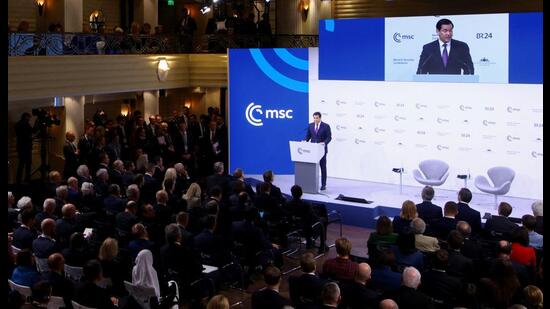
There are good reasons to take a close look at US secretary of state Marco Rubio’s Munich speech, delivered two weeks before the attack on Iran. It provides some explanation for President Trump’s roller coaster approach to international relations. Secondly, it is a window into the mind of Trump’s top diplomat, supposedly a saner MAGA voice, and a hopeful for the next Republican nomination.
The speech, which evoked a collective sigh of relief — and a standing ovation — is packaged to salve the wounded self-esteem of European leaders after Trump’s constant sniping at their “free-loading” and Vice President Vance’s harangue of a year ago. All that comes, Rubio asserts, from a place of deep caring because the transatlantic bond is essentially spiritual and cultural. It is rooted in their “shared inheritance” of “the greatest civilisation in human history”. By this, Rubio means the Western civilisation, the same elusive notion which Gandhi famously thought “would be a very good idea,” and is founded on “Christian faith, culture, heritage, language, ancestry”. The US being just 250 years old, the civilisational burden falls to the usual European suspects, all born within the last thousand years: Mozart and Michelangelo, Dante and Da Vinci, Beethoven and the Beatles. This civilisation is what Trump wants to defend, restore and renew.
But for this latter-day renaissance, much baggage has to be shed. A globalised world, free and unfettered trade and global supply chains are debunked as “dangerous delusions”. The “new Western century” needs a self-dependent reindustrialisation based on “a Western supply chain for critical minerals”. Mass migration must be resisted as it is an “urgent threat to the fabric of our societies and the survival of our civilisation itself”. Missing the irony, Rubio, whose parents migrated from Cuba in 1956, declares that America was built by migrants: English, Scottish and Irish settlers; German farmers; French fur traders.
The West must rebuild its collective strength, casting aside the “fear of climate change, fear of technology, fear of war” and resisting the forces of “civilisational erasure”. There is nostalgia for pre-1945 Western domination when the “West had been expanding — its missionaries, its pilgrims, its soldiers, its explorers pouring out from its shores to cross oceans, settle new continents, build vast empires extending out across the globe”. It was only “godless communist revolutions” and “anti-colonial uprisings” that unfortunately stemmed this supposedly benevolent imperial charge.
There is more, but this is enough to read the writing on the wall. This is a dark, dangerous statement based on a selective understanding of political realities. It references 5,000 years of recorded history but mentions no other civilisation except the “unique and distinctive and irreplaceable” Western civilisation. The West is painted as a hapless victim of globalists, immigrants, ineffective international institutions and “abstractions of international law”. Rubio fails to note the culpability of the veto-wielding powers for the hobnailed United Nations. Nor does he address the causes of mass migration, most glaringly the wars engendered by the West; further, he ignores the science behind the climate crisis and scoffs at the “climate cult”.
Most shockingly, the statement laments the passing of empires and romanticises imperialism; it ignores the massacres and loot of colonialism. It denigrates self-determination and anti-colonial movements, of which India’s was the most remarkable. While worrying about the West’s civilisational erasure, Rubio ignores the civilisational erasure of the colonies. Just when some reluctant recognition of colonial excesses was emerging, Rubio wants the West to stop atoning for “the purported (!) sins of past generations” and to drop all “guilt and shame”. Instead, he becomes a supremacist and wants to drop “the polite pretence that our way of life is just one among many”.
Recent events form unmistakable patterns in this narrative: The defunding of international institutions, the ending of life-saving humanitarian aid, the disregard for international law, the grab-as-can approach — Gaza’s real estate, Venezuela’s oil, if not Greenland, at least Diego Garcia. The vision promotes a Fortress West guarded by modern-day crusaders against the world’s unwashed masses. Unsurprisingly, the only reference to the Global South is to its markets.
It is uncertain how much Europe will buy into Rubio’s message of Western supremacy. The initial relief has already subsided: Eroded trust cannot be fully recouped by sweet talk. Our concern should be closer home. We should smell the passing whiff of this bitter coffee and recognise this approach for what it is: Narrow and self-centred, imbued with civilisational superiority and impelled by imperial ambition.
Navtej Sarna is the author, most recently, of A Flag to Live and Die for. The views expressed are personal


