
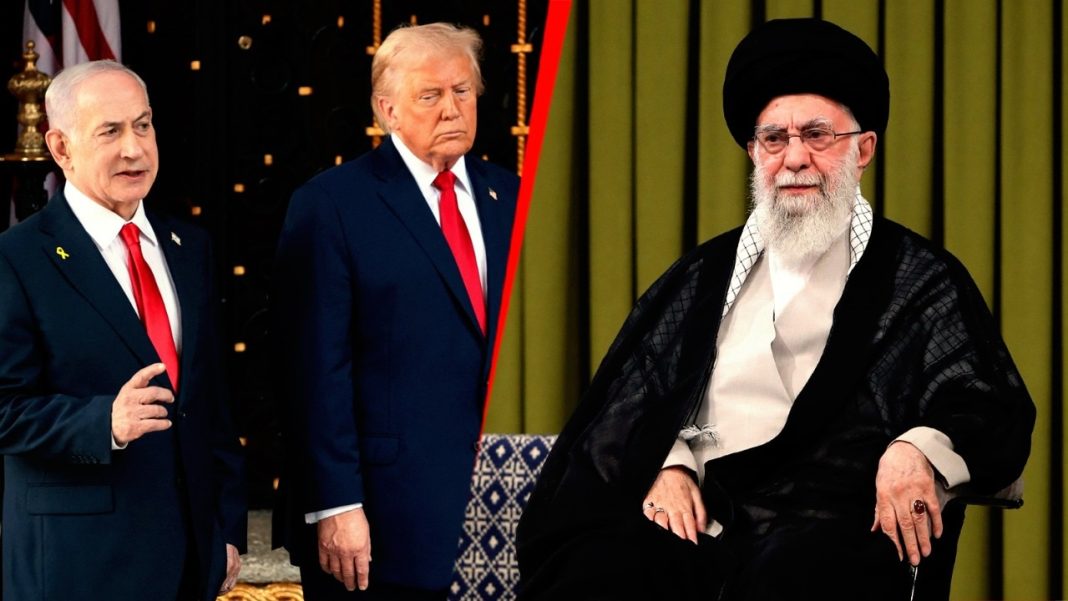
The seeds of Saturday’s operations in Iran were planted in late December, when Israeli Prime Minister Benjamin Netanyahu visited Trump at Mar-a-Lago. Anti-regime protests had just begun in Iran, and it wasn’t yet clear how significant they would become. Netanyahu used the meeting to discuss a follow-up to last year’s joint strikes — mostly focused on Iran’s ballistic missile capabilities — tentatively planned for around May.
Within days, the calculus changed.
The regime cracked down with full force, killing thousands in Iran. “Help is on its way,” Trump wrote on Truth Social, urging protesters to take over government institutions.
On January 14, Trump was on the verge of ordering strikes but pulled back. Instead, he ordered a massive military buildup in the Middle East, and began secretly planning a joint operation with Israel.
Over the following weeks, the Mossad director visited DC twice, followed by the Israeli military intelligence chief and the IDF chief of staff — all coordinating what would become Operations Epic Fury and Roaring Lion.
THE OTHER TRACK
At the same time, Trump explored whether military leverage could produce a deal with Iran on his terms.
The US and Iran met in Oman in early February for the first time since last June’s 12-day war. Days later, Netanyahu travelled urgently to Washington to discuss US red lines in the negotiations — and whether the US and Israel would launch a joint military operation if talks failed.
From the start, Trump’s envoys Jared Kushner and Steve Witkoff were sceptical about the chances of getting a deal — but three US and Israeli officials stressed that initial nuclear talks in Geneva were not a complete ruse.
Trump wanted to try to reach an agreement, and the Iranians were told explicitly that military strikes “would occur if we did not see real progress on a real deal very quickly,” a US official said.
BETWEEN THE LINES
A week before the Geneva meeting, the US and Israel agreed on a potential window for launching the attack — the coming Saturday, when Khamenei held a routine meeting with his top aides at his government compound.
But they faced a specific challenge: keeping Khamenei from suspecting anything and retreating to his underground bunker.
An Israeli intelligence official said an Axios story that mentioned the possibility of assassinating Khamenei created anxiety among military planners — but the Iranian leader didn’t change his plans.
THE FINAL TALKS
When Kushner and Witkoff travelled to Geneva on Thursday, they already suspected there was no deal to be had, but still went through with the meeting. That kept the Iranians believing diplomacy was alive.
“One of the rules of deal-making is that you have to know very quickly if there’s a deal to do or not,” a US official said.
In the room, the Iranians hadn’t come close to even the most flexible US position. After the first session, Kushner and Witkoff called Vice President JD Vance on a secure line and told him the gaps were still wide. A second round that evening changed nothing.
“Kushner and Witkoff saw that the Iranian proposal was bullshit and only meant to buy time,” a senior US official said. “There wasn’t any ‘there’ there to work with.”
Another official summed up Iran’s strategy as “games, tricks, stall-tactics” from the start. “We reported this to the president and obviously he weighed the different options,” the official said.
ZOOM IN
US officials said there were three areas they could not get Iran to agree on.
1.Nuclear program and enrichment activities: The US offered Iran free nuclear fuel for a civilian nuclear program — indefinitely — in exchange for giving up enrichment. The Iranians said no. “It was a big tell,” one official said.
2. Ballistic missile program: The Iranians refused “in every instance” to discuss their missile capabilities. “We cannot continue to live in a world where these people not only possess missiles but the ability to make 100 of them a month in perpetuity, to overwhelm any potential defences,” one official said.
3. Financing of regional proxies: Iran also refused to address its financing of militant groups across the region, which the US and Israel say have destabilised the Middle East for decades.
BEHIND THE SCENES
Before and during the talks, US officials said intelligence made clear Iran was already rebuilding the nuclear facilities that Trump claimed were “obliterated” in Operation Midnight Hammer last June.
When Kushner and Witkoff asked for a concrete proposal, the Iranians produced a seven-page document outlining enrichment needs they claimed were for civilian purposes. Trump’s team checked the numbers with the UN’s nuclear watchdog. “This would result in enrichment capability roughly five times more than laid out in the [2015 nuclear deal],” one official said.
Officials also said Iran had been secretly stockpiling enriched material at the Tehran Research Reactor under the guise of medical research.
“Never once did they use any of the fissionable material there to make even a single medicine,” one official said. “It was all designed to deceive.”
REALITY CHECK
This account is based largely on statements by US and allied officials in the aftermath of the strikes, and could not immediately be verified by independent sources.
The final hours: After Geneva, Oman’s foreign minister flew urgently to Washington and met with Vance on Friday in a last-ditch attempt to delay Trump’s decision.
But the president had already made up his mind.
When an Arab official asked Witkoff on Friday whether an attack was imminent, the White House envoy dodged the question.
On Saturday morning, Khamenei convened his aides as US and Israeli planners had anticipated.
Two other gatherings of Iranian security and intelligence officials were taking place above ground in Tehran at the same time. Minutes later, all three were struck simultaneously.
“If the Iranians had come to Geneva and given Trump what he wanted, he would have pulled the brakes on the military track. But they were arrogant and thought he wouldn’t take action,” an Israeli intelligence official said. “They were wrong.”


