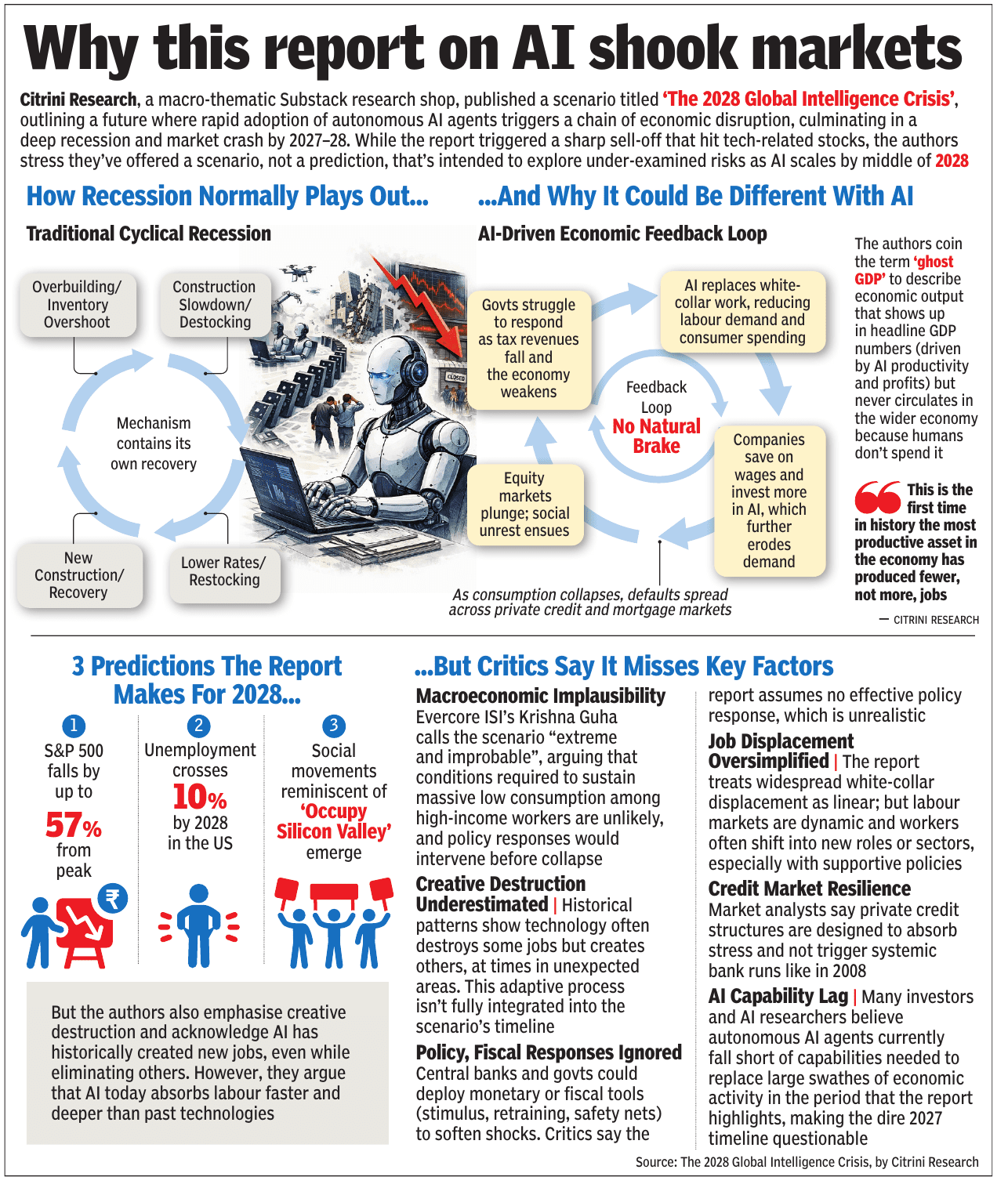
Citrini Research, a macro-thematic Substack research shop has published a scenario titled “The 2028 Global Intelligence Crisis. ” It outlines a future in which rapid adoption of autonomous AI agents sets off a chain of economic disruption, potentially leading to a deep recession and market crash by 2027–28.
The report triggered a sharp sell-off in tech-related stocks. However, the authors stress that this is a scenario is not a prediction but designed to explore under-examined risks as AI scales by mid-2028.
-
Overbuilding/Inventory Overshoot
-
Construction Slowdown/Destocking
-
New Construction/Recovery
-
Lower Rates/Restocking
In a typical cycle, excess supply leads to slowdown, followed by rate cuts and eventual recovery.
The report argues that AI could create a very different downturn:
-
AI replaces white-collar work, reducing labour demand and consumer spending
-
Governments struggle to respond as tax revenues fall and the economy weakens
-
Equity markets plunge; social unrest ensues
-
Companies save on wages and invest more in AI, which further erodes demand
The authors introduce the term “ghost GDP” to describe economic output that appears in headline GDP numbers driven by AI productivity and profits, but does not circulate in the wider economy because humans do not spend it.
As the report states, “This is the first time in history the most productive asset in the economy has produced fewer, not more, jobs.”
As consumption collapses, the report warns that defaults could spread across private credit and mortgage markets.
The scenario outlines three major outcomes:
-
Unemployment crosses 10% by 2028 in the US
-
Social movements reminiscent of “Occupy Silicon Valley” emerge
At the same time, the authors acknowledge creative destruction and note that AI has historically created new jobs even while eliminating others. However, they argue that AI today absorbs labour faster and deeper than past technologies.
Several analysts argue that the scenario overlooks key economic realities.
Evercore ISI’s Krishna Guha calls the scenario “extreme and improbable”, saying the conditions required to sustain massive low consumption among high-income workers are unlikely. He argues policy responses would intervene before any collapse.
Historical patterns show that technology often destroys some jobs but creates others — sometimes in unexpected sectors. Critics say this adaptive process is not fully reflected in the report’s timeline.
Central banks and governments could deploy monetary or fiscal tools such as stimulus, retraining, and safety nets to soften shocks. Critics argue the report assumes no effective policy response, which they see as unrealistic.
The report treats widespread white-collar displacement as linear. Analysts counter that labour markets are dynamic, and workers often shift into new roles or sectors, especially when supported by policy measures.
Market experts note that private credit structures today are designed to absorb stress and are unlikely to trigger systemic bank runs like in 2008.
Many investors and AI researchers believe autonomous AI agents currently fall short of the capabilities required to replace large parts of economic activity within the 2027 timeline, making the most severe projections questionable.
Citrini Research maintains that the paper is not a prediction but an exploration of potential risks as AI scales rapidly. Whether the “AI-driven feedback loop” materialises or is offset by innovation, policy, and labour market adaptation remains at the centre of the debate.