
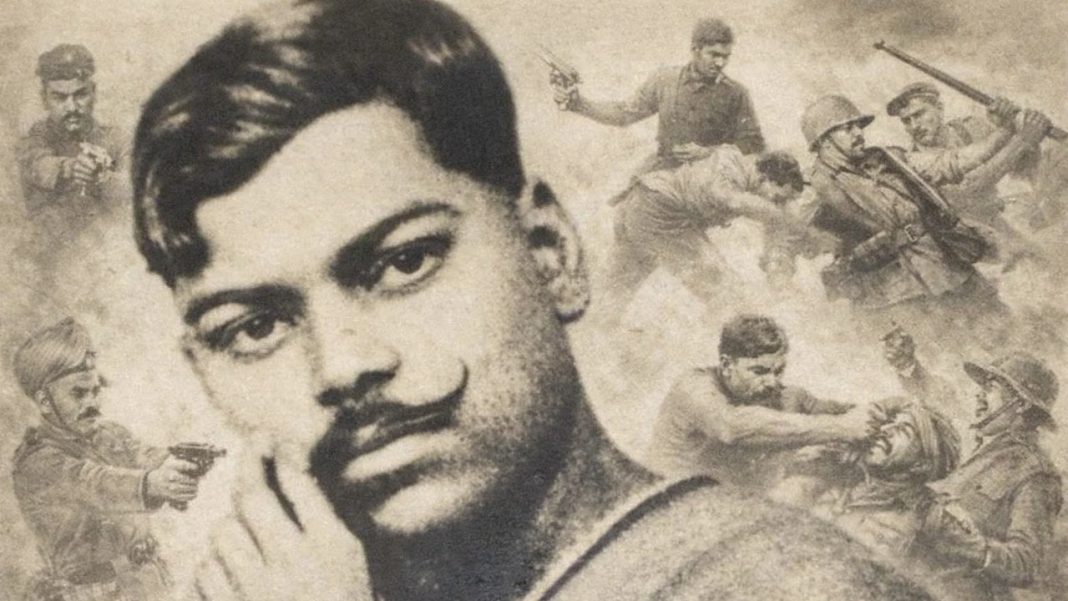
He died the way he had promised he would live – free.
“Dushman ki goliyon ka hum saamna karenge. Azad hi rahe hain, Azad hi rahenge.”
On the morning of February 27, 1931, in Alfred Park in Allahabad, Chandrashekhar Azad stood surrounded by British police. The encounter was swift. The end, inevitable. When his ammunition ran out and capture became certain, Azad kept his final vow. He would never be taken alive.
Years earlier, when asked about his identity in court, the young revolutionary had given an answer that would define his life.
At the age of 15, he was arrested during the Non-Cooperation Movement and brought before a magistrate.
“What is your name?” the judge asked.
“Azad,” he replied–meaning Free.
“What is your father’s name?”
“Swatantra,” he said–meaning Independent.
“Where do you live?”
“Jail.”
THE BOY WHO BECAME ‘AZAD’
Chandrashekhar Tiwari (Azad) was born on July 23, 1906, in Bhavra, a small village in a poor family in present-day Madhya Pradesh. Poverty was not an abstraction in his life; it was routine.
Early lessons in Azad’s life did not come from classrooms but in the open fields. Playing with Bhil tribal boys, he learned archery.
Azad’s first act of rebellion surfaced early. During his brief stint at a government office, he refused to perform the customary gesture of bowing before British officials, a ritual of submission expected from Indian employees under colonial protocol.
That direction arrived in Banaras.
In 1921, at just 15, he joined Mahatma Gandhi’s Non-Cooperation Movement. During a protest, he was arrested and brought before a magistrate.
The magistrate sentenced him to fifteen lashes. With each stroke, the boy shouted, “Mahatma Gandhi Ki Jai.”
The name stayed. Chandrashekhar Tiwari had become Chandrashekhar Azad.
Like many young men displaced by circumstance, he migrated in search of livelihood. Bombay, then the nerve centre of colonial commerce, became his first classroom in the realities of empire.
He worked at the docks as a coolie and ship hand, part of the invisible labour force that sustained imperial trade. His living conditions were harsh, overcrowded quarters, poor ventilation, and relentless physical work.
On Sundays, he sought refuge in cinema halls, where for a few hours he could detach himself from the grind of survival. The city, however, offered more than employment.
FROM NATIONALIST TO UNDERGROUND COMMANDER
The withdrawal of the Non-Cooperation Movement by Gandhi left Azad disillusioned. For him, political negotiation seemed insufficient. He moved towards the underground network of revolutionaries led by Ram Prasad Bismil and Sachindranath Sanyal.
Education did not come easily to him. He struggled with reading but compensated with discipline. Comrades read to him from books on Giuseppe Garibaldi, the Irish revolutionaries, Shivaji, and the Russian revolution.
In 1925, he joined the famous Kakori train robbery. Even though many commarades were captured, Azad escaped.
He lived in disguise in Jhansi, sometimes as a sadhu, sometimes as a mechanic. His ability to evade capture earned him a nickname among comrades, “Quicksilver.”
With senior leaders gone, responsibility fell on his shoulders. He was barely in his twenties. It was then he came in contact with Bhagat Singh.
In September 1928, at a secret meeting in Delhi’s Feroz Shah Kotla ruins, the Hindustan Republican Association was reorganised as the Hindustan Socialist Republican Association (HSRA). Azad was appointed commander-in-chief.
The HSRA carried out two actions that shook the empire, the assassination of British officer JP Saunders in Lahore and the Central Assembly bombing by Bhagat Singh and Batukeshwar Dutt.
Both events electrified Indian youth. Both also brought severe repression.
Azad remained underground, reorganising the network.
Azad’s thinking was evolving. He spoke increasingly about peasants and workers. The plan to send comrades to the Soviet Union for training came from him.
He wore disguises. As a priest. As a labourer. As a Pathan. Religious symbols were tools, not beliefs.
THE FINAL ENCOUNTER WHEN FEW BULLETS LEFT IN THE PISTOL…
By 1931, the revolutionary network had weakened. Bhagat Singh was in prison. Many others were dead or captured. Azad was alone, but still active.
On February 27, he arrived at Alfred Park to meet a contact. Police surrounded him. A gunfight followed. He held them off as long as he could.
When only one bullet remained, with tears in his eyes and “Bharat Mata” on his lips, he sought forgiveness for not being able to free Mother India and used the final bullet on himself.
He was 24.
Today, Chandrashekhar Azad is remembered as a man who chose death over surrender. But he was more than that final act.
He was a dockworker who saw injustice first-hand. A boy who defied a magistrate. An organiser who rebuilt a broken movement. A commander who believed freedom required sacrifice, and change.
a name he had chosen for himself – Azad.


