
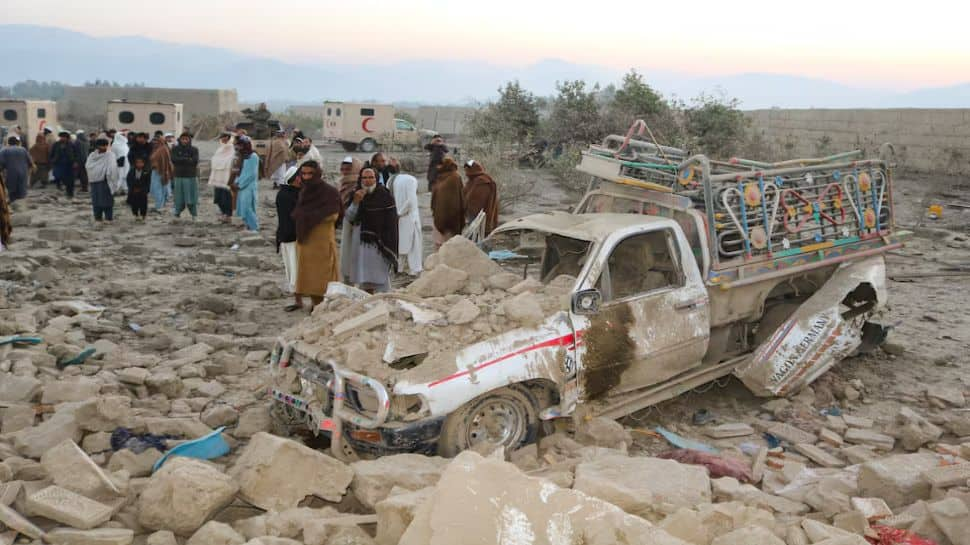
Kabul: Afghanistan’s interim Taliban government has strongly reacted to recent Pakistani air strikes carried out in eastern provinces. The Afghan defence ministry condemned the attacks and stated that a fitting reply would be given at an appropriate time.
In a statement issued on February 22 on X, the strikes were described as a criminal act and a violation of Afghanistan’s sovereignty and Islamic values. The ministry stated that protecting national sovereignty and the safety of citizens was both a national and religious duty and that the action would receive a timely response.
Pakistani military officials stated that the air strikes targeted seven locations linked to Tehreek-e-Taliban Pakistan (TTP) and other militant groups across Nangarhar, Paktika and Khost provinces. They claimed more than 80 militants were neutralised in the attack. On the contrary, Taliban authorities stated that civilians, including women and children, lost their lives in the attacks.
Relations grow tenser
Pakistan’s leadership stated that authorities were aware of the locations of militants and their supporters and warned that those responsible for attacks inside Pakistan would not escape accountability if violence continued.
Since the Taliban takeover of Afghanistan in August 2021, Pakistan has conducted several cross-border strikes, followed by repeated clashes along the border between the two countries. Islamabad has continued to accuse the Afghan Taliban administration of allowing the banned TTP to operate from Afghan territory. Taliban officials have rejected the allegation and said that militancy inside Pakistan was an internal matter.
Recent tensions have further soured relations that were already fragile following border clashes last year and a ceasefire reached through mediation by Qatar and Turkey.
The latest developments have raised questions about possible escalation and military capacity of the Taliban to respond.
No immediate prospect of conventional war
Security observers following Afghan affairs assessed that a conventional war between Pakistan and Afghanistan seems unlikely at present. The pattern of events was described as recurring, with strikes followed by limited retaliation, border tension and diplomatic engagement. Air strikes were viewed as serious actions that often triggered political messaging and controlled responses rather than large-scale conflict.
The observers said Afghanistan lacks the military structure required for a traditional war. Large-scale operations would require air power, stable supply chains and fully trained formations. Present economic conditions and available resources suggests that any response would be limited and disruptive in nature rather than military escalation on a broad front. A retaliatory move is still expected because public perception and internal legitimacy carried importance.
Another assessment stated Pakistan has already used diplomatic channels to persuade the Taliban administration to act against the TTP. Concerns about militant safe havens inside Afghanistan had also appeared in multiple United Nations reports since 2023. After the use of diplomatic options, Pakistan viewed force as a necessary step.
The analysts described internal conditions inside Afghanistan as difficult, with governance and economic pressures affecting daily life. Many Afghan households have been reported to be selling belongings to survive. External tensions are seen as a way to maintain internal unity during periods of pressure. Concerns also exist that action against the TTP could push fighters toward Islamic State affiliates, which had happened earlier.
Possible nature of retaliation
Security assessments suggest that any Taliban response would likely rely on indirect methods. Resources linked to militant networks could be used to increase pressure through attacks targeting civilian areas inside Pakistan.
Analysts asses that the Taliban lacks the capacity for direct conventional confrontation and would instead rely on asymmetric tactics similar to earlier conflicts.
An increase in militant violence in Pakistani urban centres is considered a possible outcome. Limited border clashes, symbolic strikes and stronger political statements are viewed as more likely scenarios in the near term.
Past patterns showed that controlled responses were often used to show retaliation to domestic audiences. Limited artillery exchanges along the border are a possibility.
Afghanistan’s military capability
The Taliban administration controls weapons from three main sources. These include equipment inherited from the former Afghan army, weapons left behind after the withdrawal of foreign forces and additional arms obtained through informal markets.
Previous border clash footage showed that Taliban fighters mainly used light weapons. Evidence of long-range or heavy systems appears limited. Reports from reconstruction and defence oversight bodies earlier stated that more than 1.6 million weapons and pieces of equipment had been supplied to the former Afghan government, with a large portion later falling into Taliban hands.
Present inventories include Kalashnikov rifles, American-made M-16 and M-4 rifles and light machine guns. Heavy machine guns, grenade launchers and rocket systems such as RPG-7 and anti-tank weapons are also present. Heavy equipment inherited after the withdrawal included armoured vehicles and artillery systems such as D-30 howitzers. Estimates suggest that between 100 and 120 such guns are inside Afghanistan.
Additional systems include mortars, older Soviet-era weapons and anti-aircraft platforms. During a military parade at Bagram Air Base in 2024, the Taliban displayed heavy systems, including Scud-type missiles with an estimated range of about 300 kilometres. Some of these weapons have been unused for decades and their operational readiness is unclear.
Pakistan enjoys a major advantage in air power and modern combat aircraft. The Taliban administration does not possess a comparable air force. Several helicopters have been repaired and pilots retrained, though air-to-air combat capability is absent.
Reports indicate that aircraft left behind include C-208 planes, MD-530 and MD-500 helicopters, Black Hawk helicopters, A-29 aircraft and Mi-17 and Mi-24 helicopters. Taliban authorities claimed control over around 60 aircraft and helicopters.
Long experience in guerrilla warfare
After nearly two decades of fighting against United States, NATO and former Afghan government forces, the Taliban developed extensive guerrilla warfare experience. Security assessments indicate that this is the foundation of their military approach. Evidence from recent clashes suggest that Taliban fighters continue to operate as lightly armed guerrilla formations rather than a structured regular army.
Their strategy relies on ambush tactics and surprise attacks. Field-level commanders have operational flexibility based on local conditions, while central leadership issues broad directives. Observers assess that the Taliban has not so far transformed into a conventional military force and continue to depend on guerrilla methods, while Pakistan has a regular army structured for large-scale warfare.


