
In October 2020, during a virtual interaction with Danish wind energy giant Vestas, Prime Minister Narendra Modi suggested that wind turbines could suck moisture from the air to generate clean drinking water.
Fast-forward to February 2026, and science has achieved that very goal through the work of a Nobel laureate.
As first reported by The Guardian, the Nobel laureate has unveiled an industrial machine that harvests water from the driest air on Earth.
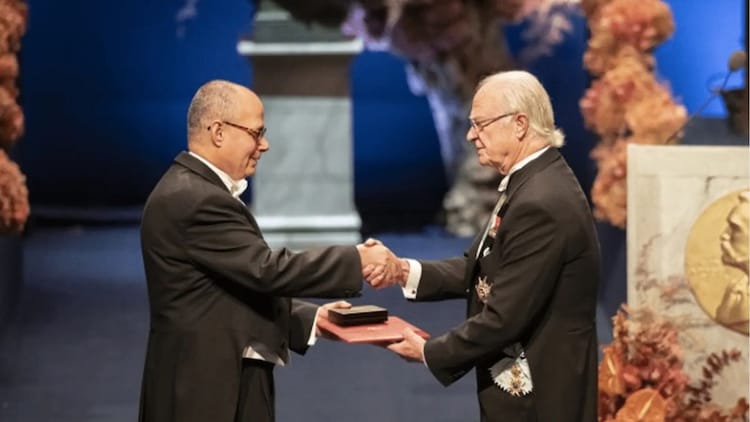
Professor Omar Yaghi, the 2025 Nobel Prize winner in Chemistry, has turned the tide with his company Atoco, a California-based deep-tech firm specialising in atmospheric water harvesting and carbon capture using atomic-scale precision.
Put simply, Yaghi has built a company that creates molecular traps to grab water and carbon directly from the sky with extreme accuracy. By using a breakthrough called reticular chemistry, the Nobel laureate is transforming what was once a subject of political mockery into a vital lifeline for a thirsty planet.
WHAT IS THE SCIENCE OF RETICULAR CHEMISTRY?
The heart of this breakthrough lies in reticular chemistry, a discipline that involves stitching together molecular building blocks into expansive, crystalline structures known as Metal Organic Frameworks (MOFs).
Think of these as the world’s most advanced molecular sponges, but instead of cleaning a kitchen counter, they are designed to soak up invisible gases and moisture from the air.
Their internal architecture is so intricate that a single gram of the material, which is hardly the weight of a paperclip, possesses an internal surface area large enough to cover several football fields.
These are nano-engineered materials, which means scientists have designed them at a scale 1,00,000 times smaller than the width of human hair.
At this microscopic level, they can build custom-made chemical pockets that act like tiny rooms specifically sized to fit water molecules.
Unlike traditional atmospheric water generators (AWGs) that rely on energy-intensive cooling to reach the dew point, Yaghi’s materials use adsorption.
To understand why this matters, we have to look at how we usually get water from air.
Most machines use the dew point, which is the exact temperature where air gets so cold that it can no longer hold moisture, forcing it to turn into liquid droplets, much like the fog we see on a cold window or a chilled soda can. This takes a massive amount of electricity.
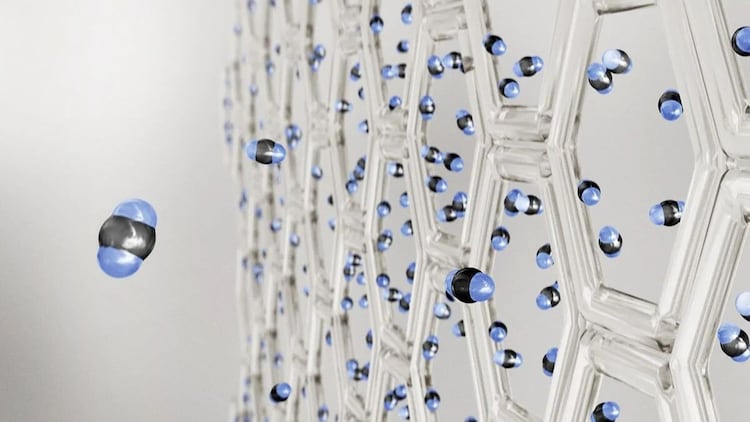
Adsorption, however, is a much more natural and elegant process. Instead of forcing the air to get cold, the water molecules are simply glued to the surface of a material because they are chemically attracted to it.
This shift in approach is the secret to the efficiency of Yaghi’s technology. By removing the need to refrigerate massive amounts of air, the system avoids the huge energy bills and heavy, noisy machinery that make old-school water harvesters impractical.
Instead, these molecular sponges do the work for free, using their natural hunger to pull in water even when the air feels bone dry. It turns a forced, high-energy mechanical struggle into a quiet, natural chemical process.
HOW DOES ATMOSPHERIC HARVESTING WORK IN ARID REGIONS?
The true struggle of previous atmospheric water generators has been their dependence on high humidity. Most fail when relative humidity drops below 45 per cent, leaving desert communities stranded.
However, Atoco has designed its technology to be resilient, functioning efficiently even in environments with less than 20 per cent humidity.
This means it can produce water in places where it almost never rains and where the air feels like a furnace.
Closer to home, the same vision is being driven by AKVO, an Indian cleantech company that pioneered indigenous Atmospheric Water Generators. Unlike Yaghi’s deep-tech molecular sponges, AKVO utilises advanced condensation technology to provide sustainable water security across India.
Navkaran Singh Bagga, CEO and Founder of AKVO, explains the core of this industry.
“Atmospheric Water Generators produce drinking water by extracting moisture present in ambient air. The system draws in air, filters out dust and pollutants, and cools it below its dew point, causing water vapour to condense into liquid form,” Bagga tells indiatoday.in.
“The collected water then undergoes multi-stage purification, including carbon filtration, UV sterilisation, and mineral balancing, to ensure it meets potable standards,” Bagga adds.
This process ensures that the water generated is not just available, but safe and healthy for consumption.
While high-end lab materials like MOF-303 tackle the extreme dry environment in deserts, commercial units like those from AKVO are already making an impact in India’s diverse climates.
From providing water to 1,500 residents in Hardua Mangarh, Madhya Pradesh, to powering industrial sites like the Haldia refinery, the technology is already on the ground.
Bagga notes that “output depends on temperature and relative humidity, with higher efficiency in warm, humid climates.”
The science behind finding water in these bone-dry regions lies in the specific chemistry of MOF-303, a material developed by Yaghi’s team.

In a desert, water molecules are scarce and spread out. Traditional systems cannot catch them because the air is not wet enough to condense.
However, MOF-303 has specific adsorption sites, which are essentially chemical magnets that are so powerful they can pluck individual water molecules out of the air even at 10 per cent humidity.
Once these molecules enter the framework, they group together into tiny clusters, making it easy to release them later as water with just a little bit of heat.
These units are designed for ultimate decentralisation. In the world of water, decentralisation means moving away from massive, expensive central plants and miles of underground pipes.
Instead of building a multi-billion dollar reservoir that a village might be too far to reach, you bring the factory to the person.

It is the difference between a massive mainframe computer in a basement and the smartphone in your pocket. A single machine, roughly the size of a standard shipping container, can pull 1,000 litres of clean water out of thin air every single day.
Because the system can run entirely on the heat from the Sun, it does not need a power grid or pipes.
It provides a water-in-a-box solution that can be dropped into a remote village or a desert outpost and start working immediately, making every community its own independent water producer.
WHY IS THIS A NEW ERA FOR WATER RESILIENCE?
As the planet enters what the UN calls a global water bankruptcy era, with 2.2 billion people lacking safely managed drinking water, the ability to generate water exactly where it is needed is a game-changer.
Research confirms that the amount of water in the air is six times the volume of all the world’s rivers combined. The water captured this way is incredibly pure because it comes from the atmosphere, avoiding the pollutants and salts found in the ground or seawater.
As a decentralised solution, AKVO’s machines are built for immediate impact. “AWGs reduce dependence on groundwater, tanker supply, desalination, and bottled water, offering a climate-resilient alternative for water-stressed regions,” says Bagga.
Professor Yaghi, who grew up in a refugee community in Jordan with no running water, has dedicated his career to ensuring the next generation does not face the same thirst.
By reimagining matter at the atomic level, we are now able to provide water security to the most vulnerable.
This innovation based on reticular chemistry, the field for which Professor Yaghi won his Nobel, holds the promise of becoming a pillar of global survival.
We are no longer waiting for the rain; we are harvesting it from the very air we breathe.