
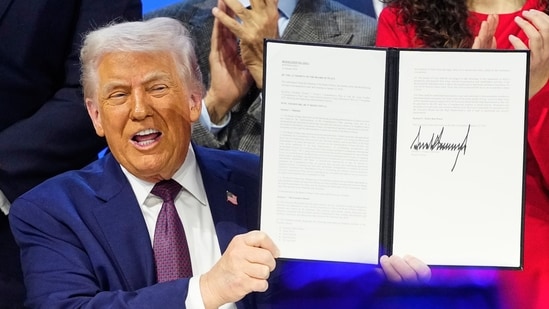
US President Donald Trump’s Board of Peace is set to meet for the first time on Thursday in Washington, an early test of whether one of his marquee foreign policy initiatives can gain broad support and advance the shaky ceasefire agreement in the Gaza Strip.
Trump’s ballooning ambitions for the board extend from governing and rebuilding Gaza as a futuristic metropolis to challenging the United Nations Security Council’s role in solving conflicts. But they could be tempered by the realities of dealing with Gaza, where there has so far been limited progress in achieving the narrower aims of the ceasefire.
Palestinians, including many civilians, are still being killed in near-daily strikes that Israel says are aimed at militants who threaten or attack its forces. Hamas hasn’t disarmed, no international forces have deployed, and a Palestinian committee meant to take over from Hamas is stuck in neighboring Egypt.
“If this meeting does not result in fast, tangible improvements on the ground — and particularly on the humanitarian front — its credibility will quickly crumble,” said Max Rodenbeck, Israel-Palestine Project Director at the International Crisis Group, a global think tank.
A new international body
More than two dozen nations have signed on as the board’s founding members.
The list includes Israel and other regional heavyweights involved in ceasefire negotiations, as well as countries from outside the Middle East whose leaders support Trump or hope to gain his favor. US allies like France, Norway and Sweden have so far declined.
Israelis are suspicious of the involvement of Qatar and Turkey, which have longstanding relations with Hamas. Palestinians object because their representatives weren’t invited to the board, even as it weighs the future of a territory that is home to some 2 million of them.
Trump, the self-appointed chairman of the board, said earlier this week that member countries had pledged $5 billion toward rebuilding Gaza and would commit thousands of personnel to peacekeeping and policing. No financial pledges — or an agenda for this week’s meeting — have been made public.
“We want to make it successful. I think it has the chance to be the most consequential board ever assembled of any kind,” Trump told reporters on Monday. He reiterated his criticism of the U.N.’s record on resolving international disputes.
Ambitious plans
Trump — along with son-in-law Jared Kushner and envoy Steve Witkoff — has laid out ambitious plans for rebuilding Gaza with international investment.
In Davos last month, Kushner suggested reconstruction could be complete in a matter of three years, even though UN forecasts suggest that clearing rubble and demining alone could take much longer.
Kushner’s slides showed a reconstructed Gaza with a coastal tourism strip, industrial zones and data centers. He conceded that rebuilding would begin only in demilitarized areas and that security would be essential to attract investment.
The latest joint estimate by the UN, European Union and World Bank says reconstruction will cost about $70 billion.
Israeli Prime Minister Benjamin Netanyahu has said there will be no reconstruction until Hamas disarms, leaving Palestinians in limbo among the widespread devastation.
Halting progress
The ceasefire deal has halted major military operations, freed the last hostages held by Hamas and ramped up aid deliveries to Gaza. But a lasting resolution to the two-year war ignited by Hamas’ Oct. 7, 2023 attack into Israel remains elusive.
The deal envisions Hamas handing over its weapons and Israeli forces withdrawing from Gaza as international forces deploy. It left some questions unanswered and set no timeline to secure buy-in and defer confrontation over those issues.
Israel and the U.S. say Hamas’ disarmament is key to progress on the other fronts. Arab and Muslim members of the Board of Peace have accused Israel of undermining the ceasefire with its daily strikes and want the U.S. to rein in its close ally. They have called on Hamas to disarm but say Israel’s withdrawal is just as important.
Israel defines demilitarization as extending from heavy weapons like rocket-propelled grenades all the way down to rifles. Netanyahu said Sunday that Hamas would have to give up roughly 60,000 automatic rifles.
Despite accepting the agreement, Hamas has made only vague or conditional commitments to disarm as part of a process leading to the establishment of a Palestinian state. Senior Hamas officials have said their security forces need to retain some weapons in order to maintain law and order during the transition.
Some of the ideas under discussion include Hamas “freezing” its arms by placing them in sealed depots under outside supervision or giving up heavy weapons while keeping some handguns for policing, according to two regional officials involved in the negotiations. One official said disarmament is a complicated process that could take months. The officials requested anonymity to discuss the negotiations.
It’s far from certain that Israel or the United States would agree to such ideas.
A stabilization force
The ceasefire deal also calls for a temporary International Stabilization Force made up of soldiers from Arab and Muslim-majority countries to vet, train and support to a new Palestinian police force. Its mandate is not spelled out in detail, but would include securing aid deliveries and preventing weapons smuggling.
Countries being asked to contribute to the force insist that any deployment be framed as a peacekeeping mission. They have refused to take part in the disarmament of Hamas, a job that could put them in harm’s way. Another concern is the presence of armed groups allied with Israel.
Indonesia has begun training a contingent of up to 8,000 soldiers for the force, though its foreign minister said last week that they would not take part in disarmament.
Postwar governance
Under the ceasefire agreement, Hamas is to hand over power to a transitional committee of politically independent Palestinian administrators. The US has named a 15-member committee and tapped former UN envoy Nickolay Mladenov to oversee them as the board’s envoy to Gaza.
The committee, led by former Palestinian Authority deputy minister Ali Shaath, has not yet been granted Israeli permission to enter Gaza from Egypt. Israel hasn’t commented on the matter.
Mladenov said last week that the committee will not be able to work unless Hamas hands over power and ceasefire violations stop.
“We’re only embarrassing the committee and ultimately making it ineffective,” he said at the Munich Security Conference. “All of this needs to move very fast.”


