
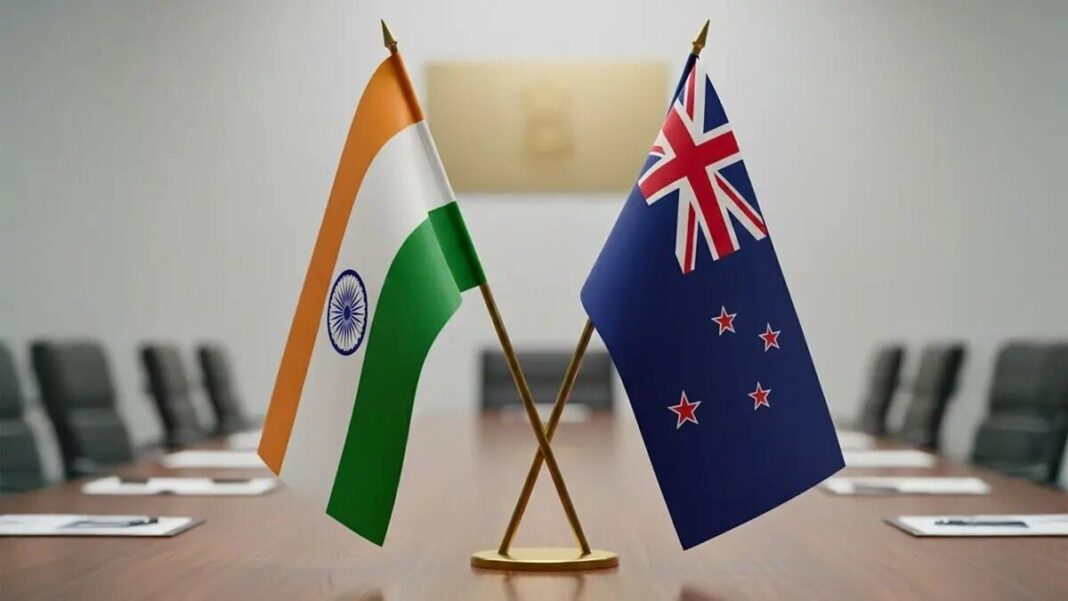
India’s newly signed free trade agreement (FTA) with New Zealand has been positioned as a big opportunity for exporters, startups and global trade expansion.
But industry experts say the benefits will not be automatic, especially for smaller businesses.
Siddharth Shankar, Global COO at Komerz Ltd and a trade finance expert, believes the agreement could be transformative—but only for those who are ready to operate at global standards.
FTAS OPEN DOORS, BUT CAPABILITY MATTERS
While the deal offers duty-free access for Indian exports, Shankar said tariffs were never the biggest hurdle for businesses.
“Tariff elimination sounds like a silver bullet, but the uncomfortable truth is that most MSMEs won’t benefit automatically,” he said.
He pointed out that many Indian MSMEs still lack consistency and technological integration.
“Global value chains today are technology-led, compliance-heavy, and ruthlessly efficient,” he said.
“If an MSME can’t deliver predictable quality, data visibility, and supply-chain discipline, zero tariffs won’t save them.”
According to him, only a small segment of businesses is likely to benefit immediately.
“Where this FTA could be transformative is for the top 15–20% of MSMEs that are already investing in automation and traceability,” he added.
FOOD PROCESSING PUSH NEEDS STRUCTURAL FIXES
One of the standout features of the agreement is the fast-track mechanism allowing Indian firms to import raw materials from New Zealand duty-free, process them, and re-export.
But Shankar cautioned against overestimating its impact.
“Duty-free inputs alone won’t make India a global food processing hub. Discipline will,” he said.
He flagged key issues in India’s logistics and distribution systems.
“Many networks still operate with outdated infrastructure and inconsistent cold chains,” he said.
“That may work domestically, but it collapses under global scrutiny.”
He added that real transformation would require investment in traceability, automation and data-driven decision-making.
FDI OPPORTUNITY, BUT WITH A WARNING
The agreement also includes a commitment from New Zealand to invest $20 billion in India over the next 15 years.
Shankar called this a strong signal but warned founders against misusing capital.
“This tells us that India is no longer just a market, but a long-term strategic partner for capital deployment,” he said.
However, he cautioned startups against excessive dilution.
“Indian founders must treat institutional capital as fuel, not ownership transfer,” he said.
“Too many startups fall into the ‘equity tragedy’—raising early and diluting heavily.”
TALENT MOBILITY A BIG POSITIVE
The FTA also allows 5,000 skilled visas for Indian professionals and introduces a working holiday visa.
Shankar said this goes beyond employment benefits.
“Cross-border mobility is not just a workforce issue—it is a strategic national capability issue,” he said.
He stressed that global exposure can strengthen India’s long-term competitiveness.
“When professionals work in global systems, they return with institutional knowledge, not just experience,” he added.
PROTECTED SECTORS REQUIRE SMART STRATEGY
India has kept sectors like dairy and agriculture protected under the agreement.
Shankar said companies must adapt rather than resist such policies.
“Strategic protection is not temporary—it’s political and structural,” he said.
He advised companies to localise operations.
“Resilience comes from designing business models that work alongside regulation, not against it,” he added.
With trade expected to grow significantly, Shankar said technology will play a critical role.
“If bilateral trade doubles, the real challenge won’t be demand—it will be orchestration,” he said.
He emphasised the need for AI-driven systems.
“Supply chains must become predictive, not reactive—anticipating demand and optimising flows,” he said.
Shankar believes the FTA has the potential to reshape India’s global trade position—but only if execution matches ambition.
“FTAs open doors—but only the prepared walk through them,” he said.


