
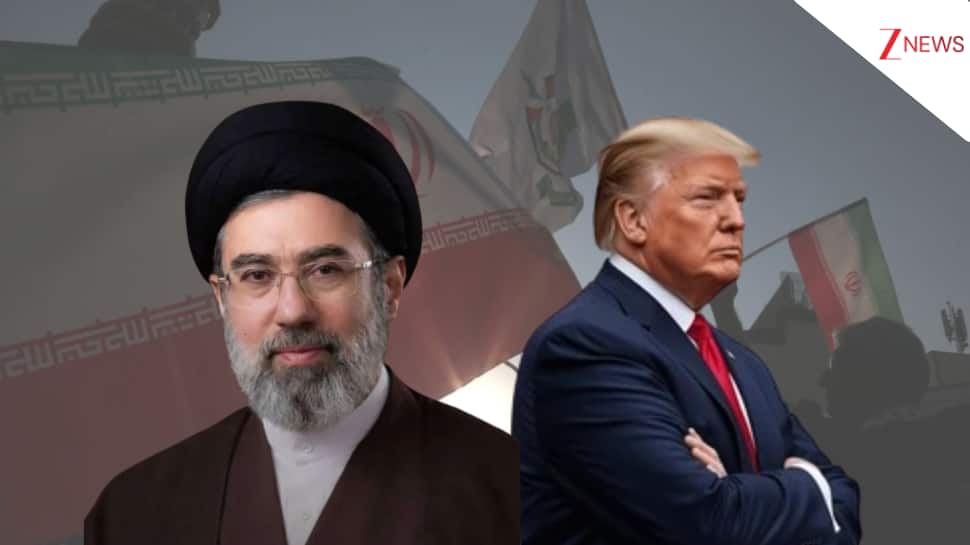
Iran’s Supreme Leader Mojtaba Khamenei issued his most defiant statement yet on Thursday, declaring that the United States faces a “disgraceful defeat” in its conflict with Tehran and that America’s only place in the Persian Gulf is “at the bottom of its waters.” The remarks, read aloud on Iranian state television, came as a fragile ceasefire holds between the two countries and a US naval blockade continues to squeeze Iran’s oil exports.
The statement was sweeping in its scope and unsparing in its language. Khamenei declared that Iran would protect its nuclear and missile capabilities as national assets, a direct rebuff to Donald Trump’s insistence that any naval blockade of the Strait of Hormuz would remain in place until a nuclear deal is reached.
What Khamenei said
“Ninety million proud and honourable Iranians inside and outside the country regard all of Iran’s identity-based, spiritual, human, scientific, industrial and technological capacities, from nanotechnology and biotechnology to nuclear and missile capabilities, as national assets and will protect them just as they protect the country’s waters, land and airspace,” he said.
On the question of America’s presence in the region, Khamenei was blunt. “By God’s help and power, the bright future of the Persian Gulf region will be a future without America, one serving the progress, comfort and prosperity of its people,” he said, adding, “Foreigners who come from thousands of kilometres away to act with greed and malice there have no place in it, except at the bottom of its waters.”
He also claimed that the United States had already been defeated, describing America and Israel as “bullies in the region” and saying that a “new chapter” was now beginning for the Persian Gulf and the Strait of Hormuz.
The blockade and its consequences
Khamenei’s words carry particular weight given the economic pressure Iran is currently under. The US Navy has imposed a blockade halting Iranian oil tankers from reaching international markets, cutting off a crucial source of revenue for Tehran. The blockade is also designed to create a storage crisis; if Iran cannot sell its oil, it may eventually have to scale back production simply because it has nowhere to put it.
Iran, for its part, has maintained its grip on the Strait of Hormuz, the narrow waterway through which roughly a fifth of all globally traded crude oil and natural gas passes. The standoff has sent oil prices surging, with benchmark Brent crude for June delivery reaching as much as $126 a barrel in trading on Thursday.
A fragile ceasefire, an unresolved standoff
Despite the ceasefire that is nominally in place, the confrontation between Washington and Tehran shows little sign of genuine resolution. The US blockade continues. Iran’s chokehold on the strait continues. And Khamenei’s statement on Thursday made clear that Tehran has no intention of negotiating away what it considers its sovereign rights, nuclear, military or otherwise.
With oil markets rattled, the Strait under strain, and both sides digging in, the gap between a ceasefire and actual peace remains as wide as ever.


