A few days before the National Eligibility cum Entrance Test Undergraduate (NEET UG) scheduled for May 3, when most conversations should ideally revolve around revision strategies and staying calm, a different kind of anxiety is quietly building in homes across India.
This anxiety is not about the question paper, nor is it about how high the cut-offs are likely to go this year. Instead, it is about what might happen before a student even enters the exam hall, and it concerns nearly 24 lakh aspirants across the country.
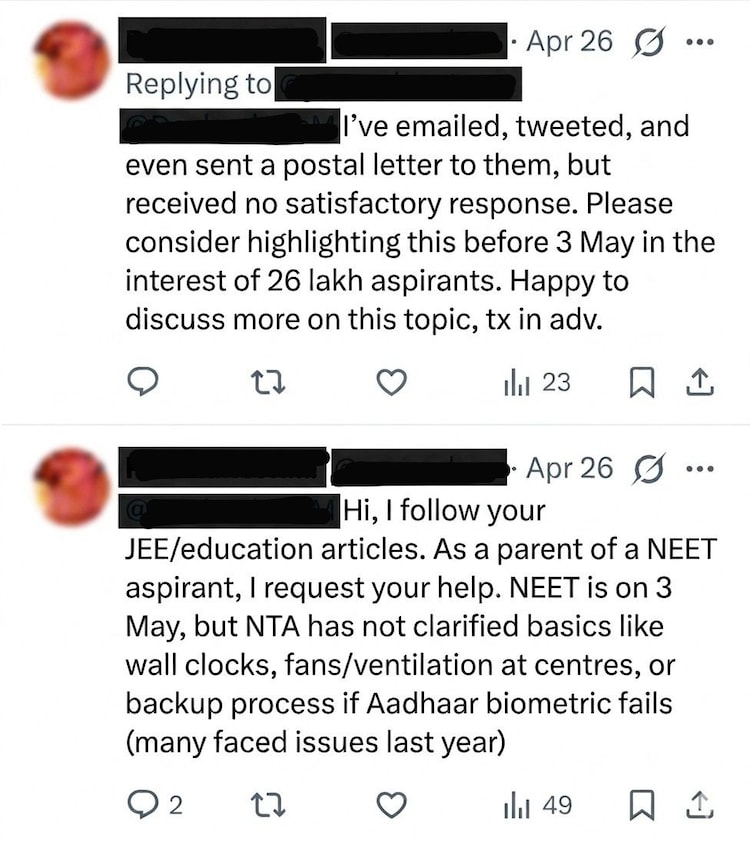
At a time when students should be focusing entirely on their preparation, some parents say they are still searching for answers to basic but crucial questions. On April 26, Prashant Jhingran, a parent of a NEET aspirant, reached out with a concern that many others have since echoed.
His question was simple and fundamental: what happens if biometric verification fails at the exam centre, and does the National Testing Agency have a clear backup plan in place?
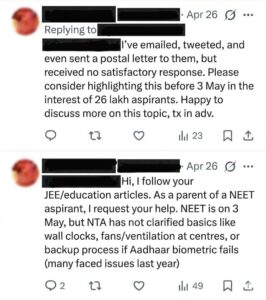
This is his message to us:
It is not an abstract fear. Last year, there were reports of fingerprint mismatches, delays at entry gates, power outages that disrupted exam schedules, and even instances of students being held up at centres. For an exam where every minute feels critical, even a small disruption can quickly spiral into panic.
“I have written emails, tweeted, and even sent a physical letter to NTA,” Jhingran, who is Director of Product at Visa Direct, said in his message to us. “All I am asking for is clarity. If something goes wrong at the centre, what is the backup plan? Students should not suffer because of a technical issue.”
WE TRUST THE SYSTEM. BUT IS IT READY?
In Kota, where thousands of students have spent years preparing for this exam, Vaishnavi Sharma has been trying to keep her daughter focused on revision. But the closer the exam gets, the more practical worries creep in.
“She’s prepared well, that’s not my concern. But what if she reaches the centre and there’s a delay because her fingerprint doesn’t match? Will someone ensure she gets her full time? Or will she just have to deal with it?” she silently queries. Vaishnavi is not on X and feels she has no clear way to raise these concerns with the authorities.
She adds, almost as an afterthought, “We are trusting the system, but we also want the very system to be ready too.”
BEYOND BIOMETRICS
In Delhi, Sanjeev Verma, who works at Samsung Technologies and whose son will be attempting NEET for the first time, is looking at the issue from another angle. His concerns relate to the exam environment itself.
“Every year we hear about problems at certain centres, including poor ventilation, overcrowding, basic arrangements missing,” he says. “Why is there no clear communication on these things beforehand? Why are parents left guessing?”
For him, it’s not about raising an alarm, it’s about removing uncertainty. After all these are national-level exams, the process should feel predictable.
NTA’s LATEST ADVISORY
To be fair, the National Testing Agency (NTA) has issued an advisory asking candidates to update their Aadhaar biometric details before the exam. It has also shared an awareness video explaining how verification will work at centres. The warning is crystal clear. If your biometric data doesn’t match, you could face delays, additional checks, or complications at entry.
Here’s the advisory
Students have taken this seriously, many have even double-checked documents, updated details, and tried to leave nothing to chance.
But for parents, that advisory answers only half the question. What happens if everything is done correctly — and yet the system fails?
THE GHOSTS OF LAST YEAR
That question matters because the memory of last year hasn’t faded. Reports of biometric glitches and logistical issues may not have affected every centre, but they were enough to leave a mark.
For students inside the exam hall, even a few minutes of delay can feel overwhelming. For parents waiting outside, it can feel worse, because there is nothing they can do.
NEET UG is not just another exam. For over 24 lakh students, it is often the only path they see towards a career in medicine. Families plan years around it, and students build their days around it. At this stage, most aspirants are doing what they can… revising notes, solving mock tests, trying to stay calm.
But alongside that preparation sits a quieter worry, one that has little to do with physics or biology. Will everything go smoothly on exam day?
What parents are asking for is not any special treatment, or for easier papers or even relaxed rules. They are seeking absolute clarity; they are asking for a system that ensures delays don’t eat into exam time, basic facilities that match the scale of the exam. Because when the stakes are this high, even small uncertainties feel amplified.
With just days to go, most students will push these questions to the back of their minds and focus on what they can control. Parents, however, tend to think a step ahead. Because sometimes, the biggest fear is not whether your child is prepared, it’s whether the system around them is.