
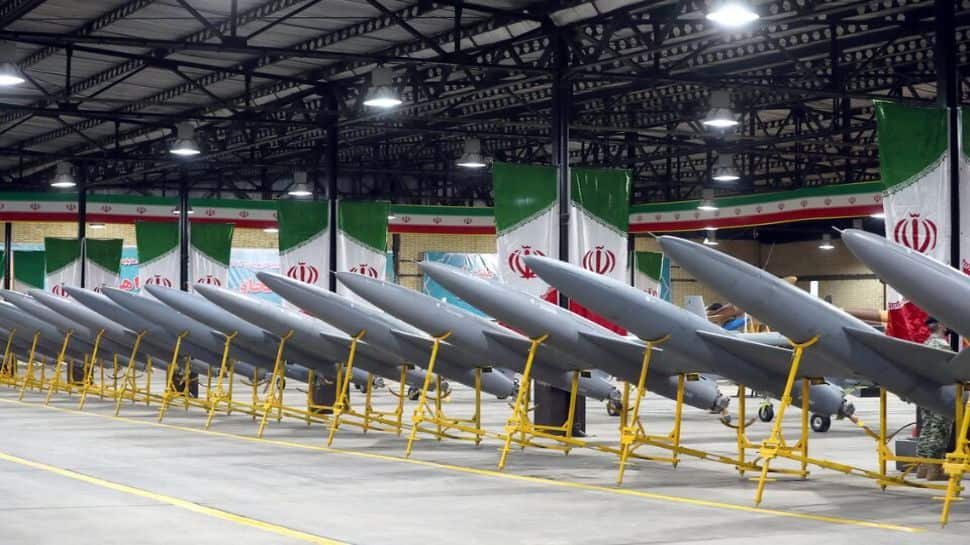
Iran’s Drone Programme: Iran’s drones are now part of wars from Ukraine to the Middle East. That has led to curiosity about how a country under years of sanctions managed to build this kind of capability in the first place.
Algerian journalist Akram Kharief, who covers defence and security, traces the story back several decades and shows how it developed step by step through war, isolation and constant improvisation. In his book titled ‘Under the Shadow of a Witness’, he says the Iranian drone programme does not begin in modern factories. It begins in universities, small workshops and a country thrown into sudden change after 1979.
From a powerful air force to sudden isolation
Before 1979, Iran had one of the strongest militaries in the region. The air force operated advanced aircraft such as the F-14 Tomcat, F-4 Phantom and F-5 Tiger. At that time, Iran ranked among the top five military powers across the world in terms of equipment.
But there was a problem in that strength. Much of the system depended on American engineers and supply of spare parts from companies such as Grumman. When the Shah monarchy was brought down in January 1979 and the new political system came into place, that entire support structure collapsed almost overnight.
Military leaders either left the country or were arrested. Foreign technicians also left. Defence companies ended their ties. Aircraft that had cost billions of dollars were grounded, not because they were old, but because there was no way left to maintain them.
A war that forced new thinking
In September 1980, Iraq launched a full-scale invasion. The war that followed lasted eight years and caused nearly one million deaths. Early in the confrontation, Baghdad held an advantage in air power and surveillance, using Soviet support and reconnaissance tools to track Iranian positions.
On the other hand, Iran was left with limited access to functioning aircraft and no way to import military technology. This situation forced it to search for alternatives rather than depend on traditional systems.
This is where the idea of unmanned aerial systems slowly entered the picture.
Small workshops, simple ideas
Around 1981, students and engineers in the Isfahan University began working on basic remote-controlled flying devices. The aim was to use smaller and cheaper aerial tools for gathering intelligence if full aircraft could not be used.
The early designs were extremely basic. Parts were often sourced from civilian equipment. In some prototypes, even hospital IV bags were used as fuel containers. These early models were built in university workshops and tested in Khuzestan’s open fields.
Three individuals – a civil pilot, Farshid; a physics student, Saeed; and a goldsmith Masoud Zahedi – took part in the early experiments. Their work moved between failure and adjustment for years before reaching military attention.
When the first prototype was shown to officials, it was not taken seriously. It looked improvised, almost like a handmade model rather than military equipment. But in 1983, one of these devices was flown about 40 kilometres behind enemy lines and returned with usable images of Iraqi positions. That moment changed how it was viewed.
The first step into combat use
After the early success, Iran formally set up a programme to develop unmanned systems. What began in a university workshop moved into structured military planning under the Islamic Revolutionary Guard Corps (IRGC).
Supply, however, was a challenge. Sanctions blocked direct access to essential components. To work around this, Tehran built procurement routes through Dubai and used intermediaries in Singapore and other trading hubs. Parts from multiple countries were assembled in Iran.
This mix of sourcing explains why later models, including the Shahed-136 seen in Ukraine, were found to contain foreign-made electronic components, including American chips.
Moving from surveillance to armed systems
By the late 1980s, Iranian engineers began moving from basic reconnaissance drones to armed versions. The Rad Brigade developed early combat drones under the name “Mohajir”.
The concept was that a drone could fly over enemy territory, record movements and later be modified to carry explosives. This idea placed Iran among the early countries experimenting with armed unmanned aircraft.
These early systems were limited in range, usually around 50 kilometres and lacked advanced navigation. Still, they were used during the later stages of the Iran-Iraq war for observation and tactical support.
A cost-based approach to warfare
One of the main ideas that drove Iran’s drone programme was not advanced technology, but cost comparison. A single cruise missile can cost around $2 million. By contrast, a basic drone can cost around $20,000. Even if a hundred drones are used in a single wave, the total cost is far below that of conventional missile systems.
This creates a different kind of pressure on defence systems. Instead of stopping one expensive weapon, a country may need to respond to multiple low-cost drones at once. That increases the load on radar systems and interception budgets.
The approach is not about precision but about stretching the opponent’s defence capacity over time.
Real-world use and international attention
This method drew international attention after the 2019 attack on Saudi Aramco facilities. The strike caused major disruption and financial losses, while the cost of the drones used was relatively low.
Later, in 2022, the appearance of Iranian-origin drones in the Ukraine war brought added attention. Known in Russian use as Geranium-2, the Shahed-136 was widely discussed after its images appeared over Kyiv skies.
Reports pointed to earlier Iranian drone activity involving groups such as Hezbollah in Lebanon and the Houthi movement in Yemen, where recovered debris suggested Iranian manufacturing ties.
Influence from earlier wars
Iran’s drone development also draws from earlier wars in the region. Israeli use of unmanned aircraft in the 1970s and 1980s, especially during operations in Lebanon, offered early examples of how drones could be used for surveillance and strikes.
These developments were studied by Iranian engineers through regional allies. Over time, Tehran built its own versions by adapting ideas to its own production limits and strategic needs.
From basic tools to strategic systems
What began with simple workshop prototypes has now turned into a large production system capable of long-range operations. Launched from Iranian territory, modern Iranian drones have been reported reaching targets across multiple countries.
The journey from plastic parts and improvised fuel tanks to international battlefield use did not follow a straight path. It grew through war pressure, restrictions on imports and a push to build something locally when external access was blocked.
A question that still follows the story
Iran’s drone programme did not develop in isolation from wars around the world. It grew along with it, influenced by wars, sanctions and changing military needs around the world.
And even today, one question continues to come up in defence circles about whether a country building advanced systems under pressure and limited resources changes how future wars are planned elsewhere.


