
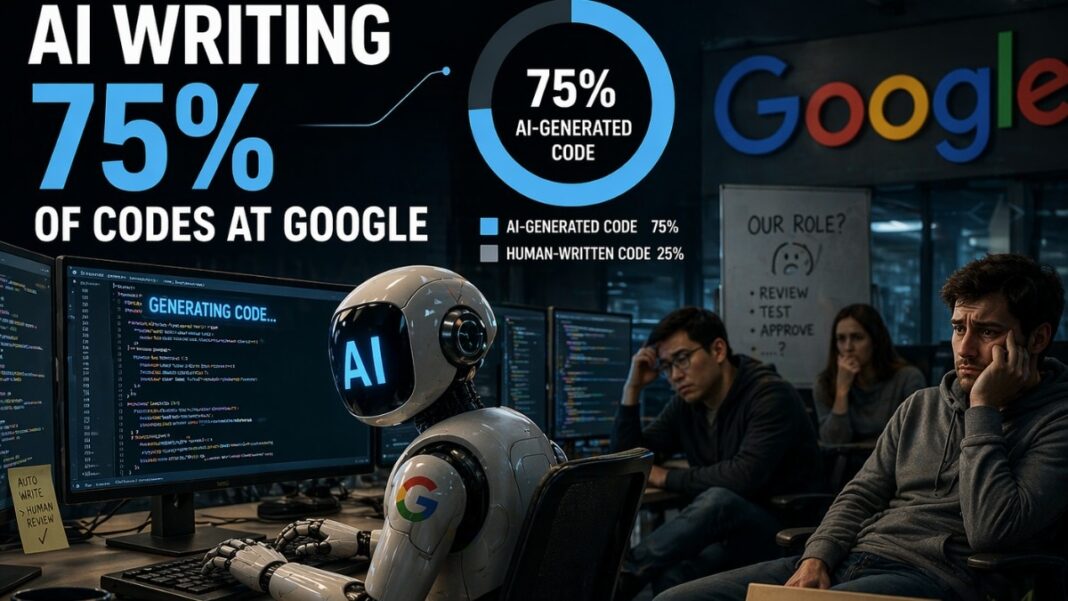
AI is quietly rewriting the rules of software development at Google, and the scale of that change is now out in the open. Inside the company, machines are no longer just helping engineers, they are doing most of the coding work. What used to take teams of developers writing and reviewing every line is now increasingly handled by AI systems working in the background. The human engineers are still involved, but their role is no longer limited to typing code.
“Today, 75 per cent of all new code at Google is now AI-generated and approved by engineers,” said CEO Sundar Pichai, giving a good sense of how deeply AI has entered the company’s core engineering work.
What engineers actually do now at Google?
Just a few months ago, AI was responsible for about half of Google’s code. That figure has now climbed to 75 per cent, showing how fast things are moving inside the company. But the bigger change is not just the number, it is the way engineers now work.
Instead of building everything line by line, developers are assigning tasks to AI agents that can execute them on their own. Multiple agents can run in parallel, handling different parts of a project, while engineers oversee the process, step in when needed, and ensure the final output is reliable. This setup allows teams to move faster without removing human control.
The results are already visible. Google says a complex code migration project was completed six times faster when AI agents worked alongside engineers compared to earlier methods. In another example, the company’s Gemini app for macOS went from an early concept to a working native Swift prototype within just a few days using its internal AI tools. But, since AI is able to do the work way too fast and quickly, there are chances that we are not that far away from the time when only a few human engineers will be needed to do the work.
Google is also using its own ecosystem to build and test these systems. Infrastructure like Bigtable and custom chips such as TPUs continue to support this rapid development, allowing the company to run large-scale AI workloads efficiently.
At the same time, this progress is adding to a growing debate about jobs. Former Google executive Mo Gawdat recently warned in Diary of a CEO podcast that AI could drastically reduce the need for large teams, as machines become capable of handling tasks across coding, content, and even leadership roles. Speaking of which, it is worth mentioning that it was recently reported that Meta is allegedly creating an AI avatar of CEO Mark Zuckerberg to handle all the internal discussions with employees. So, we have likely started moving in the direction that Gawdat is hinting at.
AI researcher Geoffrey Hinton has also raised concerns about how advanced systems may behave in the future, especially if they begin operating in ways that are not easily understood by humans.


