
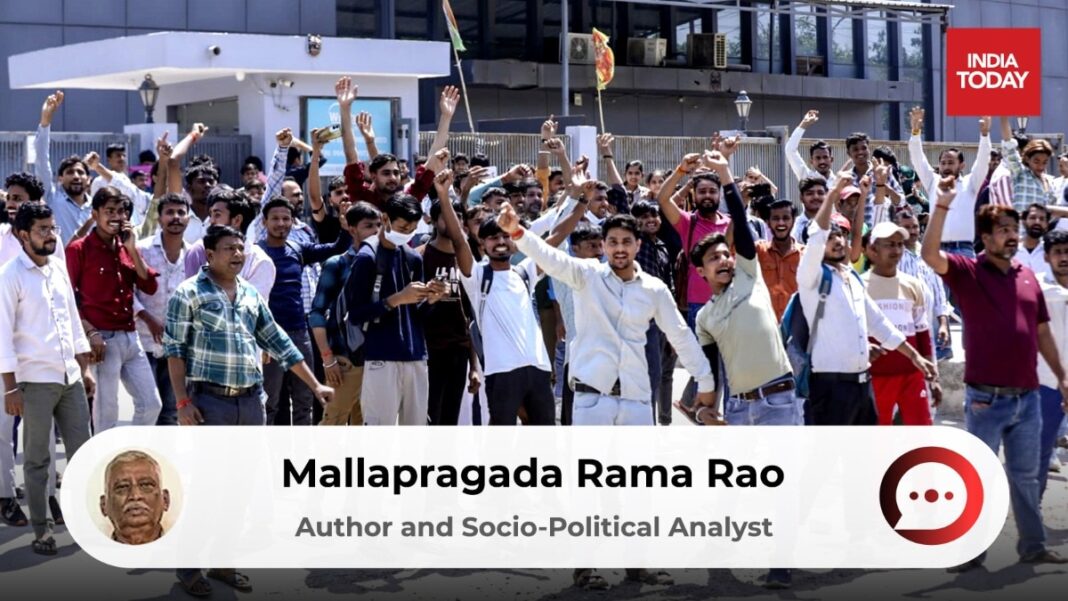
The labour uprising in Noida for low wages, wrong wages (actual payouts being less than salaries in the records) and poor working conditions, is a perfect case for arguing why we need a strict regulatory structure, even if that structure is derided as inspector raj.
What appears as compliance in official records often conceals deliberate strategies to deny workers their legal protections—revealing a deeper failure of enforcement.
What is often presented as “smart management” is, in reality, a calculated evasion of the law. Across industries, employers—frequently aided by labour consultants acting as intermediaries—deploy methods that systematically deny workers their rightful protections.
More troubling is the role of certain officials who choose to enable or overlook such practices.
In one instance, a factory inspector conducted a routine visit and reported full compliance. According to his findings, several workers were engaged by contractors outside the factory premises, in areas not covered under the Employees’ State Insurance (ESI) Act.
He further stated that the employer neither supervised their work nor exercised control over them. On this basis, the employer was deemed free from liability for statutory contributions in respect of contract workers. The conclusion was convenient, and entirely misleading.
This version went unchallenged until an accident altered the course of events.
A junior-level local office manager, known for his integrity, visited the factory to investigate the incident. His role was limited to accident enquiries, not regular inspections. However, his observations told a different story: on the day of his visit, he found at least ten workers employed within the factory premises without being brought under ESI coverage.
His report led to a special inspection being assigned to me.
The factory manufactured agricultural implements and bus bodies using electrically operated machinery. These operations were carried out within the premises through two so-called contractors—one handling framework and the other sheet metal work.
The employer claimed that such work was occasional, limited to about ten days a month. The reality was otherwise.
Verification of records confirmed that two contractors, along with 10–15 workers, were regularly working inside the factory. They functioned less as independent contractors and more as supervisors within an integrated workforce.
None of these workers had been covered under the ESI Act. Nor had other employees, including a typist and a security guard.
An initial review of records revealed no clear evidence of wage payments to these workers. However, a closer examination of the day books exposed a deliberate accounting device.
Separate ledger sheets had been maintained for each customer placing orders. Payments received were recorded as receipts, while wages paid to workers engaged for those specific jobs were shown as expenses against those receipts.
In effect, wages were being disguised as business expenditures—keeping them outside statutory scrutiny.
This was not an oversight; it was a calculated method to conceal liability.
Further entries confirmed the pattern. For example, an entry dated April 3, 1984 recorded Rs 3,162 as wages, masked within business expenses. When confronted with this evidence, the employer conceded and agreed to bring the workers under legal coverage and pay the required contributions.
But the irregularities did not end there.
Given the nature of the work and the timelines involved, overtime seemed inevitable. Yet, no records of overtime payments existed. The employer maintained that no worker had ever been required to work beyond normal hours.
This claim, too, was doubtful.
A review of financial statements revealed a striking anomaly. Expenditure on tea and meals, paid to workers in cash, exceeded the wages paid to them. In 1982–83, while Rs 17,325 was recorded as wages, Rs 26,961.25 was shown as spent on tea and meals.
In 1983–84, the figures were Rs 17,930 and Rs 25,053.17, respectively. In subsequent years, although the disparity reduced, such expenditure still accounted for nearly 9–10% of total wages.
These payments, made in cash to workers, clearly constituted “additional remuneration” and were therefore liable for statutory contributions. This was explained to the employer.
AN UNEXPECTED WARNING
That evening, after completing the inspection, I returned to my hotel, satisfied with the outcome. As I prepared to step out for dinner, the local manager visited me. After some hesitation, he advised that I should leave for headquarters that very night.
He feared that the employer might attempt to falsely implicate me—possibly by planting money in my room and accusing me of demanding and accepting a bribe.
It may have been a precaution based on suspicion. But given the manager’s integrity and the environment I was dealing with, I chose not to take the risk. I cancelled my reservation for the next morning and left that very night.
POSTSCRIPT
A recent conversation with a friend—an assistant professor in a private polytechnic college for the past five years—revealed that both faculty and staff were unaware that educational institutions employing 20 or more persons (within the wage ceiling) were brought under the ESI Act in undivided Andhra Pradesh from October 14, 2008.
They were equally unaware that, from April 21, 2011, the threshold was reduced to 10, and that the term “employees” was replaced with “persons,” thereby expanding coverage—even where the number of employees within the wage ceiling is fewer than 10.
Even during the era of the so-called “Inspector Raj,” this was the reality. The situation today, with fewer inspections and limited awareness, can only be worse.
(Views expressed in this opinion piece are those of the author)
Read earlier parts in the series:
Part 1: The end of Inspector Raj: A reform that assumes too much
Part 2: When employers evade, enforcement looks away


