The report card shines, but the reality shifts…
Every year, the Kendriya Vidyalaya Sangathan (KVS) delivers results that many schools can only aspire to, with high pass percentages, consistent toppers, and a reputation for academic discipline that has made Kendriya Vidyalayas one of India’s most trusted public school systems.
This year was no different. At PM SHRI Kendriya Vidyalaya No. 1 in Colaba, Mumbai, for instance, several students scored above 90 per cent, including Priyanka Kumari, whose father works for a small sweet shop and is not a Central Government employee, a telling reminder that the KV system today is increasingly shaping the aspirations of families beyond the constituency it was originally meant to serve.
This quiet shift raises deeper questions about access, aspiration, and also about whom the KV system now truly belongs to.
The schools were set up in the 1960s to serve children of Central Government employees, especially those in transferable jobs. Over time, the mandate expanded to include children of state government employees and eventually those from non-government families.
Admissions today follow a structured hierarchy of five priority categories, where Central Government employees remain at the top, followed by other public sector and state employees, and finally the public.
What is now visible is not just expansion (there are over 1200 schools in India), but a steady reconfiguration of whom the system is actually serving.
NUMBERS TELL THE ACTUAL STORY
The latest available KVS data (up to 2018) reveals a notable structural shift over time. The proportion of students from Central Government families declined from 60 per cent in 2011–12 to 47 per cent in 2017–18, a trend that becomes even more telling in absolute numbers.
In 2011-12, out of 10,91,931 students enroled across KVs, 6,56,527 were from Central Government families. By 2017-18, even as total enrolment increased to 12,54,922 students, the number of such students dropped to 5,92,436.
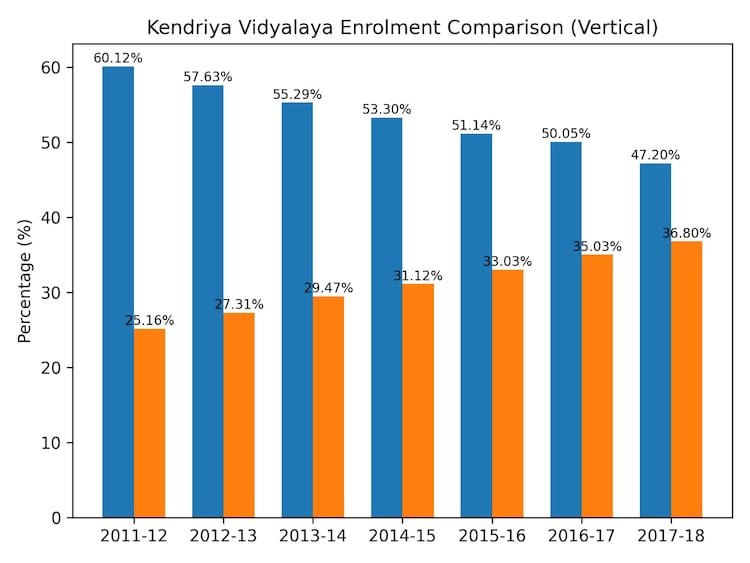
At the same time, enrolment from non-government families has risen steadily. Their share increased from 25 per cent in 2011-12 to 36 per cent in 2017-18. In absolute terms, this category grew from 2,74,791 students to 4,61,950.
These are not marginal fluctuations but clear indicators that the social composition of Kendriya Vidyalayas is shifting away from its original core constituency.
Speaking to India Today.in, Somit Shrivastav, Joint Commissioner (Academics), Kendriya Vidyalaya Sangathan (an autonomous body under India’s Ministry of Education that establishes, maintains, and manages KVs), offered a more nuanced view of the trend.
“In smaller towns, we still see children of government officers enroling in KVs. In metros, however, the growing presence of private schools does influence parental choice. That said, our mandate remains unchanged. We are here to provide quality education to all, and our academic results continue to reflect that.”
Even as the system evolves with changing parental choices, the KV model continues to adapt — expanding its reach while staying anchored to its core promise of equitable, quality education.
A few voices, however, point towards a more complex reality on the ground.
SYSTEM BUILT FOR ONE GROUP, OCCUPIED BY ANOTHER
“KVs were designed for transferable Central Government staff, but of late, many of those families are opting out. What fills the gap is a mix of discretionary admissions and aspirational demand from outside. That’s how you end up with a paradox, a system built for one group, but increasingly occupied by another,” says Rahul Singhania, a former IRS officer who sent his children to KVs in the early 1990s.
Education reformist Deepika Kulshreshta echoes this assessment.
“The numbers tell the story. With nearly 40,000 discretionary seats in play annually before the reform in 2022, and a visible shift of higher-income government families towards private schooling, KVs were no longer serving just their core constituency. Demand from outside, combined with quota-based entries, was sustaining full enrolment even as the original beneficiary group was partially opting out,” she says. Has this changed after the reform? “Only partially,” she adds, noting that at least overcrowded classrooms have been reduced.
Somit Shrivastav says the 2022 reforms were aimed at curbing what he describes as “excess” admissions. “Earlier, class sizes would often swell to 50–60 students. Now, we have capped the strength at 40 per class,” he explains.
The system, on paper, looks tighter and more efficient by the day. Which makes the shift all the more puzzling… why are the very stakeholders it was built for choosing to opt out?
THE PRIVATE SCHOOL PULL
For many bureaucrats, the decision to move away from KVs is not about academic quality alone but about exposure, peer networks, and perception.
A senior Income Tax officer in Delhi chose to send both his children to The Mother’s International School, even though a KV was located barely three kilometres from his home. “My son and daughter are proud MIS students. They’ve been there since primary school,” he says.
His wife is more candid.
“I did visit the KV nearby when we were exploring options, but I wasn’t very impressed with the overall environment. Also, most of our children’s peer group study in big private schools. That influenced our decision,” she says.
Another bureaucrat, a state government employee, currently on deputation with a Union Ministry, was equally clear that her daughter would study at Sanskriti School. “I studied in a Central school in Odisha, and we did very well. But today, if we can afford better facilities and exposure, why wouldn’t we opt for it?” she says.
And when transfers happen? “We simply move them to another private school that accepts mid-term admissions. It’s hardly an issue any more,” they say.
But there is more to this than meets the eyes…
ONE SYSTEM, TWO REALITIES
What makes these choices more revealing is what happens alongside them. The same Income Tax officer who chose a private school for his children helped his domestic help secure admission for her children in a Kendriya Vidyalaya.
“It’s the least I could do. She has worked with us for eight years. Her children are bright. They will do well in a KV,” he says.
His domestic help can’t stop beaming. “My children have passed their Class 10 exams. My son got 85 per cent, my daughter 86.76. We feel very lucky to have got admission,” she says.
In the other case, the bureaucrat who enroled her daughter in a private school also facilitated admission for her peon’s son into a KV. “He just needed that extra push, so I gave him a recommendation,” she says as a matter-of-fact.
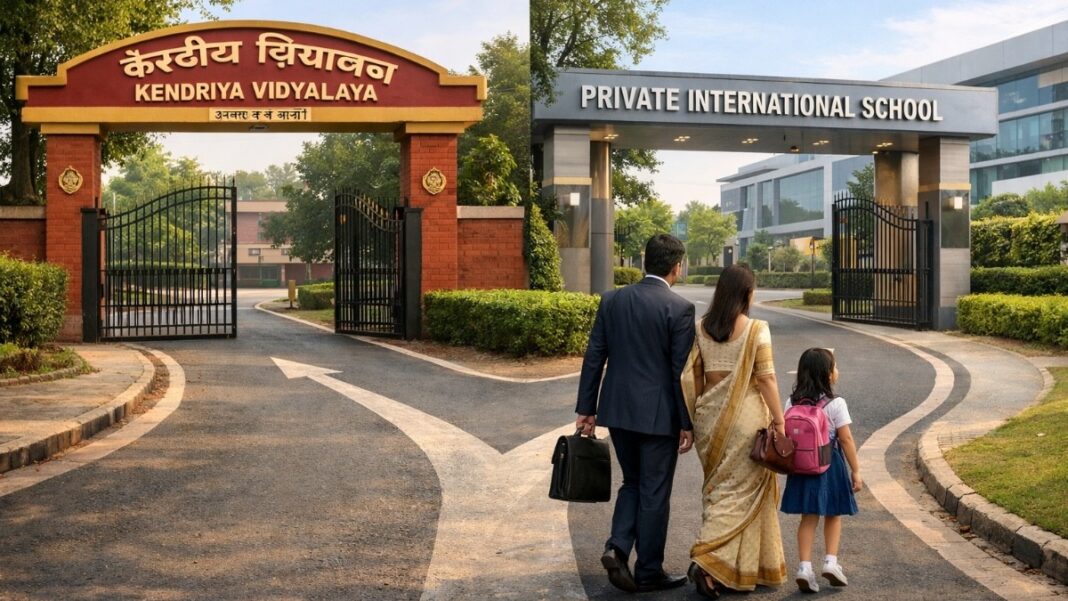
What emerges is a dual system within the same ecosystem, where private schools serve aspiration and Kendriya Vidyalayas provide access.
Srivastav acknowledges that this could indeed be a factor, suggesting that some officers may be willing to facilitate admissions for staff or others, particularly given that KV fees remain relatively affordable.
WHAT HAPPENS INSIDE THE CLASSROOM
Teachers within the system have observed this transition too closely.
A retired Kendriya Vidyalaya teacher from Powai says that nearly 90 per cent of students in her school came from marginalised backgrounds, including those from nearby slum areas, alongside 25 per cent admitted under the Right to Education quota.
“What puzzles me is why more officers don’t choose KVs for their own children. We have consistently delivered strong academic results, and our students are well-trained and capable. Of course, exposure may be somewhat limited,” she says.
She also points to structural constraints. “In KVs, offering niche subject combinations can be difficult due to limited faculty. Private schools are able to offer such flexibility much more easily,” she adds.
Another teacher coordinator from Colaba in Mumbai is more direct.
“Yes, we have all the facilities. Academically, we are doing extremely well and the results reflect that. But bureaucrats still prefer IB or ICSE schools. It is about signalling money and status,” says Kamlesh Lariyal. “They may not hesitate to recommend admissions for children of their staff, but when it comes to their own kids, it is a different story,” she adds.
THE ADMISSION MAZE
For families outside the system, entry into Kendriya Vidyalayas has often been far from straightforward. Delhi-based journalist Prachi Misra recalls navigating a confusing process. “I ran from one office to another. At one point, I was told I needed a letter from the MHRD,” she says.
She never received that letter, and her children never got admission.
Monika Roy in Noida had a different experience, but one that reveals how the system has functioned in practice. “I was told I would need a sifarish (recommendation) from a ‘badey afsar’ (a gazetted officer),” she says.
After months of persistence and securing a recommendation through bureaucratic contact in 2018, her children were admitted.
“Most of the parents I met had come with some kind of sifarish. It became a competition of whose recommendation was stronger,” she says.
Both accounts reflect a shadow system that was officially dismantled in 2022 but continues to leave traces in perception and practice.
THE SHADOW SYSTEM THAT EXISTED
Kendriya Vidyalaya admissions once operated with multiple discretionary quotas. Members of Parliament could recommend up to 10 students per school each year. District Magistrates could push through 17 admissions. The Education Ministry had its own reserved pool, along with several other special categories.
Together, these channels accounted for an estimated 40,000 seats annually.
Without any doubt, this system was originally intended for exceptional cases. But slowly provisions gradually evolved into an influence-driven system that often cut through waiting lists and lotteries.
The government has since scrapped these discretionary quotas entirely, removing recommendation-based admissions and restoring a more structured process based on priority categories and lottery systems.
However, anecdotal accounts suggest that informal influence continues to shape access in subtle ways, even as the formal system has been cleaned up.
… AND THE QUESTION STILL REMAINS
It is evident that Kendriya Vidyalayas are not losing relevance in terms of performance or demand. If anything, they remain among the most reliable public education institutions in the country. What is changing is who chooses them.
When the share of Central Government families drops from 60 per cent to 47 per cent within a few years (as shown in the infographic above), even as enrolment rises and demand from outside grows sharply, it points to a shift that goes beyond individual choice.
The system continues to deliver, but the constituency it was built for is slowly stepping away, even as it continues to rely on the same system for others within its reach.
That contradiction may well define the next chapter of India’s most successful public school network.