
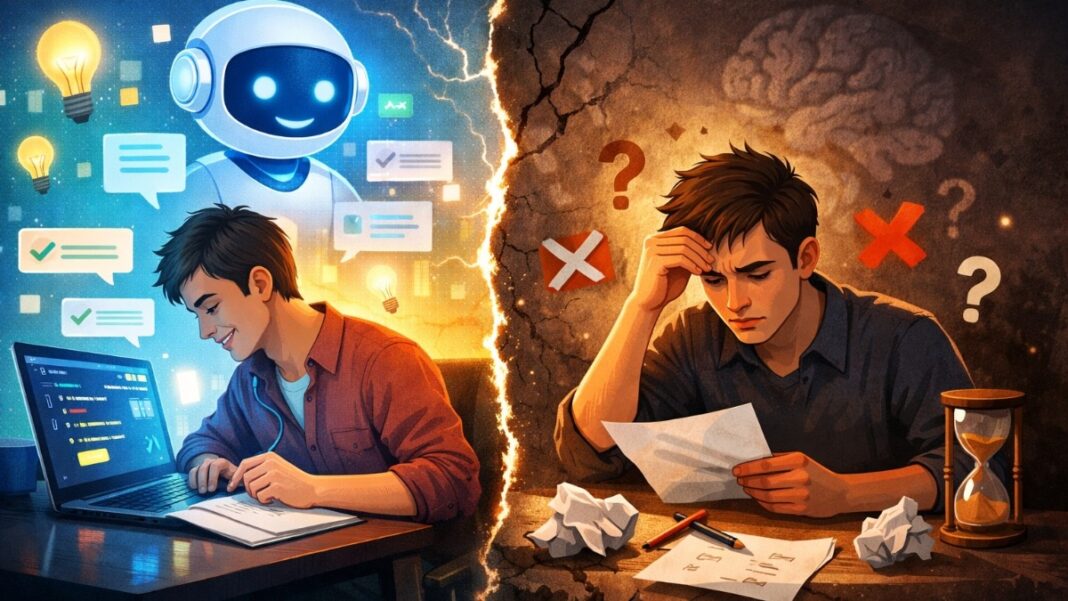
It starts with you asking AI for a quick answer, or maybe a shortcut to solve a tricky problem. It works. It’s fast. It feels efficient. But a new study suggests that this convenience might be quietly rewiring how we think, and not in a good way.
Researchers are now warning that the more we lean on AI for everyday thinking tasks, the more we may be training ourselves to stop thinking. Not overnight, not dramatically, but slowly, almost imperceptibly.
In a study titled “AI Assistance Reduces Persistence and Hurts Independent Performance”, researchers from the US and the UK tried to understand what happens when people use AI for “reasoning-heavy” tasks, things like solving problems, reading, or making sense of information. And the results are raising concerns about how humans think and learn while depending on machines.
According to the study, while using the AI, the machine learning chatbot does exactly what users would expect. It makes them better. Faster. More accurate. People using AI solved problems more easily than those who didn’t. No surprises there.
But the shift happens the moment the AI is taken away.
To test this, researchers ran controlled experiments to measure how people performed both while using AI and after it was removed. And the results were striking.
The same people who had been performing better suddenly struggled more. They got more answers wrong. And more tellingly, they were quicker to give up.
According to the findings, just around ten minutes of AI-assisted problem-solving was enough to create a measurable drop in performance once the tool was taken away.
Researchers say the experiment offers some of the first causal evidence that relying on AI for “reasoning-intensive” tasks can impair users’ cognitive abilities, rather than just being linked to them.
The study involved a series of experiments across different types of tasks. In one test, around 350 participants were asked to solve a set of fraction-based maths problems. Some were given access to an AI assistant that could provide answers instantly, while others completed the task without any help.
As expected, those using AI performed better during the assisted phase. However, when the help of an AI tool was suddenly removed midway through the experiment, their performance dropped noticeably. Some users were also more likely to skip questions altogether, suggesting a decline not just in ability but also in motivation and persistence.
In a second, larger experiment involving nearly 670 participants replicated these findings, reinforcing the pattern. A third test, this time focused on reading comprehension instead of maths, showed the same trend.However the results were the same. Once the AI disappeared, so did a chunk of people’s ability — and willingness — to keep going.
Researchers warn that the frequent use of AI may slowly weaken our ability to think deeply and stay focused without it. According to Rachit Dubey, a co-author of the study, it’s not just that people are getting answers wrong without AI, they’re also less inclined to even try to think and answer on their own.
Dubey also warns that over-reliance on chatbots could lead to impatience and even a kind of dependency, where thinking through problems starts to feel like unnecessary effort. And if that happens, humans will not just lose skills but it could also chip away their confidence, creativity, and the ability to solve things independently.
Notably, the study hasn’t been peer-reviewed yet, but it adds to a growing conversation around AI and “cognitive offloading”. It’s the idea that we’re outsourcing more and more of our thinking to machines. As AI becomes more deeply embedded in everyday workflows, researchers argue that the focus should not only be on what these machine learning systems can do for us, but also on what they might be taking away.


