
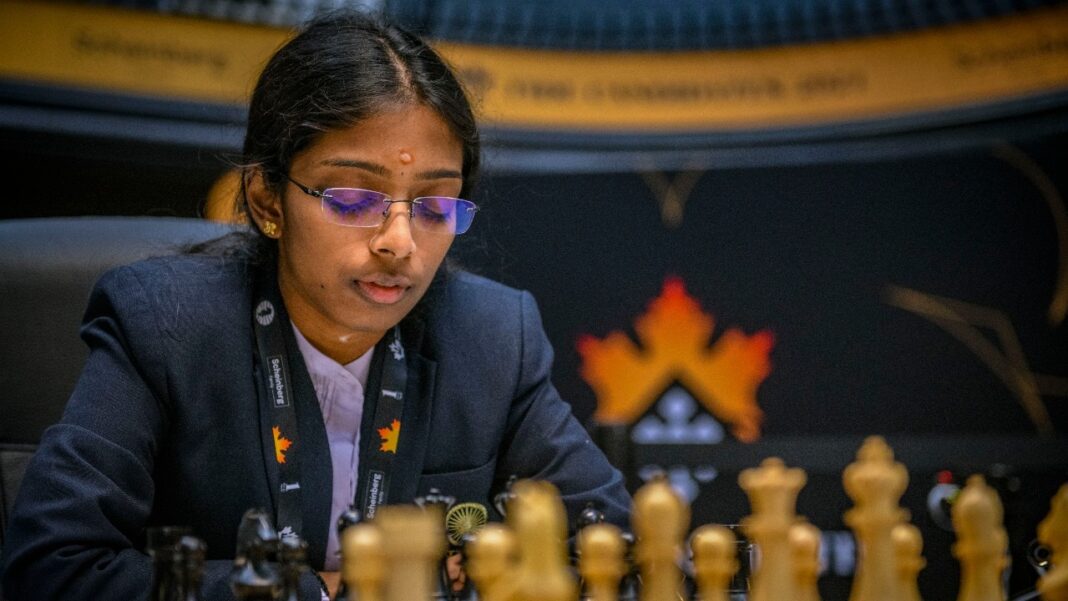
Underdog syndrome is a psychological state where individuals, believing the odds are stacked against them, harness that pressure to fuel intense motivation, resilience, and creativity, often outperforming expectations. Perhaps this is the best way to sum up R Vaishali’s epic win at the Candidates 2026. Her triumph came against all odds, needing several things to go her way.
Vaishali qualified for the Candidates by winning the Grand Swiss for the second time, just like in 2024. However, the build-up to the tournament was far from ideal. She was the lowest-rated player in the field, and very few gave her a chance against seasoned names like Kateryna Lagno, Bibisara Assaubayeva, Zhu Jiner, Tan Zhongyi, Anna Muzychuk and Aleksandra Goryachkina.
The field was stacked. Tan Zhongyi is a former world champion and a regular in the Candidates. Bibisara is a world blitz champion, while Lagno has multiple rapid and blitz titles. Goryachkina won the Candidates in 2019. Divya Deshmukh came in as a World Cup winner, while Zhu Jiner had reached a peak ranking of world No. 2. Vaishali, in comparison, did not have a major world title. Yet, she held her ground.
THE UNDERDOG FROM START TO END
The first four rounds set the tone, with most games ending in draws as if no one wanted to take risks. Vaishali’s early setback came against Zhu Jiner, where she lost ground due to mid-game complications.
In Round 6, she capitalised on a blunder from Lagno to get her campaign going. But she knew the road ahead was tough. Her win against Tan Zhongyi in Round 7 showed maturity. Despite the victory, she admitted, “I don’t deserve this point,” reflecting on a game filled with errors where she survived under immense pressure.
Momentum began to build with a draw and two wins, but another loss to Zhu Jiner halted her progress. At that stage, it seemed her campaign might fade away.
In Round 13, Goryachkina defeated Zhu Jiner, opening up a narrow gap. The equation became clear. Vaishali had to beat Lagno, while Divya needed to hold Bibisara to a draw.
Divya delivered under pressure. Despite time trouble, she maintained control and secured a draw. That result shifted the pressure entirely onto Vaishali, who responded brilliantly. She found the right moves at the right moments, eventually forcing Lagno to resign after nearly five hours of play.
WHY VAISHALI’S WIN IS EPOCHAL?
Heading into the tournament, Vaishali was among the least-fancied players. Her victory is a testament to the resilience of Indian chess at a crucial time.
After Gukesh Dommaraju’s success in 2024, momentum had dipped. Gukesh struggled for form, Koneru Humpy withdrew from the Candidates due to geopolitical tensions, and other Indian players failed to make a deep impact. Expectations were low.
Vaishali changed that narrative.
Her win reinforces the depth and resilience of Indian chess. It shows that even in uncertain phases, new champions can emerge.
Now, the dream is bigger.
India could realistically aim to have two world champions by the end of 2026. Vaishali’s potential clash with Ju Wenjun could mirror the intensity of recent title battles. It also presents a chance to challenge China’s long-standing dominance in women’s chess.
The dream is alive again.
Now, it is about finishing the job.


