
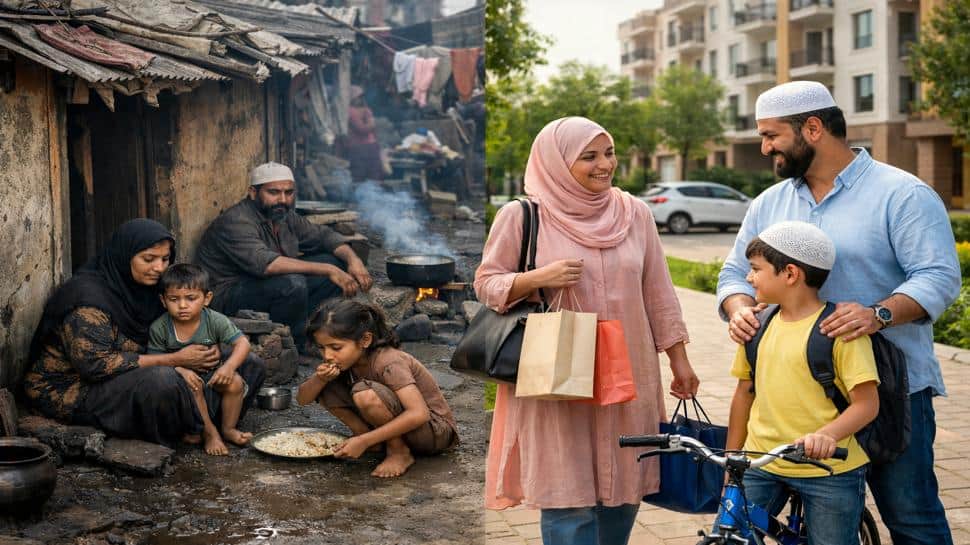
New Delhi: In 2011-12, nearly four out of every ten urban Muslim households in India were living in poverty. By 2023-24, that figure had fallen to fewer than six in a hundred. That is not a marginal improvement or a rounding-error shift. It is a transformation — the kind that changes what daily life actually feels like for millions of families across the country.
The data comes from India’s Household Consumption Expenditure Surveys for 2011-12 and 2023-24, measured using the Rangarajan poverty line — a methodology that tracks whether household spending covers basic necessities. The comparisons cover both rural and urban India, and they break down poverty rates for Hindus, Muslims, and the overall population.
Across every single category in the data — every religion, every geography — the direction is the same. Poverty rates have fallen, sharply and consistently, over twelve years.
The urban story: where the biggest drop happened
The most dramatic number in the entire dataset belongs to urban Muslim households. In 2011-12, their poverty rate stood at 39.4 percent — higher than any other group, in either rural or urban India. By 2023-24 it had come down to 5.7 percent. That is a fall of 33.7 percentage points in twelve years, the largest decline recorded across all categories.
To put that in concrete terms: if you had walked through a predominantly Muslim neighbourhood in an Indian city in 2011, roughly two in five households you passed would have been living below the poverty line. Walk through the same neighbourhood today and the equivalent figure is closer to one in eighteen.
Rural India: Muslims now have the lowest poverty rate
In rural India, the picture is equally striking — and contains a result that might surprise many readers. Muslim households, who in 2011-12 had a rural poverty rate of 31.7 percent, now have the lowest rural poverty rate of any group in the data at just 2.4 percent. Hindu households are at 4.0 percent and the overall rural average sits at 3.9 percent.
The gap that existed in 2011-12 — where rural Muslims were slightly poorer than the average — has not just closed. It has reversed. Rural Muslim households now sit below both the Hindu rate and the overall average.
What this data does and does not tell us
The data measures one specific thing: the share of households spending below a defined poverty threshold. It does not measure inequality, wealth concentration, quality of employment, or whether the gains are evenly spread within each community. A household that crossed the poverty line may have done so by a narrow margin, and many challenges beyond income persist.
What it does tell us, clearly and without ambiguity, is that the material floor of living standards — measured by basic consumption — has risen sharply for households across both communities and both geographies over the past twelve years. The scale of the reduction is large enough that it cannot be attributed to measurement noise or methodology differences. Something real happened.


