
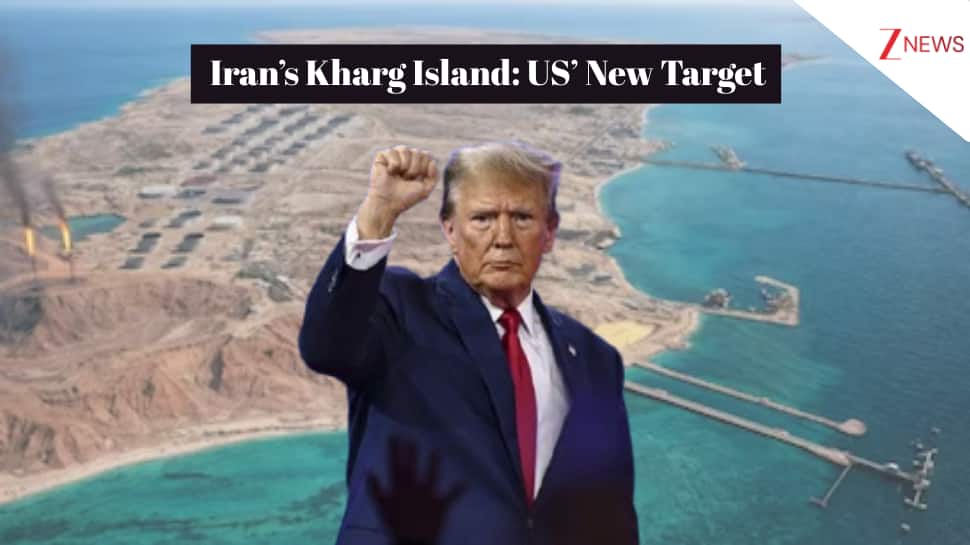
In the waters of the Persian Gulf lies a small Iranian island that quietly powers much of the country’s economy. Now, as the conflict involving the United States, Israel and Iran enters its second week, Kharg Island is drawing growing attention in Washington and Tel Aviv as a potential pressure point against Tehran.
According to a report by Israel-based Ynet News, the Trump administration is weighing options to strike the island, a move that analysts say could deal a severe financial blow to Iran but also risk shaking global energy markets.
A small island with huge economic weight
Kharg Island sits about 25 kilometres off Iran’s coast near Bushehr province. Despite its modest size, it handles nearly 90 per cent of Iran’s crude oil exports, making it the country’s primary oil export terminal and a crucial source of revenue.
The island’s facilities, including storage tanks, pipelines and tanker-loading terminals, are a vital part of Iran’s energy infrastructure. Oil income from these exports also funds key state institutions, including the Islamic Revolutionary Guard Corps (IRGC). Because of this central role, analysts say Kharg represents one of Iran’s most vulnerable strategic assets.
Reports suggest that if Washington chooses to increase pressure on Tehran beyond airstrikes, targeting or disabling Kharg Island’s oil infrastructure could deprive Iran of a major financial lifeline. However, such a move could also disrupt global energy supply and drive oil prices higher.
A potential economic pressure point
Michael Rubin, a former Pentagon adviser on Iran and Iraq, believes an attack on the island could significantly weaken Tehran’s ability to finance its military and maintain domestic control.
Rubin told Ynet News that he has discussed the island’s strategic importance with officials in Washington and believes the issue has been raised within the US National Security Council. However, he noted that it is unclear whether the idea has reached the small group of advisers who are thought to shape President Donald Trump’s decisions on the war.
Rising importance during the conflict
Kharg Island’s role has grown even more prominent in recent weeks. Before US-Israeli strikes on Iran began in late February, Tehran reportedly increased production at the terminal.
Energy analytics firm Kpler estimated that output surged to nearly four million barrels per day, approaching record levels and far above the usual average of around 1.5 million barrels a day.
Despite its importance, the island has not yet been targeted during the current conflict. Israeli strikes last week hit fuel depots in Tehran and the Alborz region, marking the first attacks on Iran’s energy infrastructure since the war began.
A target considered in past
Kharg Island has long been viewed by Iran’s rivals as a critical vulnerability. During the 1979 Iran hostage crisis, US President Jimmy Carter was advised that seizing the island could give Washington leverage over Tehran. Carter ultimately rejected the proposal.
In the 1980s, President Ronald Reagan authorised attacks on other Iranian offshore export facilities after Tehran mined the Strait of Hormuz, though Kharg itself was not struck.
The island’s oil terminal was heavily damaged during the Iran-Iraq War, when Iraqi forces targeted the facility. Iran later rebuilt the infrastructure and restored exports, according to a report by Politico-owned E&E News.
Israeli calls for a strike
Some Israeli leaders believe hitting Kharg could deal a decisive economic blow to Tehran. Opposition leader Yair Lapid recently argued that destroying the island’s oil infrastructure would cripple Iran’s economy.
“Israel should destroy all of Iran’s oil fields and energy industry on Kharg Island. That would collapse Iran’s economy and bring down the regime,” Lapid wrote on X.
Tehran has warned that any such strike would trigger retaliation against energy facilities across the region.
Global energy risks
Energy analysts caution that an attack on Kharg could have consequences far beyond Iran.
With crude oil prices already exceeding USD 100 per barrel, the Centre for Strategic and International Studies in Washington estimates that a major disruption at the terminal could push prices about USD 10 higher per barrel. Delgha Katinoglu, an Iranian energy expert with the London-based Persian-language broadcaster Iran International, said destroying Iran’s oil infrastructure could damage the country’s economy for years.
Iran earned around USD 78 billion from energy exports in 2024 despite heavy US sanctions. Katinoglu told The New York Times that crippling the country’s oil and gas facilities could make it difficult for any future government to stabilise the economy or provide basic services.
He warned that such destruction could actually hinder prospects for political change rather than accelerate it.
Why Kharg has not been hit yet
One reason the island has not been targeted may be the risk of a major escalation that would likely require direct US approval.
Reports suggest tensions have already surfaced between Washington and Israel over the scale of recent attacks on Iranian energy facilities. Israeli strikes on 30 Iranian oil depots reportedly surprised US officials, who reacted with shock when briefed on the operation.
The incident marked the first notable disagreement between the two allies since the war began on 28 February.
Domestic political considerations may also be shaping Washington’s calculations. President Trump faces pressure over rising fuel prices ahead of the midterm elections, and disruption to Iranian oil exports could further unsettle global markets.
Still, officials within the administration have reportedly explored other possibilities, including seizing Kharg Island or launching commando operations to secure Iran’s enriched uranium stockpiles, Axios reported.
When asked in an interview with ABC about potential operations, Trump did not dismiss the idea. “Everything is on the table,” he said.
For now, Kharg Island remains untouched, but its oil terminals have become one of the most closely watched strategic points in the escalating Gulf conflict. A strike on the island could reshape not only Iran’s economy but also the global energy landscape.


