
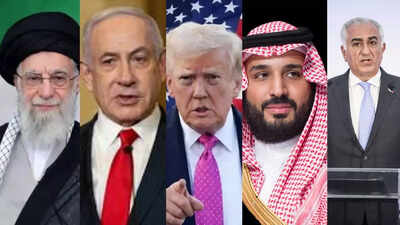
After a month-long build-up, the United States and Israel on Saturday launched strikes against Iran, killing at least 40 people. The attack comes amid negotiations between Washington and Tehran over Iran’s nuclear programme and months of mass protests against the Islamic Republic.
The United States and Iran have been sworn enemies since the 1979 Islamic Revolution and the hostage crisis at the US embassy in Tehran.
Soon after the attack, Trump warned Iranian forces to lay down their arms and surrender in exchange for immunity — or face “certain death” — as the Middle East slid into full-scale conflict following coordinated US-Israeli strikes on multiple targets across Iran.
In a televised address on Truth Social, Trump confirmed the launch of a military operation targeting Iran’s nuclear and military infrastructure.
“To the members of the Islamic Revolutionary Guard, the armed forces, and all of the police, I say tonight that you must lay down your weapons and have complete immunity, or, in the alternative, face certain death,” he said.
Addressing Iranians directly, he added: “The hour of your freedom is at hand. Stay sheltered. Don’t leave your home. It’s very dangerous outside. Bombs will be dropping everywhere. When we are finished, take over your government.
It will be yours to take. ”
While positioning himself as a “peace master,” Trump has taken a consistently hard line. Last year, US forces joined Israel’s campaign against Iran by striking nuclear sites.
During mass protests in January, he warned he would hit “very hard” if authorities “start killing people like they have in the past.”
In his first term, Trump was the architect of the “maximum pressure” doctrine aimed at weakening Iran economically and diplomatically. In 2018, he withdrew the United States from the international nuclear deal that offered Tehran sanctions relief in exchange for curbs on its programme.
While Western countries and Israel accuse Iran of seeking a nuclear weapon, Tehran maintains its programme is for civilian purposes.
In February, Trump reopened indirect negotiations with Iran even as he escalated his rhetoric.
One of the initial strikes targeted the office of Iran’s Supreme Leader in Tehran. The 86-year-old cleric was reportedly moved to a secure location before the attack.
In power since 1989, Khamenei has embodied the Islamic Republic’s long-standing posture of resistance toward its chief adversaries — the United States and Israel.
Expanding Iran’s regional footprint in Lebanon, Syria, Iraq and Yemen has defined his foreign policy. He has overseen steady advances in Iran’s nuclear programme, framing uranium enrichment as a sovereign right.
Khamenei insists Iran will “never surrender” to the United States and remains deeply sceptical of diplomacy.
During nuclear talks in 2025, he said he doubted a deal would “lead to any outcome,” arguing Iran’s problems must be solved internally. When negotiations resumed, he warned Iran was capable of sinking American warships.
He has refused to abandon uranium enrichment or discuss Iran’s missile programme.
“The Americans should know that if they start a war, this time it will be a regional war,” he warned.
The eldest son of Mohammad Reza Pahlavi has positioned himself as a face of regime change — pitching a democratic transition for an Iran he has not visited since before the 1979 revolution.
The former crown prince resurfaced during nationwide protests, with chants of “Pahlavi will return” echoing across cities.
From his US base, he urged Iranians to take to the streets and called for solidarity demonstrations abroad. He also pressed Washington to back efforts to unseat the clerical establishment.
“I am here to guarantee a transition to a secular democratic future,” he told supporters in Munich in February, adding: “It is time to end the Islamic Republic,” while urging Trump to “help.”
He remains a polarising figure within the fragmented opposition. His 2023 visit to Israel drew criticism, as did his refusal to fully reckon with abuses under his father’s rule.
Outspoken against repression under the Islamic Republic, he has yet to clearly distance himself from the monarchy he once stood to inherit.
In a national address, Netanyahu framed the operation as both defensive and strategic.
“Israel and the United States embarked on an operation to remove the existential threat posed by the terrorist regime in Iran,” he said.
He appealed directly to the Iranian people to rise up against the regime.
For decades, Netanyahu has portrayed Iran’s nuclear ambitions, missile arsenal and support for militant groups as an existential threat to Israel.
His push for military action intensified during last June’s 12-day war, and he has maintained that Israel will act again to prevent Iran from rebuilding its capabilities.
In January, he said he hoped “the Persian nation will soon be freed from the yoke of tyranny.”
Earlier this month, he warned that “if the ayatollahs make a mistake and attack us, they will experience a response they cannot even imagine.”
He has repeatedly urged Iranians to overthrow their leaders and restore pre-1979 ties.
Saudi Arabia’s de facto ruler has long held a cautious Gulf position: a weaker Iran is welcome, but a destabilised Iran could engulf the region in chaos.
Sunni-majority Saudi Arabia — the world’s top oil exporter — has shared a fraught rivalry with Shiite heavyweight Iran.
Months after becoming crown prince in 2017, Prince Mohammed angered Tehran by likening Khamenei to a “Middle East Hitler.”
Yet rivalry turned to rapprochement in 2023 when the two sides restored diplomatic ties in a China-brokered thaw.
Since then, regional stability has become Riyadh’s priority. When a US strike on Iran first appeared imminent in January, Saudi Arabia and other Gulf states quietly urged Washington to hold back.


