

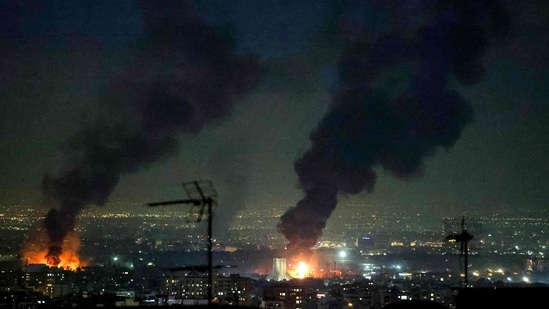
A week into the war between the US-Israel alliance and Iran, both sides sent mixed messages on Saturday — with US President Donald Trump seizing on an Iranian apology as proof of surrender while threatening to widen the bombing campaign, and Tehran expressing regret for strikes on Gulf neighbours even as its missiles and drones continued to fly. Track Iran US conflict updates
Saturday marked one week since the US and Israel began striking Iran — a conflict that has virtually shut down shipping through the Strait of Hormuz for six days, driven the sharpest weekly surge in crude prices in over four decades, and shown no sign of winding down. With Trump demanding unconditional surrender and Tehran vowing to fight on, the signals from both sides suggested the rhetoric was serving the war, not any path out of it.
Iran President Masoud Pezeshkian — part of the three-man interim leadership council that took charge after US and Israeli strikes killed Supreme Leader Ayatollah Ali Khamenei on February 28 — said he had told the military not to attack any nation that was not striking the Islamic Republic. He apologised to neighbouring countries, calling them “our brothers”, without naming them specifically.
“The idea that we would surrender unconditionally — they must take such a dream to the grave,” Pezeshkian said, responding to Trump’s demand a day earlier that Iran give up without negotiation.
In the hours that followed, Iran continued to launch drones and missiles at Gulf states including Qatar, Bahrain and the UAE, even as Kuwait, OPEC’s fifth-biggest producer, scaled back oil and refinery output, blaming what it called the “ongoing aggression by the Islamic Republic of Iran.”
An Iran armed forces spokesman said Tehran had “not attacked countries that did not provide the space or means for aggression against us” — a formulation that effectively justified strikes on Gulf states hosting US military bases, and puncturing any hopeful reading of Pezeshkian’s remarks.
Iran’s UN mission, meanwhile, asserted that Tehran “targets only military bases and U.S. assets,” and claimed, without offering evidence, that damage to non-military sites “may have resulted from interception by U.S. electronic defense systems.”
Trump seized on Pezeshkian’s apology, saying he was forced into it by “the relentless U.S. and Israeli attack.” “Today Iran will be hit very hard!” Trump said in a social media post, adding that the attacks would continue “until they surrender or, more likely, completely collapse!”
He said the US was giving “serious consideration for complete destruction and certain death, because of Iran’s bad behavior” to “areas and groups of people that were not considered for targeting up until this moment in time.”
Iranian media, including the semi-official Jamaran news agency, read the post as a threat against civilians. US and Israeli strikes have so far appeared to focus on military and government sites rather than a wholesale bombing of cities and civilian infrastructure.
Trump also called for the US and its allies to select a “GREAT & ACCEPTABLE Leader(s)” of Iran. On Mojtaba Khamenei, the slain supreme leader’s second-oldest son who is in the running for the succession, Trump said he was a “lightweight” who would not change the regime’s policies and insisted on being personally involved in picking the country’s next leader. Iran’s Assembly of Experts plans to hold a session to elect a new supreme leader within the next 24 hours, the semi-official Fars news agency reported.
The war has killed at least 1,332 people in Iran, more than 200 in Lebanon and 11 in Israel, according to officials in those countries. Six US troops have died, all in the first two days of fighting. Tehran remained under severe bombardment, with even residents far from military and government targets living in fear.
Israel also expanded its ground presence inside Lebanon, intensifying a parallel offensive against Hezbollah. Lebanon’s health ministry said at least 120 people were killed there.
The economic toll of the conflict continued to mount. US crude futures closed the week above $90 a barrel — more than $20 higher than a week earlier, according to Bloomberg. Brent crude settled above $92.
Vessel-tracking data compiled by Bloomberg showed that traffic through the Strait of Hormuz, the narrow waterway through which much of the world’s oil and gas passes, had ground to a near-standstill, with only Iran-linked tankers making the crossing. Tehran warned on Friday that it would target US- and Israel-linked ships in the strait. Saudi Arabia responded by rerouting millions of barrels of crude to a Red Sea port to keep some exports flowing.
Goldman Sachs analysts wrote on Friday that oil prices could top $100 the following week if no path to a resolution emerged, and warned that the 2008 and 2022 price peaks could be breached if Hormuz traffic remained depressed through March.
Qatar, one of the world’s largest liquefied natural gas producers, was forced to shut a major processing facility. Airlines have cancelled more than 27,000 flights to Middle East hubs since the fighting began, leaving thousands of passengers stranded across the region.
German Chancellor Friedrich Merz cautioned the US and Israel against an open-ended conflict, warning it risked the disintegration of Iran, a fresh migration crisis in Europe and prolonged economic damage. Saudi Arabia, separately, opened direct channels with Tehran to try to lower the temperature, according to several European officials cited by Bloomberg.
By agencies