

The world may be hours away from one of the most consequential military strikes in recent history. US President Donald Trump, according to American media citing White House sources, has held a secret meeting with senior military commanders in Washington in which officials recommended Saturday as the optimal window to launch a large-scale attack on Iran. The final order rests with Trump alone. And by all indications, it may already be written.
Trap is set
Iran has been surrounded. Not overnight, not by accident, but through months of deliberate, methodical positioning that has left Tehran encircled from every direction. Over 120 advanced American fighter jets are now active across six key bases in the region. Qatar’s Al Udeid Air Base, the nerve centre of US Central Command, hosts F-22 Raptors and F-35 stealth aircraft. Saudi Arabia’s Prince Sultan Air Base has F-15s, F-35s, refuelling tankers and reconnaissance aircraft, backed by freshly deployed air defence missile batteries. The UAE’s Al Dhafra Air Base adds more F-22s and F-35s to the ring. Jordan’s Muwaffaq Salti Air Base, which previously shot down Iranian drones targeting Israel, is home to F-35A and F-15E jets. Bahrain hosts the US Navy’s Fifth Fleet, capable of launching guided-missile destroyer strikes and torpedo attacks on Iranian naval assets.
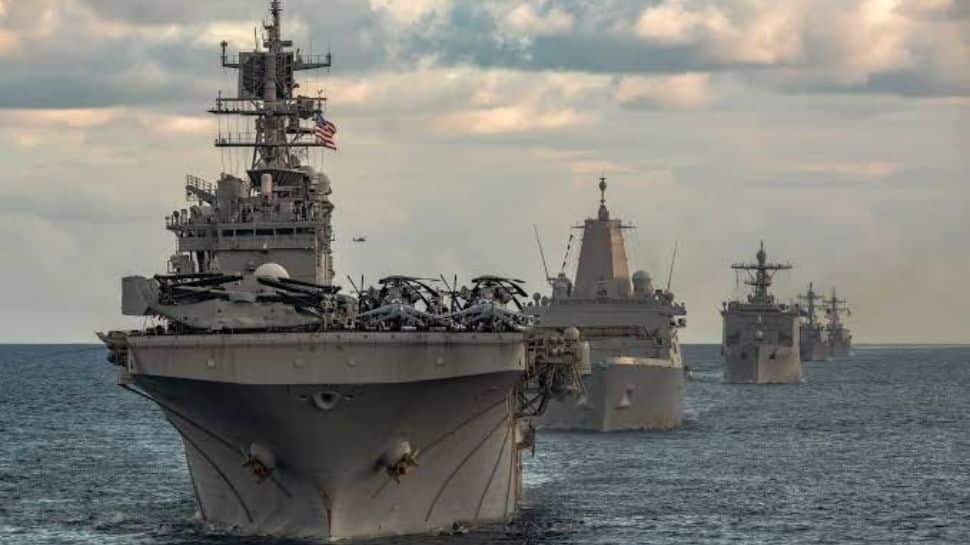
At sea, the USS Abraham Lincoln carrier strike group is already on station in the Arabian Sea. The USS Gerald R. Ford is en route. Together, they are supported by more than a dozen warships in the Persian Gulf and Gulf of Oman. In total, Washington has deployed nearly one-third of its entire naval force to this single theatre of operation.
Strike will come from everywhere
What makes this buildup different from previous standoffs is its geography. The US is not preparing a strike from one direction; it is preparing one from every direction simultaneously. American Air Force aircraft were spotted on Wednesday on the runway at Sofia Airport in Bulgaria, a NATO ally in southeastern Europe from which fighter jets can reach Tehran in just two hours. Trump has also told British Prime Minister Keir Starmer not to hand over Diego Garcia, the British-controlled island base in the Indian Ocean, under any circumstances. Trump was explicit about why. If Iran refuses a deal, he said, the US will need Diego Garcia and Britain’s Fairford airfield to neutralise Tehran. The base currently holds six B-2 stealth bombers and four B-52s. The B-2 can carry 30,000-pound GBU-57 bunker-busting bombs. The B-52 can strike targets 14,000 kilometres away. Both can reach Tehran.
Meanwhile, US Navy MQ-4C Triton surveillance drones, equipped with 360-degree radar capable of tracking hundreds of targets simultaneously, have been spotted conducting sorties over the Persian Gulf from the UAE’s Al Dhafra base. Their mission, according to reports, is to map Iran’s naval infrastructure ahead of a first strike designed to destroy Tehran’s maritime capabilities before anything else.
Iran is not waiting
Iran knows what is coming. President Masoud Pezeshkian has stated publicly that he is prepared to die but will not retreat. Satellite imagery tells the rest of the story – nuclear and military sites across Iran are being buried under concrete and reinforced earth, converted into hardened bunkers capable of withstanding aerial bombardment. The Parchin military complex, previously struck by Israel and the US, is undergoing the most intensive fortification. Iran’s message is clear: if you strike, you will not destroy us easily.
Russia chose this moment to conduct joint naval exercises with Iran in the Gulf of Oman, directly alongside American warships. The signal was unmistakable. China, however, withdrew its vessels from the drill at the last minute, a move that analysts interpreted as Beijing quietly distancing itself from Tehran at the worst possible time for Iran.
Has diplomacy failed?
Nuclear talks between Washington and Tehran concluded in Geneva on February 17 without a breakthrough. Both sides described the discussions as constructive, but sources told The Jerusalem Post that fundamental gaps remain unbridged. Iran is expected to return with fresh proposals within two weeks. But with bombers fuelled, drones mapping targets and a strike date reportedly already chosen, two weeks may be a luxury that no longer exists.
World is already reacting
Markets do not wait for official announcements. Gold surged past $5,500 per ounce in the United States, a historic record never seen before. In India, gold prices jumped Rs 3,000 in a single day to touch Rs 1,55,000 per 10 grams. Brent crude is climbing toward $70 per barrel. The reason is simple, the Strait of Hormuz, through which 20 per cent of the world’s daily oil supply passes, sits at the centre of this conflict. If war begins, that supply does not just slow down. It stops. And the economic shockwave will reach every country on earth, including India.
The date has reportedly been chosen. The assets are in position. The drones are already over Iran. What happens next depends on a single decision, one that, according to every signal coming out of Washington, may already have been made.


