
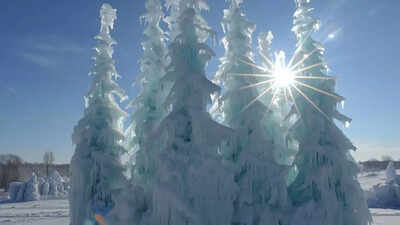
In the depths of winter, the forests of the Zao Mountain Range transform into something almost surreal. The trees no longer resemble trees. They rise in bulky, twisted shapes, layered in thick white ice, standing silently against the wind. Visitors call them Japan’s “snow monsters. ” In Japanese, they are known as juhyo, literally, “ice trees. ”
At first glance, they look mythical. In reality, they are the result of a precise and fragile atmospheric process. And scientists warn that the conditions required to create them are becoming harder to sustain.
The science behind Japan’s snow monsters
The formations occur primarily on Mount Jizō in Zao, which straddles Miyagi and Yamagata prefectures. According to researchers at Yamagata University, forms when strong seasonal winds blow in from the Sea of Japan, carrying clouds filled with supercooled water droplets.
When those droplets collide with conifer trees, especially the native Aomori fir, they freeze instantly.
Over days and weeks, layers of rime ice accumulate. The ice thickens on the windward side of the tree, gradually forming ridges known locally as “shrimp tails.” As more ice builds up, the trees lose their natural outline and take on the hulking shapes that earned them the nickname “snow monsters.”
According to local tourism authorities and the Zao Ropeway, the best time to see this phenomenon is typically from mid-January to early March, when temperatures remain consistently below freezing, and winds are strong enough to sustain ice formation.
From Hokkaido to Ishikawa: The lost range of Japan’s snow monsters
What many visitors do not realise is that these snow monsters were once far more widespread.
Professor Fumitaka Yanagisawa, Professor Emeritus at Yamagata University’s Research Institute for Ice Monsters and Volcanoes of Zao, has spent years examining historical photographs and mountaineering records. According to his research, juhyo formations were documented not only in Zao but also across Hokkaido and as far south as Ishikawa Prefecture. Historical records suggest they extended up to 50 to 60 kilometres inland from the Sea of Japan until around the mid-20th century.
One of the earliest confirmed photographs dates back to 1921, taken by a mountaineering club from Keio University in Zao. Another rare image from 1923 was identified in Toyama Prefecture. Additional documentation from Nagano and Niigata prefectures further supports the idea that juhyo once covered a broader geographic range.
Today, though, the most important remaining sites are all in three places: Mount Zao, Mount Hakkoda, and Mount Moriyoshi. Among them, Zao remains the largest and most iconic.
What rising temperatures mean for Japan’s snow monsters
The reason for their retreat is not folklore but physics.
According to Professor Yanagisawa’s climate analysis, rising winter temperatures and subtle shifts in wind patterns are reducing the frequency of ideal juhyo-forming conditions. Even small rises in the average winter temperature can make freezing periods shorter, lower the amount of supercooled cloud water, and hurt the health of Aomori fir forests that support the formations.
As per the Japan Meteorological Agency, the data over recent decades show a gradual warming trend in northern Japan’s winter temperatures. While researchers stop short of predicting a complete disappearance, projections suggest that without significant climate stabilisation, the density and range of juhyo may continue to shrink by the end of the century.
In this sense, the snow monsters are more than a tourist attraction. They are visible markers of environmental change.
The cultural pull of frozen giants
The emotional bond goes deeper than science. People who live in Yamagata and Miyagi remember the snow monsters from their childhood, winter festivals, and night tours along the ropeway.
Their ghostly shapes naturally remind us of Japan’s long history of folktales. Shintoists believe that kami, or spirits, live in nature. The strange shapes that appear in winter often remind visitors of yokai, which are supernatural beings from Japanese stories. The Snow Woman, Yuki-onna, is one of these figures. Her story goes back to the Muromachi period.
The fact that juhyo looks like these myths adds to their mystery, even though they don’t come from them directly. In books like Ancient Tales and Folklore of Japan, British naturalist Richard Gordon Smith and other early Western observers wrote about winter folklore, saying that snow spirits haunted mountain landscapes. The images still have an effect today.
For now, Zao’s snow monsters still rise each winter
Every year, thousands of people go to Zao to see the glowing ice formations against the night sky. Skiers weave between frozen towers, and photographers take pictures of the strange shapes.
But scientists still keep a close eye on the forests. The main goals are to study the weather, keep an eye on the health of the forests, and figure out how long-term warming could change the mountain ecosystems in northern Japan.
The snow monsters are still there for now. When the winds are cold enough and the clouds are heavy enough, they rise again each winter.
But their future depends on a fragile balance of time, temperature, and wind. And in Zao, many understand that equations like that are becoming harder to balance.


