The year of the fire horse, which began on February 17th, is hardly galloping along for many Chinese. A property bust and chronic deflation have eroded people’s assets, incomes and prospects. Residential property, where Chinese people store the bulk of their wealth, has lost a fifth of its value on average since 2021. Wage growth is weak. And youth unemployment is hovering around 17%. Some graduates find themselves forced into precarious employment in the gig economy. Others say they are choosing to “lie flat” rather than look for a job.

But in a sea of people losing, one group is winning. They are what Xi Jinping, China’s leader, calls nongchaoer: a Chinese term referring to those who “ride the tide” of great economic changes. Today that tide is flowing towards the strategic technologies, such as artificial intelligence and robotics, that dominate the country’s five-year plans for tech supremacy (the next one will be released in March and will cover the period to 2030). Smart, young and sometimes from modest backgrounds, the nongchaoer do not flash their growing wealth (and in any case, tend to prefer home-grown electric vehicles to Porsches). And they do not see officials as a source of pesky regulation to be avoided—but as their biggest backers. Mr Xi met a group of them publicly just before the lunar holiday.
These tide-riders are different from winners of the past in several ways. Education is an important one. In recent decades China’s economic rise created several waves of opportunity for the talented or lucky: from low-end manufacturing in the early 2000s to the rise of e-commerce in the 2010s and the property boom which lasted until 2021. Each minted its own millionaires and billionaires. In the boom times even a certificate from a backwater college could go a long way. In 2017 a survey of China’s 2,000 wealthiest entrepreneurs found that half had no degree at all.
But today’s nongchaoer are an elite bunch. They typically hold stem degrees from one of China’s top 40-odd universities, known as the “985” group, which every year produce just 460,000 of the country’s 12m graduates (including masters and phd students). The youngest members of the group that Mr Xi met, for example, included Zhang Linfeng, the co-founder of a company applying AI to science; Chen Jianyu, the founder of a robotics firm; and Wang He, another roboticist working on embodied AI. All were born in the 1990s and graduated from “985” institutions.
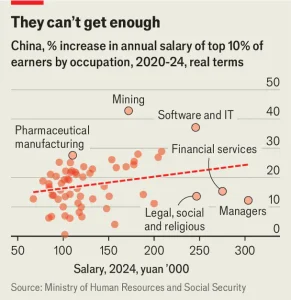
Opportunities in China’s economy once lay in lots of places, from social connections to land. Now they primarily go to those who can grasp technology, says Li Jingyuan, a graduate of Zhejiang University (also a 985 college) and the founder of a company that makes 3d printers. Government data suggest that lucrative careers in China are increasingly concentrated in the highest echelons of tech. The financial sector, although still cushy, has seen only sluggish salary growth in the past few years amid a crackdown on bankers’ bonuses (see chart). Lawyers have fared even worse.
But the top tenth of software engineers by salary have seen their wages grow by 8% per year in real terms since 2020. The smartest engineers have enjoyed pay hikes amid a war for talent among China’s big-tech companies. An ai researcher at one such company in Beijing admits he has far more money than he knows what to do with (he spends most of his time at work and his hobby, hiking, is hard to splash cash on). DeepSeek, China’s AI darling, has been offering salaries of more than 1.4m yuan ($200,000) per year, over ten times that of the average white-collar worker in China.
Nongchaoer tend to concentrate in just a few places: Yizhuang, a techy district of Beijing, Shenzhen, a southern electronics manufacturing hub, and Hangzhou, a canal-crossed city in eastern China. On the surface their offices mimic those in Silicon Valley, complete with beanbags, table football and wandering robots. But the difference lies in the looming presence of the government. The walls bear framed pictures of visiting Communist Party cadres and awards from local officials praising “model” companies.
Only recently China’s tech sector was battered by officialdom. In 2020 Jack Ma, the founder of Alibaba, a tech giant, made a speech attacking regulators for stifling innovation with “outdated supervision”. Mr Ma then disappeared for several months and officials blocked the planned initial public offering of one of his companies. China has since squeezed its tech sector, with regulators targeting everything from cryptocurrency exchanges to video-game developers. Officials prefer the brightest and best to be in the strategic industries China needs to compete with America. Mr Xi has urged tech workers to “cultivate feelings of devotion towards serving the country”.
The nongchaoer are keen to emphasise the ways officials help, rather than hinder them. Policy can cause “uncertainties”, but it creates lots of “certainties” too, says Yi Haoxiang, the 35-year-old founder of a company in the city that makes AI-powered smart-glasses and a brain-computer interface intended to help treat depression (both are technologies the government has marked as national priorities). Local officials subsidise his r&d costs, office rent and travel to overseas conferences. Mr Yi praises the way officials “prevent excessive, destructive competition” by discouraging bidding wars over new patents from universities. “The government is the most stable force in the country, so the closer you get to it the more stable you become,” says Fred Chu, a 32-year-old whose company sells ai-powered monitoring software to the Hangzhou government for around 10m yuan a year. It is used for real-time tracking of road and environmental conditions.
State-guided innovation of this sort has its problems. Priorities are set by central-government officials betting on the technologies they happen to think will prove critical. Local officials burn cash supporting favoured but feeble firms in their neighbourhoods. And state-supported industries can lurch from glory to gore if subsidies are pulled back. But for a smart entrepreneur willing to surf where directed, money sloshes from local-government coffers, state-owned companies and national venture-capital funds. Just in December China’s central government announced a new 100bn yuan fund to invest in startups. And it is hard to deny that some of the results from all this state involvement are impressive. Chinese tech companies are now globally competitive in everything from electric vehicles and renewable energy to telecommunications and ai.
The party’s big bet on high-tech industries may not end up benefiting most Chinese workers. Economists at Citigroup, a bank, point out that big industrial firms have shed 23m jobs since 2014. Automation, they argue, is largely to blame. Still, Mr Xi seems sure his approach to China’s development is the right one. “Sci-tech self reliance is the key to building China into a great modern socialist country,” he told the nongchaoer group. Mr Xi’s “cordial exchange with us has strengthened our determination and sense of mission even more”, one later told state media.