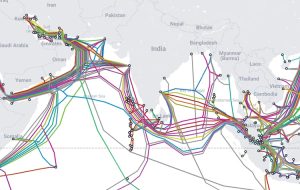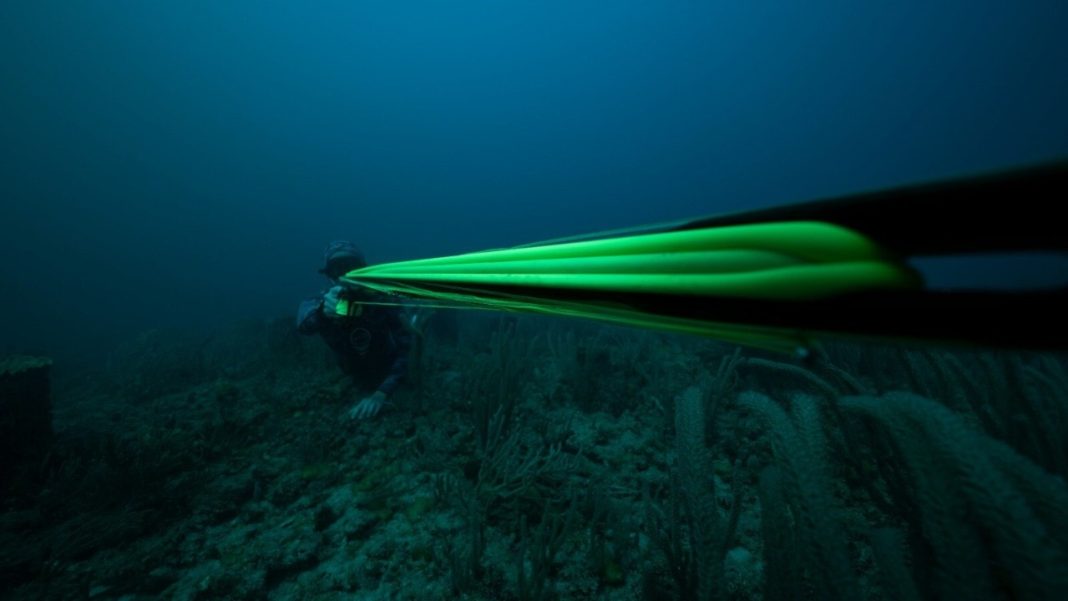
Invisible yet indispensable, submarine or subsea cables form the physical backbone of the modern internet infrastructure. Over 99% of international data traffic, from video calls and financial transactions to e-mails and cloud services, travels through fibre-optic cables laid silently across the ocean floor, according to the United Nations Office at Geneva. Two proposed undersea cable projects fit perfectly into this global network.
The first is the recently announced proposed India-America Connect Initiative announced by Google to connect India, Australia, South Africa, Singapore, and the US with new cable networks to boost AI connectivity. The second is the proposed Singapore-India-Gulf (SING) subsea cable project, stalled since 2023, but is now seeing fresh developments in the UAE-backed project that will boost data transfers from Southeast Asia to the Middle East, via India.
Before getting into why the India-America Connect Initiative and the SING projects are so important, let’s have a look at the undersea cable networks.
WHAT ARE SUBSEA CABLES AND WHY THEY ARE IMPORTANT?
As noted by TeleGeography, subsea cables are fibre-optic communication lines on the seabed that carry the vast majority of global data flows. At their core, these cables are bundles of ultra-thin glass fibres, protected by layers of steel, copper and insulation. Data is transmitted as pulses of light, amplified at intervals by underwater repeaters.
Once laid, cables can be used reliably for decades, quietly linking continents and economies.
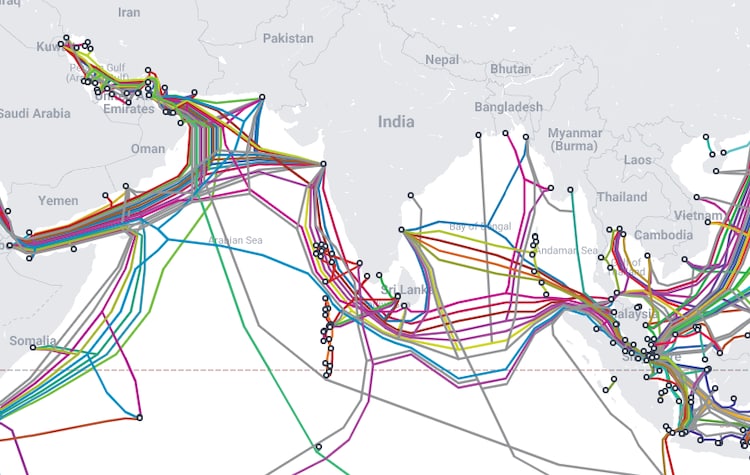
So, what are subsea-cable projects like Google’s America-India Connect project and the SING project, and how does India fit into this global infrastructure?
WHAT IS THE INDIA-AMERICA CONNECT INITIATIVE BY GOOGLE?
Speaking at a Google event in Delhi on Thursday, CEO Sundar Pichai said the company is launching the India-America Connect Initiative, under which it will build new subsea cable routes to increase AI connectivity between India and the US. “Today, we are announcing the India-America Connect Initiative, which will deliver new sub-sea cable routes to increase AI connectivity between India and the US and multiple locations across the Southern Hemisphere,” said Pichai.
At the centre of Google’s massive AI-led investment in India is its America-India Connect initiative. As part of this project, Google will establish a new international subsea landing station in Visakhapatnam, creating an additional entry point into its global network. From there, three new subsea routes are planned to link India with Singapore, South Africa and Australia.
The company will also add four terrestrial fibre routes designed to improve connectivity between India, the US and locations across the Southern Hemisphere.
The planned US–India undersea cable link is part of Google’s plans to invest $15 billion in India’s AI infrastructure. Google says the goal of the subsea cables is to increase network capacity and reduce the risk of outages by diversifying how traffic flows between regions. The new infrastructure is expected to support rising demand for cloud computing and AI services in India, while also strengthening connections with Africa, Australia and parts of Southeast Asia.
WHAT IS THE SINGAPORE-INDIA-GULF SING PROJECT?
The Singapore-India-Gulf (SING) subsea cable system is a planned high-capacity fibre-optic network designed to create a new digital corridor linking Southeast Asia, South Asia and the Middle East.
The project traces its origins to September 2019, when Cyprus-based subsea infrastructure firm Datawave Networks incorporated its Indian subsidiary and began regulatory and planning work. SING was formally announced in April 2020 as a cable connecting Singapore with India and the Gulf. In August 2021, Datawave secured an International Long Distance (ILD) licence from India’s Department of Telecommunications (DoT), a key regulatory milestone.
However, according to industry tracker Submarine Networks, the project stalled for several years due to financing challenges, missing its initial 2023 service target.
Renewed momentum came in early 2026, when the New York-based equity firm, Cerberus Capital Management acquired a majority stake in Datawave, unlocking full project financing. According to a report in Business Wire, Datawave entered into a binding investment and financing agreement with Cerberus for the development of the SING cables system. According to the report, Cerberus will make a significant equity investment in Datawave, securing a majority ownership position, and will also provide project financing to support the construction and deployment of the SING cable system. The investment will enable Datawave to advance the SING project into full execution.
As reported by Reuters, the investment also aligned SubCom, a US-based firm specialising in subsea cable infrastructure for system design, manufacturing and deployment. The project got more momentum when the Dubai-based telecom operator, du, announced a strategic partnership to land and invest in the cable in the UAE. Under the partnership, du will land the cable at its Kalba landing station and participate financially in the project’s rollout.
The SING system is planned to feature 16 fibre pairs, each capable of transmitting at least 18 terabits per second, with landing points at Kalba (UAE), Muscat (Oman), Mumbai and Chennai (India), Kedah (Malaysia), and Singapore, and is likely to be completed by 2030.
The SING undersea cable project will boost India’s plans to strengthen its role as a regional digital connectivity hub. By installing cable landing stations in Mumbai and Chennai, which already host stations for 17 other pre-existing cable networks, India aims to boost its capacity to handle global data traffic and act as a gateway between Asia and the Middle East.
The project is also intended to improve route diversity and resilience by reducing dependence on pre-existing subsea corridors such as the Red Sea route, which as recently as September last year faced disruptions due to cable networks getting damaged. Enhanced international bandwidth from the cable is expected to support India’s growing digital economy, including cloud services, data centres and AI-driven workloads. Furthermore, a report by Developing Telecoms stated that the SING project would provide lower latency, higher bandwidth and more secure east–west digital connectivity between India with Singapore, Malaysia, United Arab Emirates and Oman,
WHAT ARE SUBSEA CABLES AND WHY ARE THEY IMPORTANT?
According to TeleGeography, subsea cables, also known as Submarine Communications Cables, are specialised, highly ruggedised fibre optic cables that cross the seabed between land-based stations to carry telecommunications signals. They are the backbone of global internet and data communications and transmit data such as internet traffic, telephone calls, and private data.
As of 2025, there are more than 600 active and planned subsea cables spanning over 1.48 million kilometres of ocean floor worldwide. While most cables are laid directly on the seabed by specialised cable laying ships, they are often buried near coastlines to protect them from marine traffic and fishing activity.
Research cited by Economy Insights shows that 95–99% of international internet traffic travels through subsea cables rather than satellites. Satellites account for well under 5% of cross-border data, largely because they cannot match fibre-optic cables in capacity, speed or cost efficiency.
Modern cable systems can transmit over 200 terabits per second, with total global subsea capacity exceeding 3 petabits per second and rising rapidly due to cloud computing, streaming and AI workloads. These networks also carry trillions of dollars in financial transactions every day, and are designed with redundancy, so traffic can be rerouted during outages—making them critical, resilient infrastructure for the global economy.
WHAT SUBSEA CABLE NETWORKS ARE HOSTED BY INDIA?
According to the Telecom Regulatory Authority of India (Trai), India hosts 17 international subsea cable landing stations across five cities—Mumbai, Chennai, Kochi, Tuticorin and Thiruvananthapuram. These cables connect India to Europe, the Middle East, Africa, Southeast Asia and East Asia, carrying most of the country’s international data traffic.
According to TeleGeography, Mumbai is India’s largest subsea cable hub, hosting major systems such as SEA-ME-WE, TGN-Gulf, FLAG, IMEWE, BBG, IOX and 2Africa, providing high-capacity routes to Europe, Africa and the Middle East. On the east coast, Chennai serves as the primary gateway to Southeast Asia and the Pacific, with cables including i2i, SMW-3, Bay of Bengal Gateway (BBG) and SEA-ME-WE-5.
Between 2024 and 2026, India also saw three major new systems come online, including IAX (India-Asia Xpress), IEX (India-Europe Xpress) and 2Africa Pearls—strengthening its position as a critical node in global subsea connectivity. Projects like the India-America Connect Initiative and SING will help boost global undersea cable infrastructure, with India as a key part.
(With research support by Meenal Sharma)