

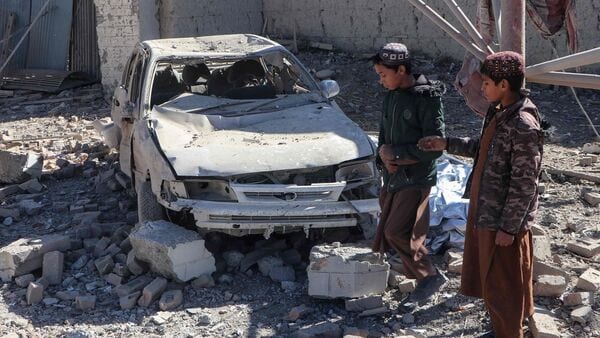
Pakistan Attack on Afghanistan: Khawaja Asif, Pakistan’s Defence Minister, declared an ‘open war’ on the Taliban government in Afghanistan on Friday, hours after Pakistan carried out airstrikes in Kabul and two other Afghan provinces in ‘retaliation’ to Afghanistan’s “cross-border attack.’
Afghanistan’s Taliban government had said it launched attacks against Pakistan’s military positions along their border in response to Pakistani air strikes last week in the latest escalation of violence between the neighbouring countries that made a Qatar-mediated ceasefire appear increasingly shaky.
“Our patience has reached its limit. Now it is open war between us and you,” Asif posted on X. Earlier, Pakistan released aerial footage of Kabul strikes.
Thursday’s strikes
In Thursday’s strikes, Pakistan said it had launched a retaliatory operation in response to the alleged border attacks by the Afghan Taliban, saying it had killed over 130 Taliban fighters. Operation Ghazab lil Haq commenced late Thursday night after the Afghan Taliban allegedly launched attacks on several border posts.
Tension has been high between the two neighbours for months, with deadly border clashes in October killing dozens of soldiers, civilians and suspected militants. The violence followed explosions in Kabul that Afghan officials blamed on Pakistan. Islamabad, at the time, conducted strikes deep inside Afghanistan to target militant hideouts.
A Qatari-mediated ceasefire between the two countries has largely held, but the two sides have still occasionally traded fire across the border. Several rounds of peace talks in November failed to produce a formal agreement.
On Sunday, Pakistan’s military carried out strikes along the border with Afghanistan, saying it had killed at least 70 militants.
Afghanistan rejected the claim, saying dozens of civilians had been killed, including women and children. The Afghan Defence Ministry said “various civilian areas” in eastern Afghanistan had been hit, including a madrasa, an Islamic seminary and several homes. The ministry said the strikes violated Afghanistan’s airspace and sovereignty.
What’s at the heart of border tensions?
The series of attacks threatens a fragile ceasefire following border clashes in October that killed dozens of soldiers, the worst fighting between the two countries since the Taliban took over Kabul in 2021.
Pakistan welcomed the return to power of the Taliban in 2021, with then-Prime Minister Imran Khan saying that Afghans had “broken the shackles of slavery”. But Islamabad soon found that the Taliban were not as cooperative as it had hoped, according to a Reuters report.
Over the years, however, Pakistan has accused Afghanistan of harbouring armed groups led by the Pakistan Taliban, known by its acronym TTP, on its soil. Militancy has increased every year since 2022, with attacks from the TTP and Baloch insurgents growing, according to Armed Conflict Location & Event Data, a global monitoring organisation cited by Reuters.
The blame on Tehrik-i-Taliban Pakistan
Islamabad says militant violence has surged in Pakistan in recent years, much of which Pakistan blames on the Tehrik-i-Taliban Pakistan (TTP) and Baloch separatist groups. The TTP is separate from the Afghan Taliban but shares deep ideological, social and linguistic ties with the group. The TTP emerged in 2007 in Pakistan’s tribal districts.
The Afghan Taliban has repeatedly denied allowing militants to use Afghan territory to launch attacks in Pakistan.
Pearl Pandya, South Asia senior analyst at the US-based Armed Conflict Location & Event Data, an independent, impartial conflict monitor, told Al Jazeera that the “porous border” with Afghanistan provides fighters with a safe haven to retreat to amid military pressure.
“The Afghan Taliban, however, appear unwilling to seriously crack down on the TTP, partly due to prior affinities between the two groups but also out of fear of TTP militants defecting to its main rival, the Islamic State Khorasan Province,” she added.
Ready to secure nation’s safety: Shehbaz Sharif
Earlier this week, President Asif Ali Zardari also voiced that Pakistan would not compromise on peace and territorial integrity, asserting, “Our armed forces’ response is comprehensive and decisive. Those who mistake our peace for weakness will face a strong response – and no one will be beyond reach.”
Prime Minister Shehbaz Sharif said that the people and armed forces of Pakistan are always ready to secure the nation’s safety, sovereignty, and territorial integrity. In a statement released by the Prime Minister’s Office, Sharif reiterated the armed forces’ commitment to safeguard the country’s security and peace.
“Our forces are fully capable of crushing any aggressive ambitions,” he said. “There will be no compromise on the defence of the beloved homeland and every aggression will be met with a befitting reply,” he said.
Pakistan vs Afghanistan – what next?
As things stand, Pakistan’s Defence Minister has on social media declared an ‘open war’ on the Taliban government in Afghanistan. And earlier, after the Pakistan air strikes, the Taliban warned, “an appropriate and measured response will be taken at a suitable time.”
Analysts say this is likely to impede cross-border action. Militarily, there is a wide mismatch between the two countries. At 172,000, the Taliban have less than a third of Pakistan’s army personnel.
Though the Taliban do possess at least six aircraft and 23 helicopters, their condition is unknown, and they have no fighter jets or effective air force, according to Reuters
Our patience has reached its limit. Now it is open war between us and you.
Pakistan’s armed forces include more than 600,000 active personnel, have more than 6,000 armoured fighting vehicles and more than 400 combat aircraft, according to 2025 data from the International Institute for Strategic Studies. The country is also nuclear-armed, as cited by news agencies.
(With inputs from Reuters, AP and Al Jazeera)
- The fragile ceasefire between Pakistan and Afghanistan is increasingly threatened by retaliatory strikes.
- Pakistan’s military claims a significant number of Taliban fighters have been killed in recent operations.
- The conflict is fueled by accusations of cross-border militant activity and the harboring of the Pakistan Taliban (TTP) by Afghanistan.


