

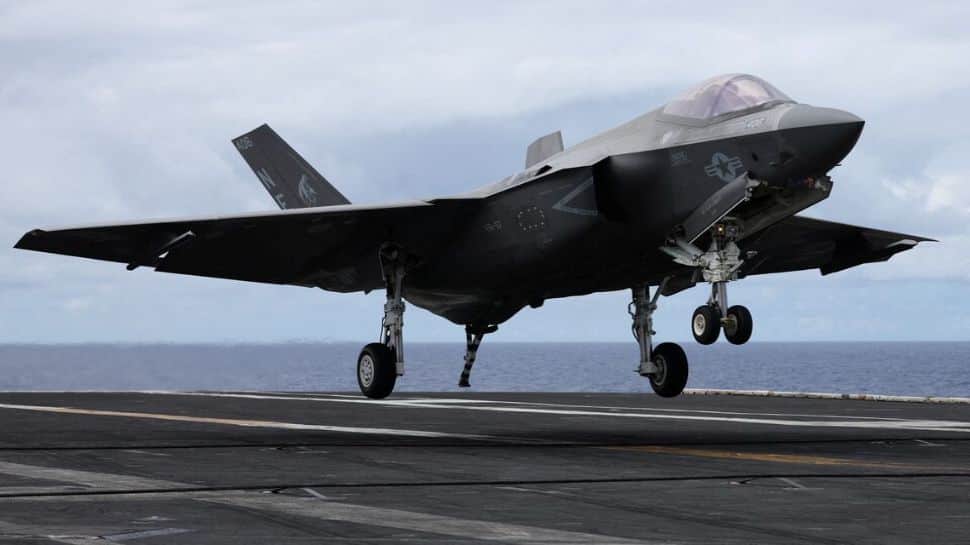
F-35 Lightning II: How America’s Stealth Fighter Controls Global Air Power
Key Takeaways
- The F-35 serves as both a combat aircraft and strategic diplomatic tool for the United States
- Advanced sensor fusion and networking capabilities make it virtually undetectable while providing complete battlefield awareness
- Washington maintains strict control over technology access, creating tiered alliances among partner nations
The Lockheed Martin F-35 Lightning II represents a fundamental shift in air combat, combining fifth-generation stealth technology with unprecedented networking capabilities that have reshaped global military alliances and power dynamics.
Since its introduction, this fighter jet has transformed from a mere aircraft into a strategic instrument of US foreign policy, influencing defense decisions from the Indo-Pacific to Europe and the Middle East.
Middle Eastern Strategic Calculus
The potential F-35 sale to Saudi Arabia highlights Washington’s careful balancing act in the region. While discussions occurred during Crown Prince Mohammed bin Salman’s White House visit, any Saudi jets would operate in restricted configurations to preserve Israel’s qualitative military edge.
Israel maintains exclusive access to advanced systems and modification rights as the first West Asian operator eight years ago. Experts note that even if Saudi Arabia acquires F-35s, it would likely be denied next-generation weapons like the AIM-260 Joint Advanced Tactical Missile and sophisticated electronic warfare software.
Fifth-Generation Combat Revolution
The F-35 represents a complete transformation in air power concepts. Unlike legacy aircraft relying on speed and maneuverability, fifth-generation fighters prioritize stealth, sensor fusion, and network-centric operations.
Core capabilities include:
- Radar and infrared signature minimization
- Real-time data fusion from multiple sources
- Electronic warfare and jamming systems
- Software-upgradable combat systems
These features allow F-35 pilots to detect threats, make decisions, and engage targets while remaining virtually invisible. As one US defense analyst noted, “The F-35 is what happens when a jet becomes a computer that kills.”
Diplomatic Leverage Through Technology
Each F-35 sale binds recipient nations to American logistics, training, and strategic oversight. The aircraft serves as a powerful diplomatic tool, with operational capabilities directly tied to alignment with US policy.
Turkey’s expulsion from the program after acquiring Russian S-400 systems demonstrates the consequences of deviating from Washington’s expectations. Even close allies operate with carefully calibrated access levels, with Israel enjoying unprecedented autonomy while others use export-limited systems.
Global Air Power Landscape
The F-35 dominates fifth-generation aircraft deployment worldwide, with operations across Europe, Japan, South Korea, and Australia aligned with US strategic priorities.
While China’s J-20 and Russia’s Su-57 represent competing efforts, both face limitations in production numbers and global integration. The F-35 remains the benchmark for advanced airpower, determining which nations participate in the world’s most sophisticated combat network.
The aircraft’s satellite-driven mesh network allows passive intelligence gathering, weapons guidance, and tactical data sharing across hundreds of kilometers while maintaining stealth. Nations operating F-35s gain entry into this exclusive ecosystem, while those excluded face growing technological disparities in modern air combat capabilities.