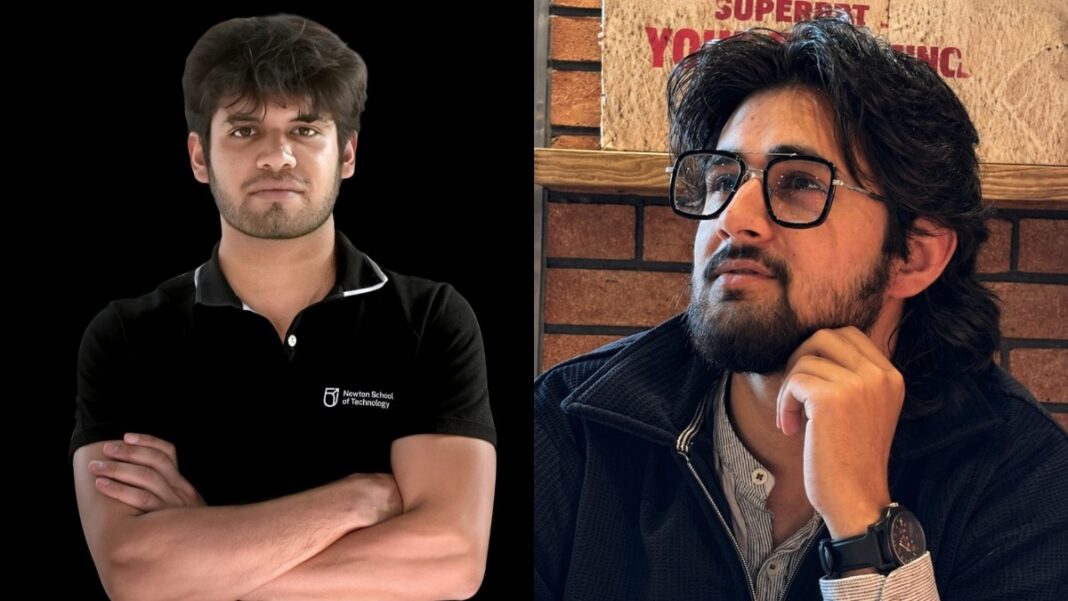
They came to hire 10 students for different job roles and ended up offering 11 students internships, each with a stipend of over Rs 45,000. Emergent, an AI web builder company, chose to hire interns with such stipends instead of opting for fixed roles with multiple engineering designations.
This hiring took place at Newton School of Technology when Emergent visited the campus in March, and what followed was not a typical placement drive but a process that focused less on grades and more on whether students could solve real AI problems, build systems, and work in environments where things do not always behave as expected.
The placement drive has elevated the status of interns in the industry, overturning long-held perceptions of their limited worth.
The focus was clear from the beginning, the company was not looking for perfect resumes, but for students who could think, debug, and handle real systems, and that is where the story begins to reflect a larger change happening across AI companies.
“In high-growth environments, the constraint is rarely sanctioned roles, it is execution bandwidth. When companies find engineers who can operate across systems and contribute from day one, they expand hiring to match that capability. So hiring becomes more fluid. Strong candidates are seen as a way to accelerate product and execution, not just fill predefined roles,” says Tanmay Pandya, Senior Director Newton School of Technology.
WHEN HIRING PLANS BECOME FLEXIBLE
In fast-growing AI companies, the real challenge is not how many roles are approved. The focus has shifted to how effectively teams can build and improve products. When companies find someone who can contribute from day one, they are willing to expand hiring to include that person.
Responding to a question on this, Pandya added, “Earlier, the scarcity lay in the ability to write code. Today, with AI-assisted coding becoming significantly more capable, that constraint is easing. As a result, the scope of an engineer’s role is expanding rapidly.”
He suggests engineers are now expected to:
- Understand systems end-to-end
- Work across multiple layers
- Handle real-world complexity and edge cases
One of the roles offered in this process was AI Agent Reliability Engineer, also known as a Forward Deployed Engineer, and for many students, this was not a familiar role.
Unlike traditional software jobs, where the focus is on building features, this role is about making sure the system works in real-world conditions.
This means working across frontend, backend, and data systems, identifying where things break when users interact with the product, and fixing those issues in a practical way.
It is less about writing code in isolation, and more about making sure the entire system functions properly when it is actually used.

WHAT THE INTERVIEW ACTUALLY TESTED
Students who went through the process realised that this was not a typical placement interview.
Aditya Bijalwan shared that his internship at GyanDhan helped him the most, because he had already worked on production systems involving API integrations, SSO migration, and platform-level debugging.
He also built systems like a Kubernetes cluster, a chatbot, and a real-time voice assistant, which helped him understand how different parts of a system connect and behave in real environments.
“I’m quite comfortable working across the stack because most of my work has been system-oriented rather than limited to a single layer. For example, while building full-stack applications and working during my internship, I had to frequently move between frontend, backend, and infrastructure layers. More importantly, I focus on understanding how data flows through the system, once that’s clear, switching between technologies becomes much easier,” told Bijalwan to India Today.
Because of this experience, he was able to approach problems by understanding the system first, instead of trying random solutions.
“My experience working on production-level systems had the biggest impact,” adds Bijalwan which is a learning for students who are wishing to secure a good position at the beginning of their careers.
Manshu Saini shared a similar experience, where his internship at Allen Digital helped him deal with real-world issues.
He explained that during one round, he had to debug a login issue without being given the code, and instead of guessing, he used tools like the browser developer console and API responses to identify the problem.
“I was quite comfortable switching between these technologies, as they are already part of my working stack and portfolio,” says Saini.
This shows that companies are now focusing on how students think and solve problems, rather than just what they know.
WHY REAL-WORLD EXPERIENCE MATTERS NOW
Earlier, the main focus in placements was coding ability.
Now, that is changing.
“What stood out was the emphasis on both technical and soft skills. Unlike typical campus placements that focus heavily on theoretical or coding-based evaluation, this process also assessed communication, practical thinking, and how you approach real-world scenarios,” says Saini.
With AI tools helping in writing code, companies are placing more importance on engineers who can understand complete systems and solve real-world problems.
This is why students who have worked on real projects, deployed systems, and handled bugs are better prepared for such roles.
RISE OF ALL-ROUND ENGINEERS AND CHANGING ROLE OF INTERNS
What is becoming clear from this shift is the need for engineers who are not limited to one part of the system.
These engineers understand how a product is built, how it is used, and where it can fail.
They are comfortable working across different technologies and layers. This kind of “all-round” engineer is becoming more common in AI companies.
Another important change is how early-stage talent is being treated.
Students selected in this process were offered around 50,000 as stipend, and more importantly, they are expected to work on real systems from the beginning.
This means interns are no longer just learners, but contributors.

Companies expect them to solve problems, take ownership, and be part of the product-building process.
WHAT STUDENTS SHOULD FOCUS ON
For students, this shift changes how preparation should look.
Instead of only focusing on theory or coding questions, it is important to:
- Work on real projects
- Understand how systems work end-to-end
- Practice debugging
- Learn how to handle real-world problems
- The main change is in thinking.
This hiring case is not just one event, because it shows that AI companies are moving towards hiring engineers who can work across roles, handle real systems, and solve problems in live environments, where the focus is shifting from fixed job titles to flexible roles, and from resumes to real-world capability and execution.