

Key Takeaways
- Comet 3I/ATLAS is the third known interstellar visitor to our solar system
- NASA confirms it poses absolutely no threat to Earth
- The comet will pass safely at 130 million miles from the Sun on October 30, 2025
- Scientists confirm it’s a natural object, not an alien spacecraft
A rare interstellar comet named 3I/ATLAS is capturing global attention as it approaches our solar system, with NASA confirming it poses no danger to Earth despite widespread online speculation.
Discovered by NASA’s ATLAS telescope in Chile on July 1, 2025, this mysterious visitor represents the third known interstellar object to pass through our solar system after Oumuamua and 2I/Borisov.
What Makes 3I/ATLAS Special?
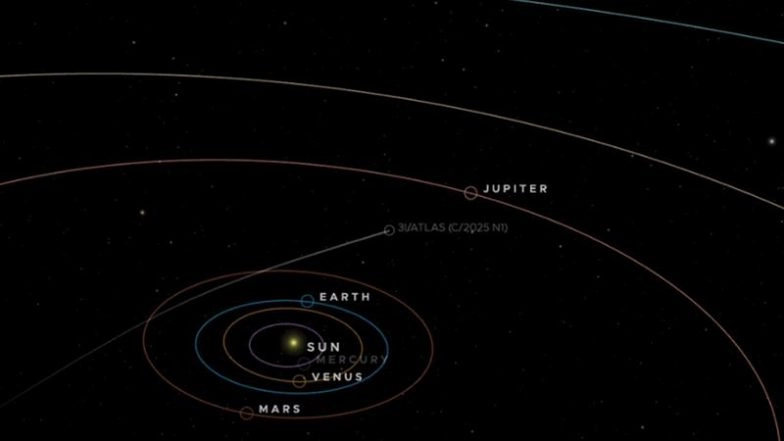
Comet 3I/ATLAS follows a hyperbolic orbital path that doesn’t loop around the Sun, confirming its origins from outside our solar system. This unique trajectory means it’s merely passing through before returning to deep space.
Despite viral theories suggesting alien origins, NASA and astronomers have confirmed the object shows only natural characteristics of a comet – a mixture of ice, rock, and dust. Scientists have observed a teardrop-shaped dust cocoon surrounding its icy core, indicating natural outgassing as it warms near the Sun.
The Hubble Space Telescope and other NASA missions are actively monitoring the comet to better estimate its size, currently believed to be between 440 meters and 5.6 kilometers across.
Earth Impact Risk: Zero
NASA has definitively stated that Comet 3I/ATLAS poses no threat to Earth. The comet will reach its closest point to the Sun around October 30, 2025, at approximately 1.4 astronomical units – about 130 million miles away, safely inside Mars’ orbit.
Its nearest approach to Earth will be approximately 1.8 AU (170 million miles), ensuring a completely safe passage. While not visible to the naked eye, telescopes will capture this spectacular cosmic event.
NASA scientists expect the comet to remain visible through ground-based telescopes until September 2025 before it moves too close to the Sun. It should reappear on the opposite side by early December 2025, providing astronomers another valuable opportunity to study interstellar material.
This rare visitor offers scientists an unprecedented chance to study material from another star system, helping researchers understand how comets form beyond our solar system. The data collected could provide crucial insights into the building blocks of planetary systems throughout our galaxy.