
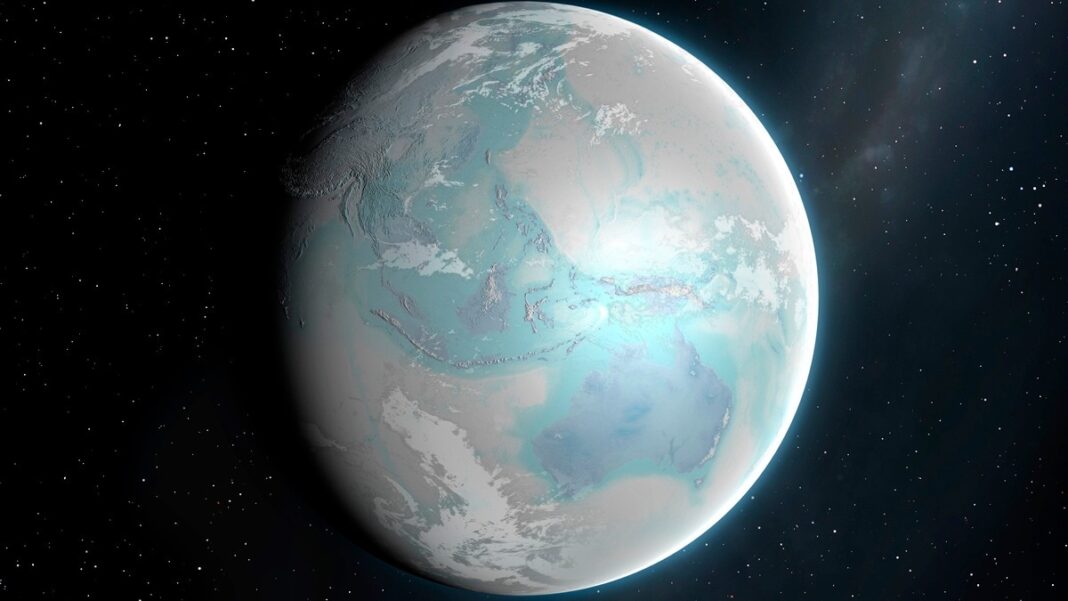
What happened when Earth turned into a giant snowball? New details uncovered

Earth’s climate has undergone dramatic swings over its long history, but few events were as extreme as the periods when the planet nearly froze over entirely.

During these episodes, known as Snowball Earth, ice sheets spread from the poles toward the equator, turning much of the planet into a frozen world.

Now, a new study led by researchers at the Earth-Life Science Institute at Institute of Science Tokyo has uncovered fresh clues about what kept Earth locked in these deep freezes for millions of years.

Using advanced numerical geochemical models, scientists found that chemical reactions between water and rock may have continued beneath massive ice sheets, something previously thought unlikely.

These reactions, known as chemical weathering, can remove carbon dioxide (CO2) from the atmosphere. According to the study, this process may have continued under thick glaciers during ancient ice ages, potentially slowing the warming needed to melt the ice and prolonging the frozen conditions.
Earth

“Subglacial weathering represents a previously unrecognised feedback mechanism that could explain the very different durations of snowball Earth events,” said lead author Shintaro Kadoya.

The research focuses on two major global glaciations that occurred during the Neoproterozoic Era, the Sturtian glaciation and the Marinoan glaciation. Geological evidence shows that the Sturtian event lasted four to fifteen times longer than the Marinoan glaciation, despite occurring under broadly similar conditions. Until now, scientists have struggled to explain this striking difference.

Traditionally, researchers believed that chemical weathering would have stopped during global glaciations because continents were buried under ice and lacked liquid water. Without weathering, removing CO2 from the atmosphere, volcanic emissions would slowly accumulate greenhouse gases until warming became strong enough to melt the ice.

However, the new modelling suggests a different scenario. Beneath thick ice sheets, geothermal heat from Earth’s interior could melt ice at the base of glaciers, producing liquid water.

This meltwater may flow through crushed rock created by glacial erosion, allowing chemical reactions to continue even while the planet’s surface remained frozen.

The simulations show that under such conditions, subglacial weathering could consume substantial amounts of atmospheric CO—sometimes nearly matching the amount released by volcanoes. If true, this hidden process could have delayed global warming and extended the duration of snowball Earth states.

The findings also suggest that differences in meltwater supply and erosion beneath glaciers could explain why some glaciations lasted far longer than others.

Researchers say these subglacial reactions may also have influenced ocean chemistry by delivering nutrients such as phosphorus into the seas once the ice began melting.

Together, the study reveals that the frozen landscapes of ancient Earth may have been far more chemically active than previously believed, playing a key role in shaping the planet’s most extreme climate episodes.


Latest

US startup wants to sell sunlight at $5,000/hour, send 50,000 big mirrors to space — the idea is controversial

California-based Reflect Orbital has proposed deploying 50,000 large mirrors into orbit around Earth. The company wants to sell sunlight — brighting up the ni

Earth’s days are getting longer as climate change slows the planet’s spin

Rising sea levels caused by melting glaciers and polar ice sheets are slowing Earth’s rotation, adding approximately 1.33 milliseconds to the length of a day

Humanity in trouble: Earth is getting hotter faster than ever before

For India, already grappling with intensifying heatwaves, erratic monsoons, and rising sea levels, a world that crosses the 1.5°C threshold ahead of schedule w

Why do we dream, and why do we forget most of them when we wake up?

In today's The Daily Why, a new series from India Today Science, we try to understand the mechanism that triggers dreams, and the one that makes us forget them.

Rain brings relief across India, but hailstorms loom for the east on Monday

IMD and experts predict reduced rain for Delhi on Monday but warn of intense hailstorms in Odisha and West Bengal. A fresh Western Disturbance is set to arrive

Topics

‘Firms need to move to adaptive, energy-efficient AI models’

Sarah Hooker is convinced that the future lies in AI systems that use less computing power, cost less to run and can adapt to the needs of users.

Khushbu Sundar comes out in support of Trisha amid her viral pics with Vijay: ‘She is one of the most dignified women’

Khushbu Sundar has addressed the online chatter surrounding the public appearance of Vijay and Trisha Krishnan, after the divorce petition filed by Sangeeta.

Shocked Karan Johar reveals his 9-year-old son Yash’s ‘business proposal’ as he wants to pay rent to him. Watch

Karan Johar and his son Yash had a fun conversation as they discussed a business proposal. Watch their banter here.

Antitrust trial against Live Nation and Ticketmaster continues with states leading the charge

Antitrust trial against Live Nation and Ticketmaster continues with states leading the charge

49ers sign receiver Christian Kirk to a 1-year, $6 million contract, AP source says

49ers sign receiver Christian Kirk to a 1-year, $6 million contract, AP source says

Nancy Guthrie case: FBI finds fresh images from Arizona home; critical clue still missing

Investigators have recovered images from cameras at Nancy Guthrie’s Arizona home as the FBI continues its investigation.

‘Lying under oath’: $220 million DHS advertising campaign lands Kristi Noem in DOJ perjury probe

US News: Democratic lawmakers have formally asked the US Justice Department to investigate Kristi Noem, the outgoing secretary of Homeland Security, over alleg.

5 things Green Card holders should do as DHS gets a new secretary, advises immigration attorney

US News: Immigration attorney Sekou Clarke said under DHS Secretary Kristi Noem, 170 US citizens were detained by ICE and around eight to ten US citizens were .
spot_img

Related Articles

Popular Categories

spot_imgspot_img
