

Key Takeaways
- Two green comets – Lemmon and SWAN – are visible in October skies
- Comet Lemmon may become naked-eye visible around October 21
- Both can be spotted with binoculars or small telescopes
- A rare interstellar comet is also passing through our solar system
Skywatchers are in for a rare treat this October as two greenish comets streak through our night skies. Comets C/2025 A6 (Lemmon) and C/2025 R2 (SWAN) are both visible from the Northern Hemisphere, offering a unique double celestial spectacle that astronomers say is quite uncommon for a single month.
Spotting Comet Lemmon
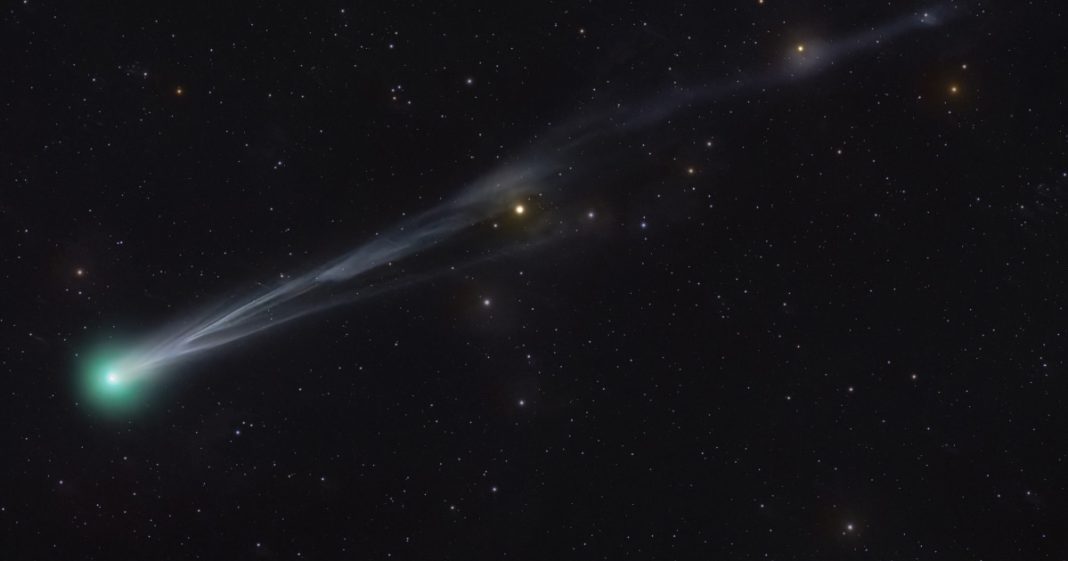
Comet Lemmon reaches its brightest point around October 21 when it comes closest to Earth. During this period, it might even be visible to the naked eye under ideal conditions. The comet’s distinctive emerald glow comes from carbon in the gas cloud surrounding its nucleus.
Until mid-October, look northeast before dawn near the Big Dipper constellation. After about a week, it shifts to the evening sky, rising in the west. Astrophotographer Julien De Winter already captured its dramatic green tail from Texas in late September.
Finding Comet SWAN
Comet SWAN remains an evening object through month’s end. The best viewing time is approximately 90 minutes after sunset while facing southwest. Unlike Lemmon, SWAN will likely require binoculars or a small telescope for spotting.
In coming days, SWAN will appear higher on the horizon after sunset and may brighten as it approaches its closest Earth distance around October 20.
Rare Double Feature Opportunity
Under perfect conditions – clear weather, dark skies with minimal light pollution – you might catch both comets on the same night around late October. This double appearance makes October 2024 particularly special for astronomy enthusiasts.
Discovery Background
Comet Lemmon was discovered in January by the Mount Lemmon Survey in Arizona. Comet SWAN has an even more recent origin – an amateur astronomer spotted it in early September while examining images from NASA’s Solar & Heliospheric Observatory.
Bonus: Interstellar Visitor
Adding to the celestial excitement, Comet 3I/ATLAS – only the third confirmed interstellar visitor from beyond our solar system – is also passing through. This extraordinary object was recently photographed by a Mars-orbiting spacecraft and makes its closest solar approach around October 30.


