

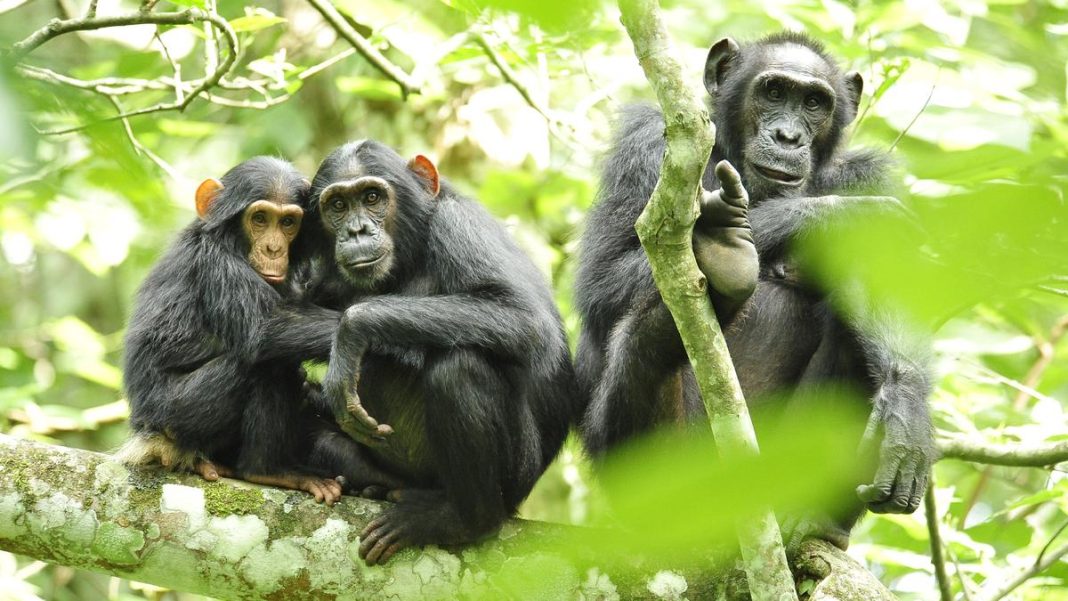
Chimpanzees Show Human-Like Rational Thinking, Study Reveals
Chimpanzees can weigh evidence, update beliefs, and make rational decisions much like humans, according to groundbreaking research published in Science. The study challenges the long-held assumption that complex reasoning is uniquely human.
Key Takeaways
- Chimpanzees evaluate clue reliability rather than just reacting to recent signals
- They maintain multiple possibilities and update choices based on new evidence
- This suggests rational thinking has deeper evolutionary roots than previously thought
A multinational research team conducted five behavioral tests with 15-23 chimpanzees at Uganda’s Ngamba Island Chimpanzee Sanctuary. The experiments examined whether great apes could combine information and revise beliefs when faced with conflicting clues about hidden food.
“To run this study, we really had to break it down and ask: what is rationality at its roots?” Utrecht University assistant professor and the study’s lead author Hanna Schleihauf said. “What are its most fundamental components? And how do you test this in a non-verbal way?”
Five Tests of Chimpanzee Reasoning
Test 1: Strong vs Weak Clues – Chimpanzees preferred reliable clues (seeing food) over weaker ones (hearing rattles), especially when strong evidence appeared later, showing they weren’t just following the most recent signal.
Test 2: Swapped Clues – Even when strong clues were auditory and weak clues were visual, chimpanzees consistently favored more reliable information regardless of timing.
Test 3: Memory and Multiple Options – When presented with three containers (strong clue, weak clue, no clue) and then the strongest option removed, chimpanzees preferred the weak-clue container over the no-information one, demonstrating they keep multiple possibilities in mind.
Test 4: New vs Old Information – Chimpanzees only changed choices when hearing new sounds, not repeated ones, indicating they distinguish between novel and familiar evidence.
Test 5: Contradictory Evidence – When “defeater” clues directly undermined previous strong evidence, chimpanzees revised their choices, but ignored irrelevant contradicting information.
Not a Uniquely Human Trait
The combined results show chimpanzees don’t simply react to the last or loudest clues. Instead, they assess information relevance and reliability, maintain multiple hypotheses, and update decisions in ways mirroring human rational thinking.
“This shows [the study] that they are aware of the reasons for their choices, a skill that has been believed to be uniquely human,” Prof. Schleihauf said.
Researchers provided hypothetical examples of how this reasoning might appear in wild chimpanzees, such as revising beliefs about fruit-bearing trees after discovering red leaves mistaken for fruit.
Evolutionary Implications
Primatologist Tetsuro Matsuzawa, not involved in the study, noted the difficulty of observing such traits in wild chimpanzees but acknowledged the research’s significance.
“This study also raises bigger questions about the evolutionary roots of human rationality. It shows that rational thinking is not limited to humans, and prompts us to ask how much of this ability is shared with chimpanzees and other great apes, a question now brought to the forefront.”
The findings suggest rational thinking has deeper evolutionary origins than previously recognized, challenging our understanding of and what separates humans from other species.