

30.1 C
Delhi
Monday, March 2, 2026

NISAR Satellite Beams First Stunning Images of India from Space

NISAR Satellite Beams First Stunning Images of India from Space

India’s groundbreaking NISAR satellite has transmitted its first high-resolution images of the Indian landmass, officially commencing science operations exactly 100 days after its historic launch.

Key Takeaways

  • First S-Band SAR images reveal Godavari River Delta with remarkable detail
  • $1.5 billion satellite successfully deployed massive 12-meter antenna
  • Mission will scan Earth every 12 days for climate and disaster monitoring

Historic First Images

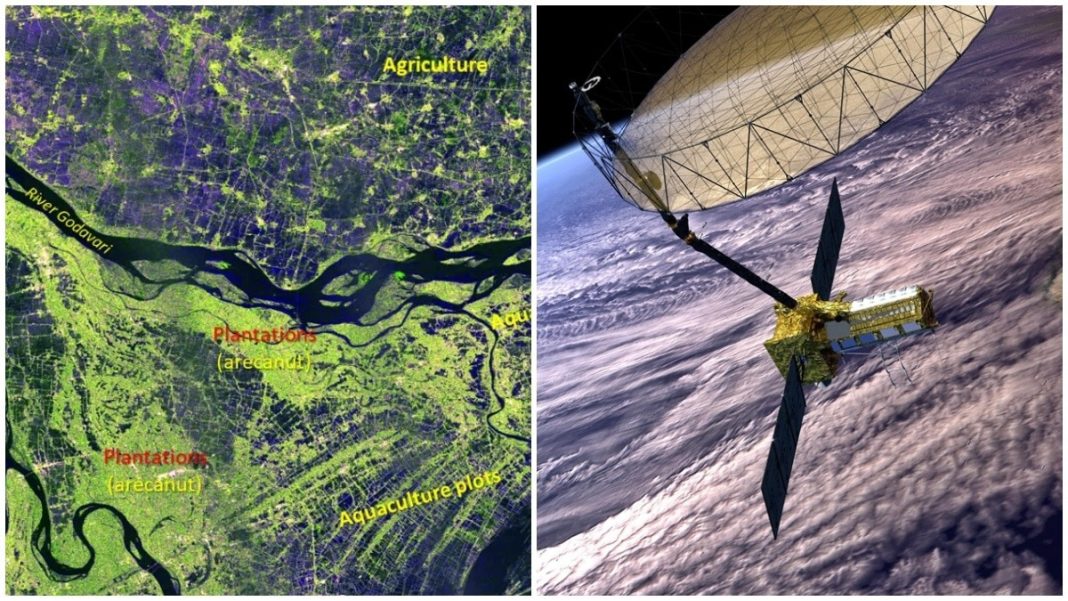
The Indian Space Research Organisation publicly released the inaugural S-Band Synthetic Aperture Radar image capturing the lush Godavari River Delta in Andhra Pradesh. The image vividly displays mangroves, agricultural fields, arecanut plantations, and aquaculture ponds with unprecedented precision.

Mangroves and other land use in Godavari Delta, Andhra Pradesh
Mangroves and other land use in Godavari Delta, Andhra Pradesh. (Photo: Isro)

Complex Deployment Success

Launched aboard ISRO’s GSLV-F16 on July 30, 2025, from Sriharikota, the dual-frequency radar satellite overcame a challenging deployment process. NASA’s largest-ever Earth orbit antenna – a massive 12-meter diameter reflector mounted on a 9-meter boom – successfully unfurled over five days from August 9 to 15.

The intricate deployment involved wrist, shoulder, elbow, and root joints, managed jointly by ISRO’s ISTRAC in Bengaluru and NASA’s Jet Propulsion Laboratory. Both S-Band (ISRO) and L-Band (NASA) radars confirmed optimal performance.

Advanced Earth Monitoring Capabilities

Since its first data acquisition on August 19, NISAR’s S-Band has imaged India and global calibration sites in diverse modes. The satellite used corner reflectors near Ahmedabad, Gujarat, and Amazon rainforest data to fine-tune pointing accuracy.

Initial analyses demonstrate NISAR’s powerful capability to map dynamic landscapes like river deltas, even through cloud cover or during nighttime. Orbiting at 747 km in a sun-synchronous polar path, the satellite scans nearly all land and ice surfaces every 12 days, detecting centimeter-scale changes essential for:

  • Disaster alerts and early warning systems
  • Ecosystem and forestry tracking
  • Climate change insights and monitoring
  • Agricultural and hydrological studies
  • Himalayan ice monitoring

This milestone solidifies the Indo-US space partnership, establishing NISAR as a transformative tool for global Earth observation amid increasing demand for precise environmental data.
Latest

Bright Sun lights up Earth every day, then why is space so dark?

This new series from India Today Science explores the why and how behind everyday phenomena we notice, question, and often overlook. Each edition breaks down th

North India to stay hot and dry on Monday, cool morning to bring respite

India will face rising temperatures and cool mornings tomorrow. The IMD predicts a four to seven degrees Celsius rise in Northwest India.

Skyroot fires new rocket engine, makes diamonds in the air

Skyroot Aerospace has tested its Dhawan-III cryogenic engine, a 3D-printed marvel for reusable rockets. This breakthrough boosts India's space ambitions with gr

China races to land humans on Moon as Nasa revamps Artemis. All you need to know

China announces steady advances in its crewed Moon mission with successful tests on lunar spacecraft, and a detailed 2026 space station schedule.

Are crash diets worth the risk? How drastic weight loss ruins your skin tone and texture

The skin is one of the first places that shows the ill effects of drastic dieting. From dryness and dullness to premature ageing and breakouts, a crash diet can

Topics

Taliban attacks Pak’s Nur Khan base in latest escalation of cross border conflict

Taliban forces reportedly launched armed drone strikes targeting Pakistan’s Command and Control Centre at Nur Khan Air Base in Rawalpindi. Taliban forces carr

Satellite images show damage across Iranian military sites after US-Israel strikes

Fresh satellite imagery shows visible damage to air, drone and naval facilities near Iran’s Konarak region amid escalating regional tensions. The visuals offe

Sensex down 1,000 points: Why is the stock market falling today?

The S&P BSE Sensex fell sharply in early trade, and the NSE Nifty50 also slipped more than 1%, as investors reacted to the fast-changing situation between the U

Qatar, UAE, Syria, Oman: Full list of places that saw attacks amid US-Iran conflict

The Middle East is engulfed in conflict as Iran retaliates against US-Israeli strikes, launching missile and drone attacks across multiple countries. 

AIIMS-trained neurologist warns against repeatedly using reheated cooking oils: ‘Risk of cancer increases manifold…’

Reusing cooking oil is a common practice in many households, but does the money it saves outweigh the health risks? Dr Sehrawat explains the health risks.

Quote of the day by Jon Bon Jovi: ‘You better stand tall when they’re calling you out, don’t bend, don’t break…’

On his birthday, we look back at one of Jon Bon Jovi's most influential quotes, which highlights the importance of standing tall in the face of criticism.

Satellite images show black smoke over Dubai as Iran continues to fire missiles, drones

Iran-US war: Dubai's skyline has dramatically changed after Iranian attacks, with smoke visible in satellite images.

Sam Altman reveals real reason why OpenAI rushed to partner with US Military after Trump banned Anthropic

OpenAI executives have given more information regarding the AI startup’s contract with the US Department of Defense after facing backlash online. The Sam Altm
spot_img

Related Articles

Popular Categories

spot_imgspot_img