

Key Takeaways
- Two major LVM-3 rocket launches scheduled for November and December 2024
- Gaganyaan human spaceflight program is 90% complete, targeting 2027 launch
- India’s first space station module planned for 2028 orbit placement
- NavIC navigation system to be completed within 18 months with three new satellites
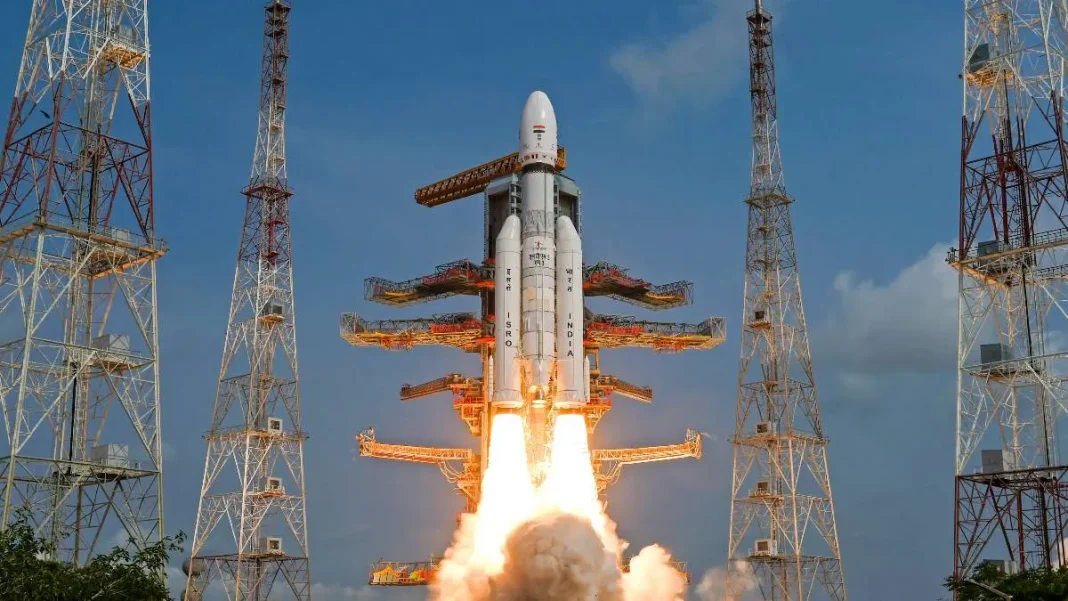
ISRO Chairman V Narayanan has announced a packed launch schedule with two LVM-3 heavy-lift rocket missions before year-end, while confirming that India’s ambitious Gaganyaan human spaceflight program is 90% complete.
The space agency will launch the CMS-03 communication satellite in early November, followed by the commercial BlueBird-6 satellite for a U.S. firm by December. Both missions will utilize ISRO’s most powerful launch vehicle.
Upcoming Satellite Launches
CMS-03 Mission: The LVM3-M5 launch carrying the communication satellite is scheduled for November 2, marking the first of the two major launches.
BlueBird-6 Commercial Launch: The 6.5-tonne U.S. satellite, one of the heaviest commercial payloads handled by ISRO, arrived in India on October 19. “We have received the satellite and are currently working on the launch, with the launch vehicle build-up underway,” Narayanan confirmed.
NISAR Satellite Status: The NASA-ISRO Synthetic Aperture Radar satellite launched on July 30 is in final calibration and will become operational within 10-15 days. “The satellite is healthy, and both the payloads are working well,” he stated.
Major Mission Updates
Gaganyaan Program: India’s first human spaceflight mission is progressing rapidly with 90% work completion. The program aims to send Indian astronauts to space by 2027.
Bharatiya Antariksh Station: India’s own space station plans are advancing, with the first module receiving project approval. ISRO targets placing it in orbit by 2028, working toward the 2035 completion goal.
Chandrayaan-4: The ambitious moon sample return mission is currently in design phase. “We are establishing the basic infrastructure and working on the design phase for the approved project,” Narayanan explained.
Navigation System and Technical Issues
The NavIC navigation constellation will be completed within 18 months with three new satellite launches. “We currently have four satellites and are building three more. Yes, there were setbacks, but we’re working on it,” the chairman acknowledged.
Regarding the NVS-02 satellite anomaly, he clarified: “The satellite has gone into an elliptical orbit, and we could not take it to the circular orbit because of a valve malfunction.” The failure analysis committee has completed its investigation and will present recommendations to the government.
Exponential Growth Projections
Aligning with Prime Minister Narendra Modi’s Space Mission 2047 vision, Narayanan projected significant expansion. India currently operates 56 satellites, with plans to triple this number within 3-4 years.
The commercial sector has shown remarkable growth – of the 433 satellites launched from 34 countries since 1980, 95 were accomplished in the last decade alone.
Future launch vehicle development includes a next-generation launcher capable of lifting 30,000 kg to low Earth orbit, and conceptual designs for a crewed lunar mission launcher with 75,000-80,000 kg capacity.


