
Key Takeaways
- Astronomers have spotted a mysterious white dwarf star creating a long-lasting, colourful shockwave in space.
- The star is stealing gas from a companion but lacks the typical disk seen in similar systems, baffling scientists.
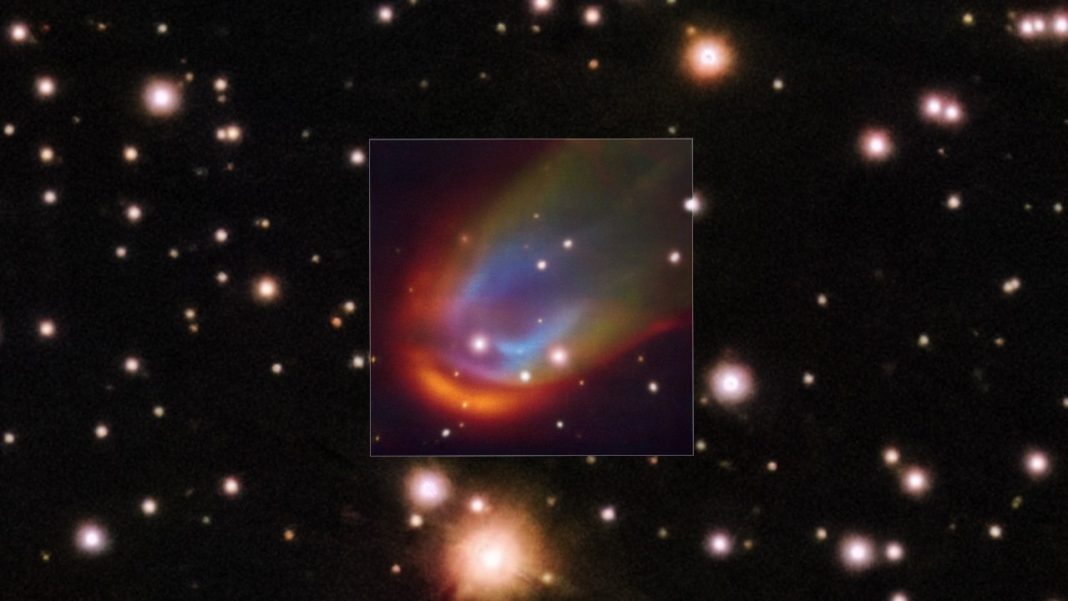
- The shockwave’s red, green, and blue hues reveal the chemical makeup of interstellar gas.
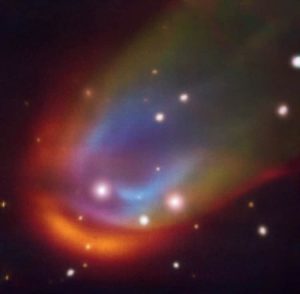
Astronomers have discovered a puzzling cosmic spectacle: a dying star creating a vibrant, multi-coloured shockwave as it hurtles through space. The observation has left scientists searching for an explanation, as the star’s behaviour defies known models.
The highly magnetised white dwarf—an Earth-sized stellar corpse—is locked in a tight orbit with a companion star, siphoning gas from it. Located a relatively close 730 light-years away in the constellation Auriga, the system was imaged by the European Southern Observatory’s Very Large Telescope in Chile.
What is a Bow Shock?
“A shockwave is created when fast-moving material ploughs into surrounding gas, suddenly compressing and heating it,” explained study co-lead author Simone Scaringi, an astrophysicist at Durham University. “A bow shock is the curved shock front that forms when an object moves rapidly through space, similar to the wave in front of a boat.”
The stunning colours—red for hydrogen, green for nitrogen, and blue for oxygen—are produced as the shockwave excites these elements in the interstellar gas.
A Cosmic Mystery
While other white dwarfs have been seen with shockwaves, they were all surrounded by disks of stolen gas. This star, however, lacks such a disk and is somehow ejecting material into space, creating the shockwave for reasons that remain unknown.
“Every mechanism with outflowing gas we have considered does not explain our observation,” Scaringi admitted. “We still remain puzzled by this system, which is why this result is so interesting and exciting.”
The shockwave structure indicates this enigmatic process has been ongoing for at least 1,000 years.
The Binary System
The white dwarf has a sun’s worth of mass packed into a body slightly larger than Earth. Its companion is a small, dim red dwarf, orbiting incredibly close—about the Earth-Moon distance—every 80 minutes. The white dwarf’s gravity strips gas from the red dwarf, which flows along magnetic field lines to the white dwarf’s poles.
This accretion process releases energy, but not enough to explain the powerful outflow creating the massive shockwave.
The Fate of Stars
White dwarfs are the common end state for stars like our Sun, which will become one billions of years from now. They form when a star exhausts its hydrogen fuel, sheds its outer layers as a red giant, and leaves behind a dense, hot core.
Scaringi noted the discovery’s beauty as well as its scientific intrigue: “Beyond the science, it’s a striking reminder that space is not empty or static… it’s dynamic and sculpted by motion and energy.”