

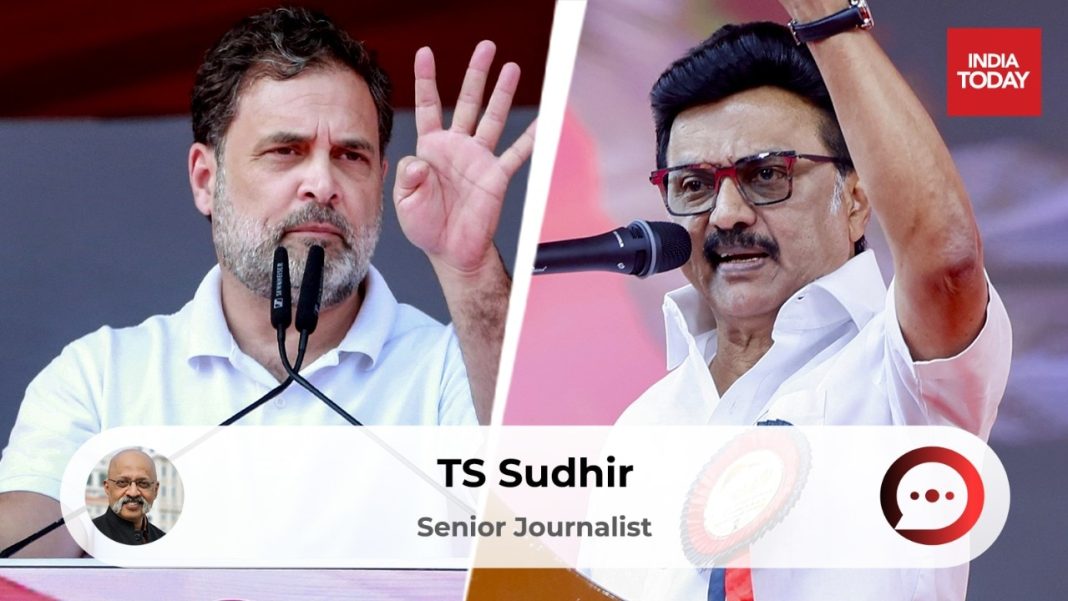
Is the Congress looking at the state assembly elections in Tamil Nadu through the prism of its numbers in the Rajya Sabha? It would seem so given its insistence, according to various news reports, on the DMK allotting it two of the four Rajya Sabha seats that the DMK-led combine can win in Tamil Nadu in March. Chief minister and DMK supremo, MK Stalin, is willing to give only one seat to the Congress and that has led to a stalemate in the dialogue between the two political partners. The two partners meet again on Saturday to find a way out of the impasse.
The Congress leadership has reason to worry about its numbers in the Rajya Sabha. To ensure Mallikarjun Kharge retains his post as the Leader of Opposition in the Upper House, the party must have 25 MPs – 10 per cent of the total strength of the House. Though it has 27 parliamentarians now, it runs the risk of the number falling below the magic mark as 75 seats are due for re-election this year and the Congress being in power in only three states, could see its numbers shrinking.
What does it mean for the DMK-Congress alliance ahead of the elections? Confusion over where the Congress reported decision to play hardball on being allotted 41 assembly seats and 2 Rajya Sabha seats could lead to. While Delhi plays the House of Elders card, a section among the state leaders want the aberration of 2021 when it was allotted just 25 seats to be corrected. It has put forth the number of 41 because that was the number of seats the party contested in 2016.
Though MP Manickam Tagore and party leader Praveen Chakravarty had also articulated the need to have Congress ministers in the Tamil Nadu cabinet if the alliance returns to power, the leadership is not stuck on that right now. In any case, as far as power-sharing in Chennai is concerned, the DMK was unwilling to concede that despite having presided over plum portfolios during the UPA era at the Centre.
Right now, the DMK is playing hardball in giving in to the Congress demand for 41 seats or a possible 35, pointing to a demand and supply issue as new alliance partners like the DMDK and MNM need to be accommodated as well. At best, it is willing to increase the 2016 figure of 25 by 2-3 seats.
Is the Congress committing political harakiri by standing up to one of its oldest allies? Yes, because it could impact opposition unity in Parliament. Yes, because the ”brotherly” affection between Stalin and Rahul Gandhi could be a casualty. Yes, because it reminds one of 1996 when PV Narasimha Rao committed a blunder by allying with the AIADMK, only to see P Chidambaram and GK Moopanar break away and ally with the DMK. Yes, because it makes one recall 2014 when the DMK and the Congress fought separately after the 2G fiasco, only to witness political catastrophe. Both failed to open their account and the Congress lost its deposit in 38 of the 39 Lok Sabha constituencies. That is why Delhi is wary of pulling the plug in a hurry.
At the same time, 2026 presents the Congress with a chance to press the reset button in Tamil Nadu. Out of power for 59 years, the Congress state unit needs to think and act like a political start-up, not a legacy institution. With a willing option in the form of actor-turned-politician Vijay’s Tamilaga Vettri Kazhagam (TVK), available on the table, the Congress has everything to gain and nothing to lose. At the moment, the assembly and Parliament seats it wins in Tamil Nadu are not a reflection of its strength but a survival on borrowed strength of the DMK. No surprise that the DMK apparatus in the districts treats the Congress cadre with disdain. This election is therefore asking the Congress to choose between self-respect and a few elected representatives.
The stalemate has further exposed the fissures in the relationship at the district level. Will there be a smooth transfer of votes from the DMK to the Congress candidates if the alliance stays, is the question.
The TVK is interested in the Congress because it will give Vijay’s party respectability and in the alliance-centric politics of Tamil Nadu, be seen as the third front instead of being a solo player. The national party is also likely to be given as many as 50 seats to contest, a move that could energise its miniscule cadre. If Vijay fails to set the Kaveri on fire, the Congress will at best lose the few MLA seats it would win in Tamil Nadu and Kharge could lose his LoP position. On the other hand, if the TVK-Congress tango takes off, it could open a new chapter for the party deep south.
But if the Congress is a weak party, what would it bring to the TVK table? Not much in terms of votes as the Congress with a 4 percent vote share in the 2021 assembly polls, has strength only in half a dozen districts and would still depend largely on the Vijay vote to see its candidates through. But a shift could dramatically change the perception that the DMK is the favourite to win this election. It could also dent the minority vote that would have otherwise gone almost entirely to the DMK and Co.
However, if the Congress is going to wait till the last minute, it would only mean that the break-up happened not due to fundamental differences but only due to Stalin’s refusal to concede to the demands made by the Congress. That is unlikely to cut ice with the electorate. Also not everyone in the Tamil Nadu Congress is comfortable with the idea of breaking ties with the DMK and should that happen, the party could see a split from within.
The NDA is looking at the unhappiness in the DMK-Congress marriage with interest. It could stand to gain if instead of the anti-incumbency vote splitting, there is a division in the vote that would have otherwise accrued to the DMK.
All eyes are on Chennai to see who blinks first.


