

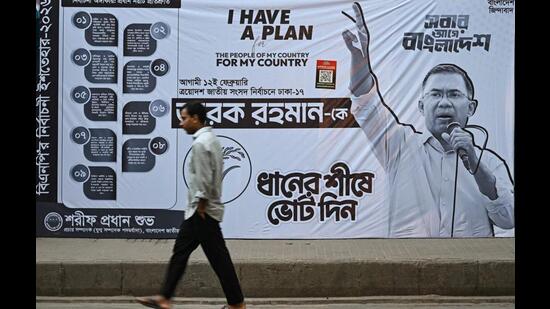
After 15 years of Sheikh Hasina-led Awami League’s (AL) regime that is believed to have jailed thousands, disappeared hundreds, and killed over 1,400 people in July 2024 before being toppled by a mass uprising, and the ensuing uncertainty over the last 18 months, Bangladesh has finally turned a corner.
In the first free and fair, if not inclusive, elections since 2008, the Bangladeshi public has (re)elected to power the Bangladesh Nationalist Party (BNP) under the leadership of Tarique Rahman. The Jamaat-e-Islami (JeI), under the leadership of its ameer, Shafiqur Rahman, won 77 of 300 seats, whereas the BNP stands at 212. The referendum on the July National Charter that promises a structural overhaul of the country’s body politic has also passed.
This is a strategically significant moment. Not only did the elections occur peacefully, but they also witnessed nearly 60% voter turnout. Instead of challenging the results and questioning the process, the JeI-led coalition conceded defeat with grace. The army, which took a decisive political call in 2024 to end Hasina’s excesses, is committed to military professionalism and is steering clear of civilian politics.
Such is the power of an honest ballot that it is hard to overstate the emotional value of this moment for the Bangladeshi public. Be it the young who grew up under Hasina’s regime and never knew what genuine political participation looks like, or others with longer memories, these elections mark a watershed. The BNP now has a five-year mandate to deliver on Rahman’s “plan for the people of my country”. The interim government and Bangladesh’s armed forces deserve credit for rebuilding the country’s political contract along democratic, civilian lines.
There is an interesting paradox at play, though. The 2024 uprising generated powerful escape velocity that ended an oppressive cycle of compromised elections overseen by a traditional political party. Regardless of whether the AL re-emerges in some form or other, Hasina and her family’s political career is likely over. Still, the 2026 elections have demonstrated an equally powerful capture velocity wherein another traditional, family-led political party has been voted back to power. From promising voter turnout and the social coalitions both parties built, to voting patterns across demographics and regions, these elections indicate the electorate’s hunger for institutional stability and prosperity.
This paradox is unsurprising given the context and build-up to these elections. But it tells a cautionary tale of continuity more than change. The JeI has an image of being clean; it moderated rhetoric on several issues, barring women’s rights, and faced much worse persecution and violence under Hasina than most BNP cadre and leaders did. It still struggled at the ballot. Similarly, the students-led National Citizens Party, despite its key role in the 2024 uprising and winning six seats, has a long way to go.
In contrast, the BNP, regardless of its dynastic constitution, history of mis-governance, and an inclination towards corruption, won hands down. Even if the tables turn in the next elections, there is a case to be made that Islamist parties, though part of Bangladesh’s social fabric, do not form its political core. And that despite the deluge of understandable optimism, Bangladesh’s political economy remains unchanged. This poses its own risks.
To be clear, thanks to the quality of these elections, two immediate concerns have abated. The law-and-order situation is not currently a serious impediment. This reduces pressure on the army to manage the streets under duress. The BNP too, for now, is not being driven by anti-AL vendetta.
On the implementation of the July National Charter, the BNP can safely adopt a “yes, but” approach. It may implement some core reforms that correspond to its own 31-point agenda, while amending those clauses that it challenged from the outset.
On foreign policy and economy, Rahman’s centrism will afford policy stability. His decision to mend ties with India and New Delhi’s reciprocity are promising signs. If his government reduces inflation from its current standing at 8.5%, continues to build forex reserves, limits external debt, and supports the mid-term development of revenue-generating sectors beyond ready-made garments exports, then the electoral bet will pay off.
But, given Bangladesh’s unchanged political economy, the biggest challenge for the new prime minister is likely to come from within the party itself. Not in the form of a direct leadership challenge. The long-term line of succession is clear with daughter Zaima Rahman’s centrality to her father’s political network, along with a clutch of loyalists who supported Rahman during exile in London. More in the form of passive resistance to institutional change and accountability by the party’s regional satraps, who have long been waiting for “good times”. These cleavages, less salient when the BNP was fighting for survival, are likely to grow as it begins to govern. How Rahman manages intra-party dynamics will shape the BNP’s overall performance.
Rahman could opt for insularity and tighten the circle of loyalists around him. Such an approach risks putting the party on the same path as the AL. Hasina’s inward turn under pressure, and towards India, backfired. Or Rahman could adopt a consensual approach, respect those who deserve recognition and responsibility for not abandoning the country and the party and develop a transparent inner-party system of accountability.
The initial signs indicate that Rahman has opted for the latter route while retaining political command. Sustenance of intra-party discipline will test his leadership. Mismanagement on this count will put BNP’s historic win at risk. The capture velocity of Bangladeshi politics means that the field for Rahman to prove his word and his worth is now fully set.
Avinash Paliwal teaches at SOAS University of London and is the author of India’s Near East: A New History (London: Hurst, 2024). The views expressed are personal